
This page contains affiliate links. Far Cornel may earn a commission if you buy through them, at no extra cost to you.
See the top-rated gear on Amazon →
Quick answer: A compact lithium jump starter is the best pick for touring: barely bigger than a paperback, it cranks a stalled engine and doubles as a power bank. Step up to a heavy-duty lithium pack for a large diesel or multiple starts, one with a built-in compressor if you want tyres and starts in one box, and keep a lead-acid booster for the garage.
A flat battery a long way from help turns a good trip into a bad one, and with no passing traffic to ask for a jump, a lithium jump starter is the small box that saves the day. Modern packs are barely bigger than a paperback yet crank a stalled diesel back to life, then double as a power bank and a torch. The trick is buying one with enough grunt for your engine and the safety to use it without drama.
The catch is that two packs that look identical can be worlds apart in real cranking power. What matters is the sustained output, the battery capacity and the protection built in, matched to the vehicle you actually drive rather than the biggest number on the box. Brands like NOCO, Projecta and Hulk 4×4 sit across the range. Here are the five types and where each one fits.
Quick Picks
- Best overall: a compact lithium jump starter for everyday touring.
- Best for big diesels: a heavy-duty lithium pack with high sustained output.
- Best dual-duty: a jump starter with a built-in air compressor.
- Best for device charging: a large-capacity jump starter and power bank.
- Best for the garage: a traditional lead-acid booster pack.

How to Choose a 4WD Jump Starter
Start with cranking power, and here is the myth to kill: peak amps is not the number that matters. Peak amps is a brief spike a pack quotes on the box, and many cannot hold anything like it; what actually restarts a stalled engine is the sustained cranking current and the battery capacity behind it. Trust the manufacturer’s stated engine-size rating instead — a small petrol engine is easy, but a 3.0-litre or larger diesel wants a pack rated well up the scale, so give yourself a comfortable margin rather than the bare minimum. Then check the capacity, in milliamp-hours, which decides how many starts you get and how much is left to charge phones and run a light.
Safety is not optional, because jump-starting shifts a huge burst of current. Look for reverse-polarity and short-circuit protection and spark-proof clamps, which save a costly mistake if you clip the leads the wrong way or brush them together, and on a modern vehicle full of electronics they protect the car as much as you. A rugged, sealed case with a decent IP rating earns its keep in dust and rain. The most important day-one habit is dull but vital: charge the pack fully and set a reminder to top it up every couple of months, because lithium slowly self-discharges and a flat pack in a hot glovebox will not crank when you finally need it.
Two things the box won’t tell you. First, a lithium pack self-discharges on the shelf: leave one in the glovebox for six months and it will be flat the morning you finally need it, so top it up every couple of months and again before a big trip, and keep it in the cab on a frosty start because cold saps its punch. Second, connect it in the right order — red clamp to the battery positive, then the black clamp to a solid, unpainted chassis or engine bracket a little away from the battery, not to the battery’s own negative post. That keeps the small spark of the last connection away from the hydrogen a tired battery can vent. It costs nothing, and it is the difference between a boring restart and a very bad day.
The Jump Starters
Check today’s prices on Amazon →
Compact lithium jump starter
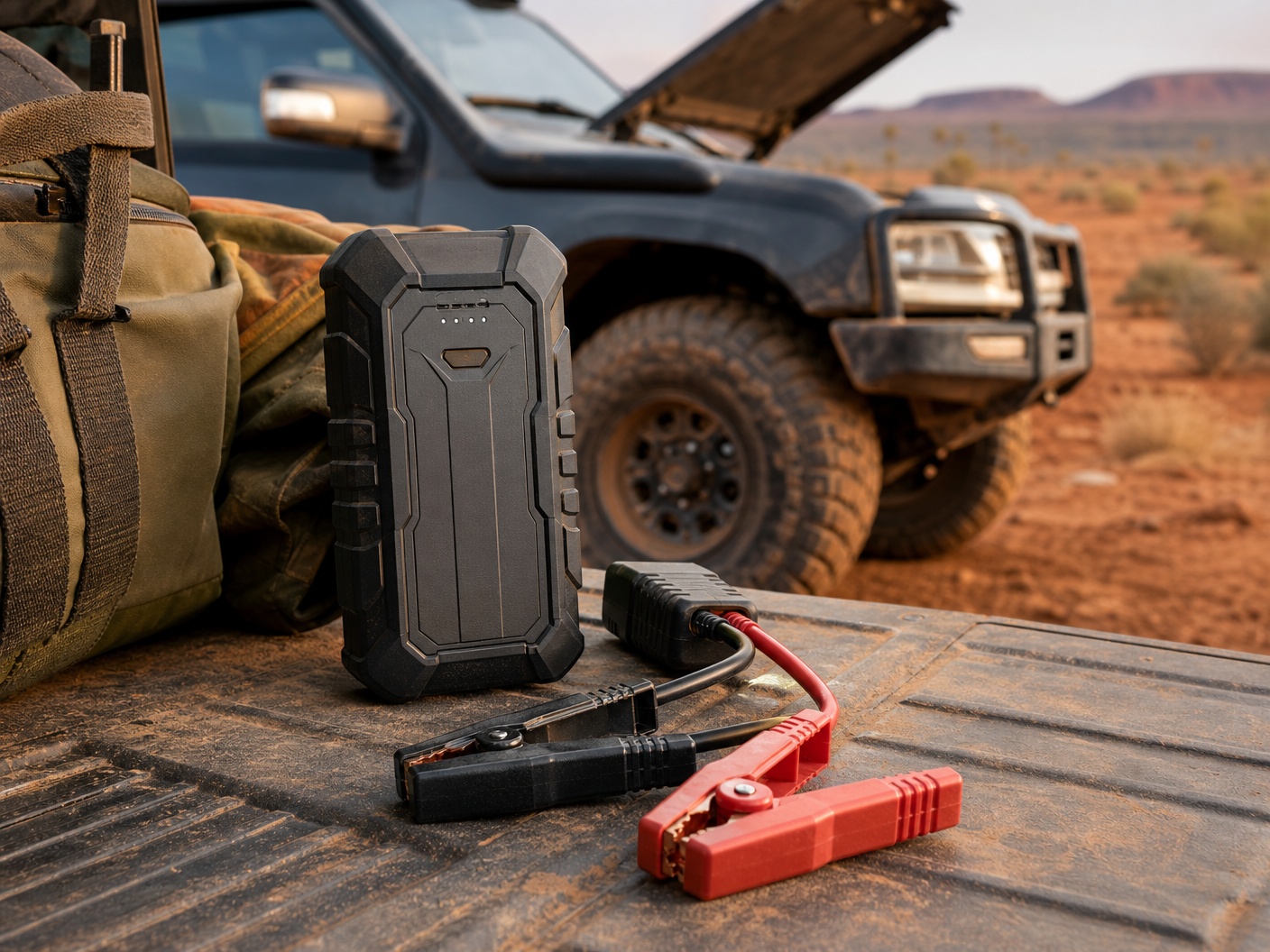
This is the pack to carry nine trips out of ten. A compact lithium jump starter, in the mould of a NOCO Boost, is barely bigger than a paperback, cranks a standard petrol or mid-size diesel, and doubles as a power bank and torch in the glovebox. It holds charge for months and weighs almost nothing. Just match its engine-size rating to your vehicle, because a very large diesel in the cold can outrun a small pack. see what a compact lithium jump starter costs now
Heavy-duty lithium jump starter
For a big diesel, or for starting several times on one charge, a heavy-duty lithium pack is worth the extra size. It carries higher sustained output and a larger capacity, so it cranks a tired 3.0-litre-plus engine without flinching and still has plenty left over. It is bigger, heavier and dearer, and slower to recharge, so it suits remote travel and large 4WDs rather than a small runabout. If your engine is at the top of the range, buy up. price up a heavy-duty pack for a big diesel
Jump starter with a built-in compressor
Some packs build an air compressor into the same case, so one box both jump-starts the engine and airs up a tyre. For touring that is a neat saving of space and money, covering two of the jobs most likely to strand you. The compressor is usually modest rather than fast, so it suits topping up or a slow reinflate rather than airing four big tyres in a hurry, but as an all-in-one safety net it is genuinely handy. look at the packs with a built-in compressor
Large-capacity jump starter and power bank
If you lean on the pack for more than the occasional start, a large-capacity jump starter and power bank keeps the lights, phones and cameras going around camp as well. The bigger cell means more starts between charges and real reserve power for devices, turning it into a small portable power source. It is heavier than a bare starter, but if you value that backup power as much as the cranking, the extra capacity earns its place. compare the large-capacity power-bank packs
Traditional lead-acid booster pack
The old lead-acid booster still has a place, just not in the vehicle. It delivers strong cranking amps and often includes a compressor and work light, and it is cheap for the grunt, but it is heavy, bulky, loses charge quickly in storage and needs regular top-up charging. Keep one on the garage shelf or a workshop bench for home starts and short trips, and carry a lithium pack for the tracks. check what a lead-acid booster runs to for the garage

Comparison
| Type | Cranking | Portability | Best for |
|---|---|---|---|
| Compact lithium | Good | Very portable | Everyday touring |
| Heavy-duty lithium | Highest | Larger, heavier | Big diesels, remote trips |
| With built-in compressor | Good | Portable | Starts and tyres in one |
| Large-capacity power bank | Good | Heavier | Device charging too |
| Lead-acid booster | Strong | Heavy, bulky | Garage and workshop |
Frequently Asked Questions
What size jump starter do I need?
Match it to your engine, and go by the manufacturer’s engine-size rating rather than the headline peak amps, which is a brief spike many packs cannot hold. A large diesel needs far more sustained cranking than a small petrol engine, so aim for a comfortable margin above your engine, not the bare minimum.
Can it do more than jump-start?
Most double as a power bank for phones and tablets, and many add a bright light, USB ports and sometimes a compressor or a 12-volt outlet. Those extras are a big part of why a jump starter is worth carrying every trip, not just for the rare dead battery.
How do I keep it ready to use?
Recharge it every couple of months even when unused, because lithium slowly self-discharges and can drop too low to crank. Keep it out of extreme heat, which damages the cells, and give it a full charge before any long or remote trip.
How do I use it safely?
Connect it the right way round — the protection helps, but do not rely on it — clip the negative to bare metal ground rather than the battery post, and crank in short bursts of a few seconds with a pause between. Continuous cranking overheats the pack and can damage the cells.
The Bottom Line
A good jump starter is cheap insurance against being stranded by a dead battery, and the extras make it useful long before any emergency. A compact lithium pack is the right call for the average tourer, a heavy-duty one earns its size for a big diesel, and a lead-acid booster belongs in the garage. Judge packs by their engine-size rating rather than headline peak amps, keep the pack charged, and clip it up carefully.
For the rest of your 12V and recovery kit, see our guides to dual battery monitors and inverters for caravans and vehicles.
While you are sorting the 12V side, see our guides to the best dual battery monitors, DC-DC chargers, and lithium battery boxes.