
This page contains affiliate links. Far Cornel may earn a commission if you buy through them, at no extra cost to you.
Browse recovery jacks on Amazon →
Quick answer: A long-travel hydraulic bottle jack sitting on a proper base plate is the right first jack for almost every tourer — it changes tyres safely and packs small. Add a 48-inch farm jack only if your vehicle has rated steel lift points, and an exhaust air jack if you spend real time on sand or mud. Skip the farm jack entirely if your rig wears plastic side steps and a stock body.
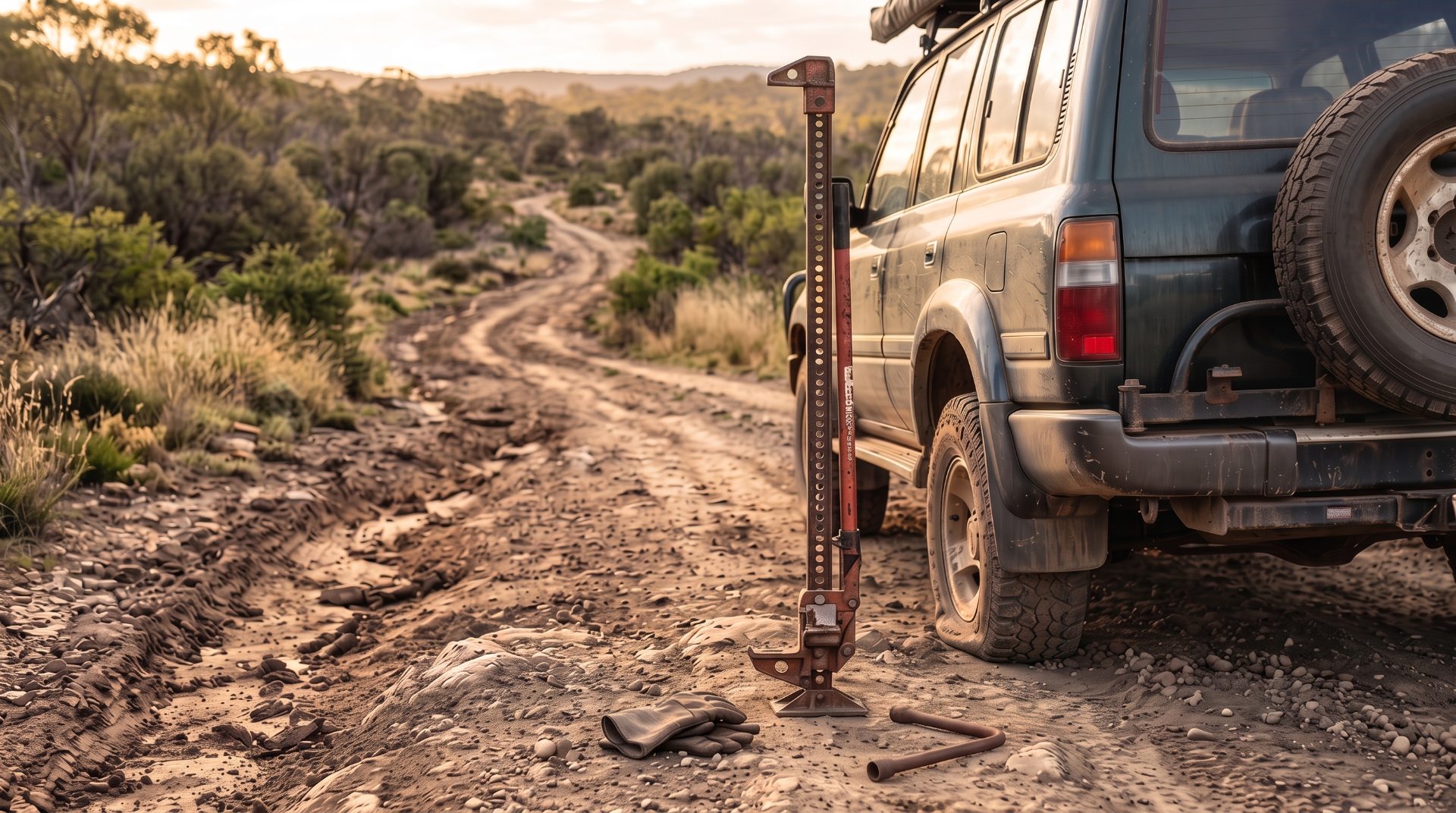
There is a particular farm jack that has lived on a roof rack for six years, cooked by sun, rusted solid at the climbing pins, and never once lifted a vehicle. Its owner bought it because every serious-looking wagon seemed to have one. That jack is closer to jewellery than equipment — and if it were ever pressed into service in its current state, it would be the most dangerous item in the entire setup.
The uncomfortable truth about lifting a four-wheel drive is that the jack itself is only half the purchase. The other half is the question almost nobody asks in the shop: where, exactly, does this tool meet my vehicle, and will that point take the load? Answer that first and the right jack picks itself. Answer it never, and you own 13 kilograms of decoration.
Quick Picks
- Best first jack for most tourers: a long-travel hydraulic bottle jack with an extendable saddle, paired with a base plate.
- Best for vehicles with steel bar work: a 48-inch cast-and-steel farm jack from a reputable maker.
- Best on sand and mud: an exhaust air jack, with its bag footprint doing what no steel foot can.
- The non-negotiable accessory: a wide base plate — no jack performs on soft ground without one.
- Best fix for suspension droop: a wheel-lifter strap that raises the tyre directly instead of the chassis.

How to Choose a Recovery Jack
Start under the vehicle, not in the catalogue. A farm jack needs a vertical steel face to climb against — a rated bar, rock sliders, or a purpose-made wheel-lift attachment. Factory plastic sills, sidesteps and painted bodywork are not lift points, and a jack tongue punched through a sill is a repair bill that outruns the jack many times over. A bottle jack instead wants a flat, strong horizontal surface: a chassis rail, a diff housing or an axle. Walk around your vehicle with a torch before you spend anything, and buy the jack your lift points can actually use.
Then think in millimetres of travel, not tonnes of rating. A loaded touring wagon runs roughly 700–900 kilograms per corner, so even a modest 2-tonne bottle jack has rating to spare — what it usually lacks is reach. Lift from the chassis and the suspension droops as the body rises, eating the first 100 millimetres or more of stroke before the tyre leaves the ground. That is why two-stage, long-travel designs and extendable screw saddles matter more than headline tonnage, and why measuring your chassis-rail height at full droop tells you more than any spec sheet.
Finally, let the ground pick the tool. Firm dirt and rock suit hydraulics and steel. Sand and wet clay swallow them whole — a standard jack foot loaded to half a tonne simply leaves, headed down. Out there the answer is either a base plate spreading the load, or an air bag jack whose entire working principle is footprint.
The Jacks and Accessories
See what jacks are selling for on Amazon →
48-Inch Farm Jack (Cast-and-Steel)
The classic mechanical jack — Hi-Lift is the original name, with Ironman 4×4 and Mean Mother among the makers producing the same pattern — lifts around a tonne through more than a metre of travel, and doubles as a clamp, a spreader and even a crude hand winch with the right chain and shackles. That versatility is why it earned its reputation on farm gates and fence lines long before it migrated onto roof racks.
It is also the tool that demands the most respect in this guide. The handle stores real energy under load: leave it away from the upright at the wrong moment, or put your chin over its arc, and it will swing hard enough to break bone. Keep your thumb wrapped the correct side of the grip, ride the handle to the upright between strokes, and never, ever put any part of yourself under a vehicle held only by one. Casting quality varies wildly between the brand-name originals and the cheapest copies — this is one purchase where the reputable maker is worth it. Compare 48-inch farm jacks and their load ratings
Long-Travel Hydraulic Bottle Jack
For the job you will actually do — a tyre change away from concrete — a quality bottle jack beats the farm jack for speed, stability and safety every time. Buy more capacity than the maths says you need: a 4-tonne unit is not about the rating, it is about the fatter ram, wider base and better seals that come with it. The features that matter are a two-stage or long-reach design, an extendable screw saddle to close the gap to the chassis, and a closed height that fits under your vehicle when a tyre is flat — measure that gap before ordering, because it is the one dimension that catches people out.
Kincrome and T-Max both make long-reach units suited to high-clearance vehicles. Keep it stored upright so the hydraulic oil stays where the pump expects it, and cycle it empty a few times a year. Scan the long-travel bottle jacks built for high-clearance rigs
Exhaust Air Jack
On soft sand, an exhaust jack looks like cheating. A tough multi-layer bag slides under the sill or chassis, the hose clips over the tailpipe, and idle exhaust pressure floats up to two tonnes on a footprint the size of a coffee table — ground pressure so low the vehicle rises instead of the jack sinking. Bushranger’s X-Jack made the format famous; T-Max and others build the same idea.
Its honest limitations: the engine must run, it is a bulky thing once used and never quite folds back to new, and it is a lifting device, not a precision one — the vehicle sits on a cushion, so expect movement. Lay the protective mat down first every time, because one sharp stone is the difference between a recovery and a repair claim. See what an exhaust air jack costs right now
Jack Base Plate
Every jack in this guide is only as good as what it stands on, which makes the humble base plate the highest value-per-dollar item here. For farm jacks, the moulded off-road bases from ARB and Hi-Lift lock the foot into a recess so it cannot skate sideways mid-lift — the failure that causes most farm-jack incidents on dirt. For bottle jacks, a broad alloy or reinforced poly plate turns a sinking point load into a stable platform. A hardwood offcut does the same job until the day it splits under load, which is always the day you needed it most.
If the budget only stretches to one item from this page, make it this one — it upgrades the jack you already own. Browse the off-road jack base plates available now
Wheel-Lifter Strap and Jack Accessories
Here is the trick most owners of long-travel suspension never learn: stop lifting the chassis. A wheel-lifter strap loops from the farm jack’s runner around the tyre itself, so every millimetre of jack stroke becomes a millimetre of actual wheel lift — no more pumping half the mechanism’s height into suspension droop before the rubber moves. For independent front ends and softly sprung tourers it turns the farm jack from frustrating into genuinely quick.
While you are at it, a handle keeper stops the rattle that drives you mad on corrugations, and a neoprene cover keeps dust out of the climbing pins — a gritted mechanism is the main reason old farm jacks stick and slip. Find a wheel-lifter strap to match your jack
Comparison
| Jack | Ground it suits | How it lifts | Carry weight | Buy it if |
|---|---|---|---|---|
| 48” farm jack | Firm dirt, rock | Mechanical climb, up to a metre of travel | ~13 kg | You have rated steel lift points and practise with it |
| Long-travel bottle jack | Hard, mostly level | Hydraulic ram from chassis or axle | 4–6 kg | You want the safest, fastest tyre change — everyone’s first jack |
| Exhaust air jack | Sand, mud, uneven | Exhaust-inflated bag, huge footprint | 5–7 kg packed | Soft ground features in most of your trips |
| Base plate | Everything soft | Doesn’t — it stops the jack sinking | 1–3 kg | You own any jack at all |
| Wheel-lifter strap | Anywhere a farm jack works | Lifts the tyre directly, beating droop | Under 1 kg | Your suspension eats half the jack’s stroke |

Frequently Asked Questions
What size bottle jack does a four-wheel drive actually need?
Rating-wise, less than you think — a loaded wagon puts well under a tonne on each corner. Buy a 4-tonne unit anyway, because bigger jacks bring taller lifts, wider bases and tougher seals. The spec that disqualifies most jacks is geometry: closed height low enough to slide under a flat-tyred chassis, and enough stroke plus saddle extension to finish the lift.
Are farm jacks actually dangerous, or is that overblown?
The danger is real but specific: it lives in the handle. Under load the handle can kick through its arc with serious force if it slips or is let go partway. Treated with the same respect as a chainsaw — head clear, thumb positioned, handle parked against the upright — a good farm jack is a safe tool. Treated casually, it is the tool most likely on this page to put someone in hospital.
Will an exhaust jack damage my exhaust system?
Brief use at idle pressure is harmless to a healthy system — the bag fills at very low pressure and modern engines shrug off the momentary back-pressure. The genuine risks are a leaking exhaust upstream of the tailpipe slowing inflation, and punctures from what lies under the bag. The supplied ground mat is not optional equipment.
Can I just keep using the factory jack?
On a flat driveway, yes — that is what it was built for. Off the bitumen its narrow foot, short stroke and fussy positioning turn it into a liability. If a full jack upgrade is not in the budget yet, at minimum carry a base plate to spread that little foot’s load, and chock the opposite wheel before you lift anything.
Do jacks need maintenance?
Both kinds, a little. Bottle jacks want to live upright, get cycled through full stroke occasionally, and have air bled if the lift goes spongy. Farm jacks need their climbing pins kept clean and lightly oiled — a mechanism packed with red dust is what makes them stick under load, and a stuck mechanism is where most of the horror stories start.
The Bottom Line
Buy the boring one first. A long-travel bottle jack on a decent base plate covers the recovery task you will genuinely face — the remote tyre change — with the least drama and the smallest hole in the budget. Earn the farm jack by fitting the steel it needs and learning its manners, and add the exhaust bag when your trips run soft and sandy. The strapped-to-the-rack showpiece that never comes down? Leave that to someone else’s wagon.
Planning the rest of your recovery kit? Read our guides to the best traction boards for self-recovery, the best folding recovery shovels and the best wheel chocks and levelling ramps to round out the set.