
This page contains affiliate links. Far Cornel may earn a commission if you buy through them, at no extra cost to you.
See the top-rated outrigger kits on Amazon →
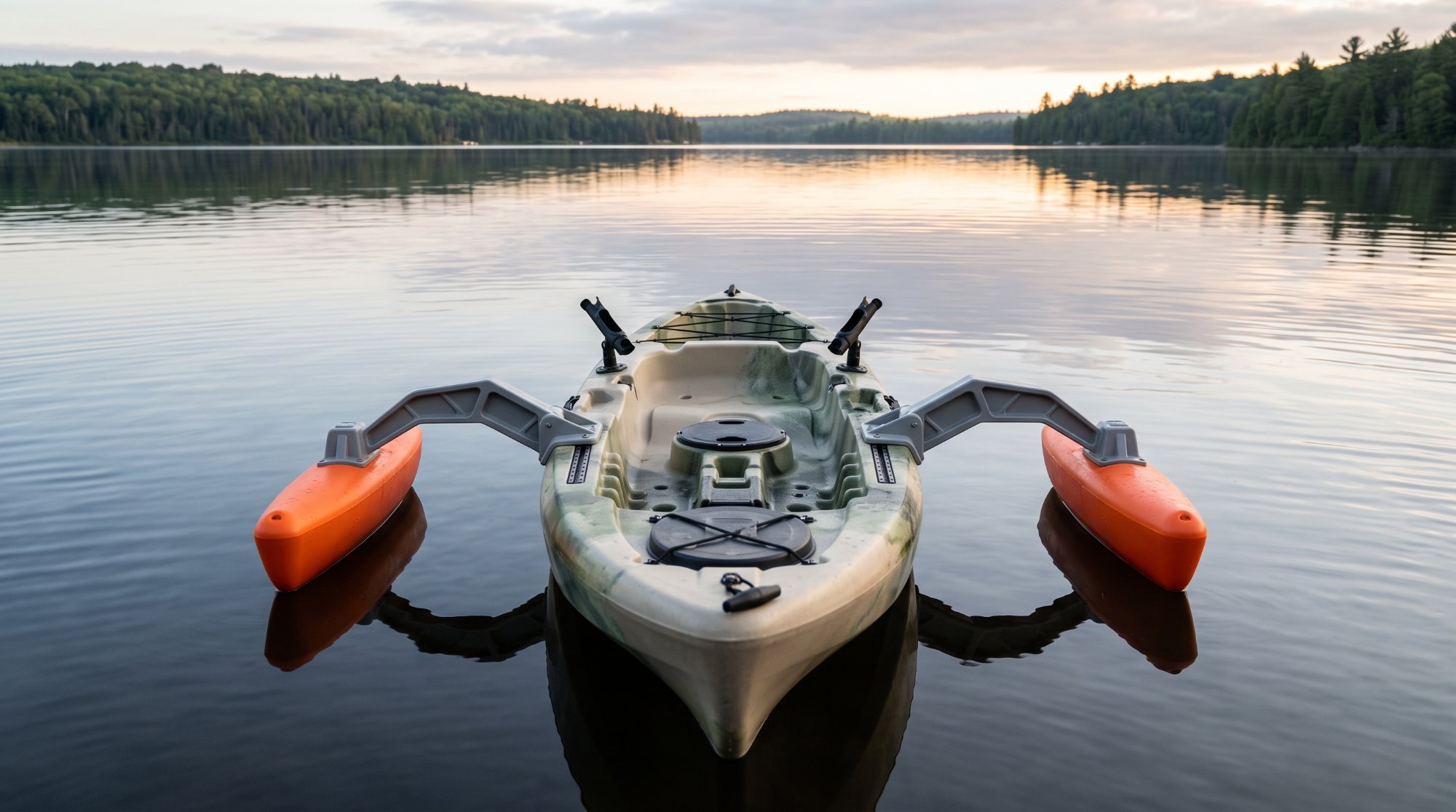
Quick answer: A universal rigid-arm kit with hard-shell floats is the pick for most kayak anglers — it bolts to standard gear tracks and adds enough buoyancy to stand and cast from a 75–90cm hull. Pedal-kayak owners should pay extra for a factory-matched system that clears the drive. Skip outriggers entirely if you fish seated in a wide, stable sit-on-top and never feel the urge to stand: you’d be buying drag.
Kayak outriggers get bought by the wrong people. The nervous first-timer orders a set before their maiden paddle, then discovers their 82cm-wide sit-on-top was never going to flip on calm water anyway. Meanwhile the angler who’d benefit most — the one who wants to stand, spot fish in the shallows and work a surface lure with a full casting arc — talks themselves out of it because outriggers look like training wheels. That’s backwards.
Standing changes everything about how you fish from a kayak. Your eyes go from barely a metre off the water to nearly two, which is the difference between casting blind and watching a shape peel off a sand edge to eat your plastic. A good outrigger set doesn’t make your kayak unsinkable — nothing does — but it moves the tipping point far enough that a careless weight shift becomes a wobble instead of a swim. That’s the honest job description: a wider margin for the things standing anglers actually do.
Quick Picks
- Best overall: a universal rigid-arm kit with hard polyethylene floats — consistent buoyancy, no punctures, fits most gear tracks.
- Best for pedal kayaks: a factory-matched system sized for your hull, in the mould of Hobie’s Sidekick — clears the drive and keeps the deck tidy.
- Best budget and lightest: an inflatable float kit — packs into a hatch, weighs next to nothing, does the job on sheltered water.
- Best tool-free setup: a track-mounted adjustable kit in the RailBlaza style — clips in and out between sessions, no drilling.
- Best for narrow touring hulls: compact mini floats — lean-support for skinny kayaks, not a standing platform.

How to Choose Kayak Outriggers
Start with float volume, because it’s the number that decides whether you can actually stand. Quality kits run roughly 9–15 litres of displacement per float; that’s what catches you when 90kg of angler leans past the hull’s own secondary stability. Small decorative floats — and most of the cheapest kits — carry half that and will simply bury under a real weight shift. Arm length matters too, and it’s a genuine trade-off: floats set 60–75cm off the gunwale give a firmer platform than short-arm kits, but every centimetre of width adds drag and complicates docking and car-topping with the arms still fitted.
Mount the arms behind your seat, not ahead of it. This is the mistake that ruins most first installs: mounted forward, the arms foul your paddle stroke on every second blade plant, and the floats bury when the bow loads up in chop. Behind the seat they sit in the widest part of the hull, clear of your stroke, with the bow left free for an anchor trolley. Think about the fish, too — you’ll land everything over the stern quarter between float and hull, so keep that lane clear of rod holders.
Finally, be honest about whether you need them at all. A modern 85cm-plus platform with a flat standing deck already supports careful stand-up casting in flat water. Outriggers earn their keep on narrower hulls, in wind chop, or under a heavy, high setup — sounder, crate, battery — that’s raised your centre of gravity.
The Outrigger Kits
Check today’s stabiliser kit prices on Amazon →
Universal Rigid-Arm Outrigger Kits
The workhorse of the category: two hard-shell polyethylene or nylon floats on aluminium arms, mounting to standard gear tracks or bolt-through brackets. Brands like YakGear and Brocraft built their reputations here. Rigid kits win on predictability — the float’s buoyancy is the same on trip forty as trip one, there’s nothing to inflate or puncture, and the solid arm transmits a reassuring, immediate resistance the moment you lean. The cost is bulk: expect 2–3kg on the stern and a wider load to store and car-top with the arms fitted. If you fish every weekend and stand for half the session, this is the kit to buy once.
Run through the rigid-arm kits and compare their arm lengths
Inflatable Stabiliser Float Kits
Inflatable pontoons on the same style of arms, in the mould of Scotty’s long-running stabiliser system. The whole kit stows in a hatch, adds barely a kilogram, and inflates in a couple of minutes at the ramp. On sheltered water they work well — but treat the trade-offs honestly. PVC bladders lose pressure as the day cools and need topping up, a stray treble or oyster-crusted pylon can end a float’s day, and under a hard lean an inflatable gives a softer, spongier catch than a rigid float. Ideal as a sometimes-accessory for the paddler who mostly sits; wrong for the everyday stand-up caster.
Size up the inflatable float kits and their pack-down bulk
Factory-Matched Systems for Pedal Kayaks
Pedal hulls complicate outriggers: the drive sits amidships, and generic clamp-on arms have a habit of landing exactly where a fin or prop needs clearance. Factory-matched systems — Hobie’s Sidekick is the best-known example — solve this by design, with mounting points and arm geometry drawn for that hull family. You pay more and the kit fits nothing else you’ll ever own, but the install is clean, the load ratings are matched to the boat, and nothing fouls the drive at full stroke. If you stand and pedal-fish, this is the one category where brand-matching beats bargain-hunting.
See the factory-matched kits made for pedal hulls
Track-Mounted Adjustable Kits
The tool-free option: arms that drop into star-port or t-track fittings — RailBlaza’s ecosystem is the reference point — and come off again in seconds at the end of the session. That removability is worth more than it sounds: run outriggers on the days that need them and paddle clean the rest of the time — which answers the drag complaint that dogs permanently-fitted kits. Check your track’s load rating before buying; a lightly-screwed accessory rail is not a structural mount.
Compare the tool-free track-mount kits and spare fittings
Compact Mini Floats for Narrow Hulls
Slim touring and sit-in kayaks used for light fishing don’t suit full-size outriggers — the hull was drawn for efficiency, and strapping two buckets of drag to it defeats the point. Compact float sets exist for exactly this boat: smaller pontoons on short arms that add lean-support for photographing a fish, rigging a rod or riding out a ferry wake. Be clear-eyed about the limit: these are stability insurance for a seated paddler, not a standing platform, and no honest seller claims otherwise. If your goal is standing to cast, buy a wider kayak or a full-size kit — not mini floats.
Scan the compact float sets sized for slimmer hulls
Comparison
| Kit type | Float style | Added width & weight | Stand-up support | Watch for |
|---|---|---|---|---|
| Universal rigid-arm | Hard polyethylene | High — 2–3kg, widest footprint | Strong, immediate | Transport width with arms fitted |
| Inflatable kit | PVC pontoons | Lowest — about 1kg | Moderate, softer catch | Punctures, pressure drop as it cools |
| Factory-matched | Hard, hull-specific | Moderate, tidy fit | Strong, engineered to the hull | Fits one hull family only |
| Track-mounted | Hard or inflatable | Moderate, removable | Strong when locked down | Track load rating, fitting wear |
| Compact mini floats | Small hard or foam | Low | Lean-support only | Not for standing, ever |

Frequently Asked Questions
Will outriggers make my kayak impossible to capsize?
No — be suspicious of anything that implies it. Outriggers raise the capsize threshold: a lean that would have tipped you becomes recoverable. A breaking wave or a hard snag can still put you in the water, so wear your PFD exactly as before.
Do outriggers slow a kayak down?
Yes, noticeably, whenever the floats are riding on the water. Two extra wetted hulls add drag you’ll feel over a long paddle. That’s why adjustable arms matter: lift the floats clear for the transit, drop them when you arrive at the flat. Trolling with floats down also changes lure action slightly at slow speeds — worth knowing before you blame the fish.
Should the floats touch the water or sit just above it?
Just above, for most fishing. Floats set 2–5cm clear let the hull paddle at its natural speed and only engage when you lean — the training-wheel geometry. Set them touching when you’re standing for long spells or fishing chop, when constant contact gives the steadiest platform.
Can I stand in any kayak once outriggers are fitted?
No. You also need somewhere flat to put your feet. A sit-in cockpit or a heavily-contoured deck stays a seated boat no matter what’s bolted to it. Outriggers extend the ability of a kayak that already has a standing deck; they don’t create one.
Are DIY pool-noodle or pipe outriggers worth trying first?
As a calm-water experiment to see whether you like standing, sure. As permanent kit, no. Home-built rigs fail at the hardware: flexing joints, fatiguing zip ties and fittings never rated for a person’s full weight arriving sideways. The commercial kits cost what they cost largely because of the mounts.
The Bottom Line
Buy outriggers for what they really are: a standing-platform upgrade, not flip insurance. For most kayak anglers that means a universal rigid-arm kit with 9–15 litre hard floats mounted behind the seat — predictable, puncture-proof and firm under a real lean. Pedal-kayak owners should spend up on the factory-matched option and keep the drive clear. And if you fish seated in a wide, steady hull and stand up twice a season, spend the money on better line instead — an honest gear cupboard has gaps in it.
Building out the rest of the boat? Our guides to the best kayak anchors and trolleys, best kayak life jackets and PFDs and best electric trolling motors for kayaks cover the other pieces of a stable, fishable setup.