
This page contains affiliate links. Far Cornel may earn a commission if you buy through them, at no extra cost to you.
See today’s power banks on Amazon →
Quick answer: A 20,000mAh+ USB-C power bank with fast-charge output covers most campers for a long weekend of phones, headlamps and GPS units without much extra weight. Go rugged and water-resistant if you’re near the coast or expect rough weather. Add a small folding solar panel only once you’re off-grid past day four or five. Skip the category entirely if a power station and a big folding panel already run your camp — a phone bank becomes dead weight once a bigger battery is already doing the job.
Every camping group has one person who packed an expensive portable power station just to charge a phone, and another who packed a bargain power bank hoping it would run the camp fridge overnight. Both had the wrong tool for the job. A power bank tops up small USB devices — phones, GPS units, headlamps, maybe a tablet. A portable power station runs appliances: fridges, kettles, CPAP machines. Confuse the two and you either carry capacity you never touch, or wake up to a fridge full of warm food.
This guide only covers the first category: the pocket-sized batteries and folding chargers that keep your devices running without touching your main camp power. If you’re wiring up 12V systems, dual batteries or DC-DC charging for a fridge, that’s a separate buying decision — the numbers that matter here are milliamp-hours (mAh) and watts, not amp-hours and cranking amps, and the gear is priced and sized accordingly.
Quick Picks
- Best all-rounder: A 20,000–26,800mAh USB-C power bank with 18W+ PD fast charging — several phone charges from a pack about the size of a paperback.
- Best for wet or dusty trips: An IP65/IP67-rated rugged power bank with a rubberised shell and sealed ports.
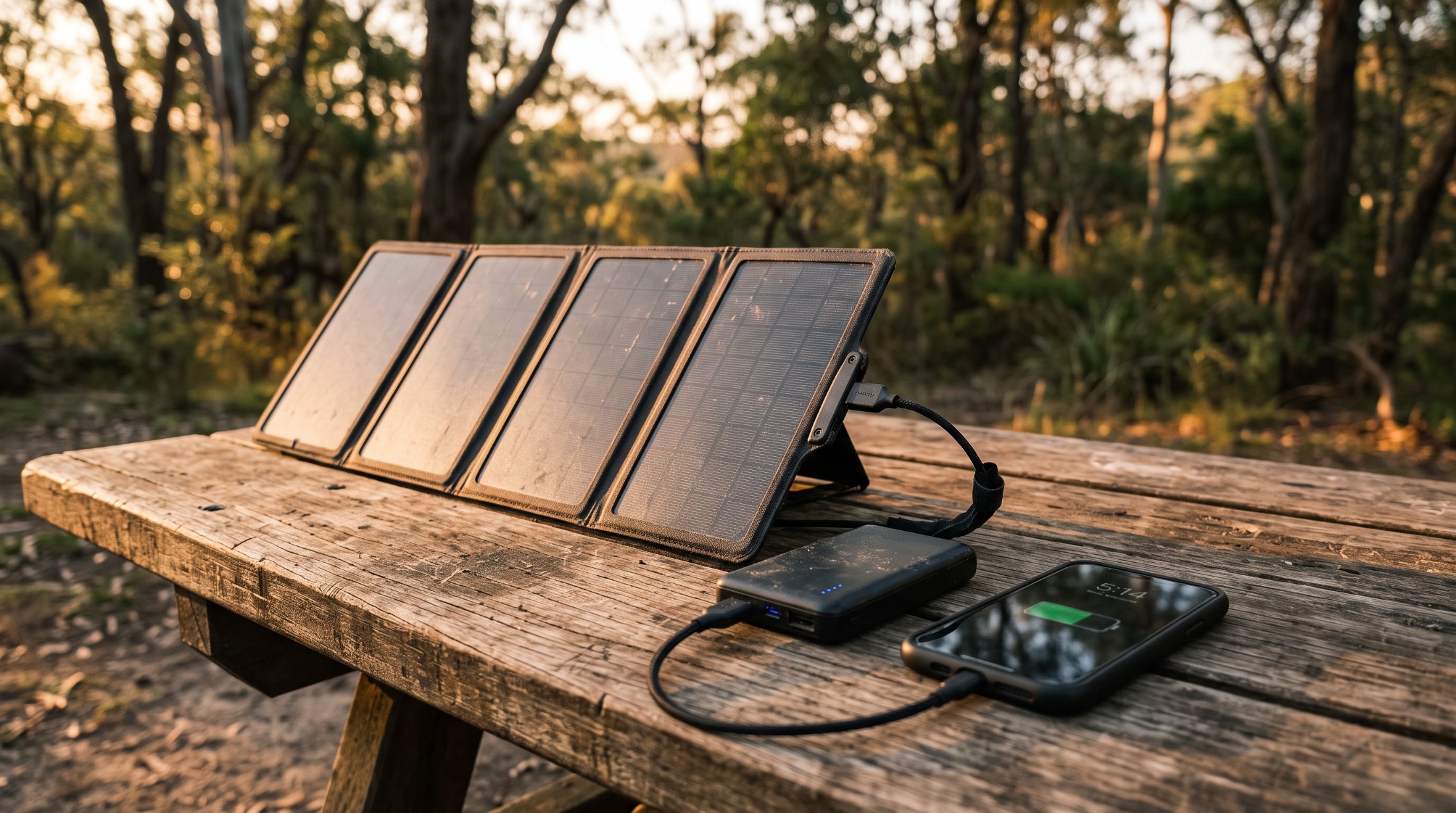
- Best for longer off-grid stretches: A solar power bank combo — a small panel bonded to the battery, trickle-charging while it rides on your pack.
- Best ultralight option: A standalone foldable solar charger with no built-in battery, feeding your phone or a separate bank directly.
- Best for bigger loads: A high-output 65W+ power bank that can also top up a laptop, camp fan or portable speaker, not just a phone.

How to Choose a Power Bank or Solar Charger for Camping
Capacity numbers on the box are milliamp-hours (mAh), and bigger isn’t automatically better once weight and charge speed enter the picture. A 10,000mAh bank weighs roughly 200g and gives a modern phone two full charges; a 26,800mAh bank weighs closer to 550g for five or six. Past about 30,000mAh you’re carrying a brick for diminishing return unless you’re charging for an entire group.
The number buyers overlook is output wattage, not capacity. A bank rated at 10W will trickle-charge a phone overnight; one with 18W or higher USB-C Power Delivery gets you from empty to useful in under an hour. If you plan to charge the bank itself from a solar panel while also pulling power out of it for a device, check it explicitly supports pass-through charging — plenty of budget banks don’t, and either refuse to do both at once or quietly degrade the battery doing it.
Be realistic about solar. A phone-sized folding panel in full sun might deliver 5–10W — enough to slowly refill a bank over a full day, not fast-charge a phone directly. Solar earns its pack weight on trips longer than four or five days where mains power isn’t an option; for a weekend, a second charged bank is lighter and far less fussy than chasing sun angles all afternoon.
Cables and ports matter more than most buyers expect. A bank with only USB-A output paired with a USB-C-only phone means an extra cable to lose track of, and older banks often ship with a Micro-USB input that charges painfully slowly compared to USB-C in. Match the bank’s ports to what’s already in your kit before you match anything else.
The Power Banks and Solar Chargers
Check today’s prices on Amazon →
The everyday all-rounder: 20,000mAh+ USB-C power banks
A bank in the 20,000–26,800mAh range with 18W or higher USB-C Power Delivery output is the sweet spot for the vast majority of trips. It’s light enough to live in a daypack permanently, holds enough charge for a long weekend of phone, GPS and headlamp top-ups, and charges fast enough overnight that you’re not still waiting at breakfast. Look for a percentage display rather than the old four-LED guess, and at least two output ports so you’re not fighting a camp-mate for the only socket. See what today’s 20,000mAh+ banks are priced at.
Rugged and waterproof power banks
Camping near the coast, fishing off a kayak, or travelling through rough weather changes what you need from a bank. An IP65 or IP67 rating means it shrugs off splashes, dust and the odd dunking, usually behind a rubberised shell with sealed port covers. They run heavier and often charge a touch slower than a sleek equivalent of the same capacity, but a dead bank after one wave over the side of a boat is worse than a bit of extra bulk. Compare the rugged, IP-rated banks built for wet or dusty trips.
Solar power bank combos
A solar combo bundles a small folding panel — usually 5 to 10 watts — directly onto the battery, so it trickle-charges itself strapped to the outside of a pack while you walk. It won’t outrun your devices’ daily draw on its own, but on trips past four or five days off-grid it’s the difference between a flat bank on day six and one that’s still ticking over. Treat the panel as a slow top-up, not a fast-charge source. Browse the solar-combo banks currently listed.
Standalone foldable solar chargers
If you’re already carrying a separate power bank and just want a lightweight way to keep it topped up, a standalone folding panel without a built-in battery is the lighter option — some fold down to roughly tablet-sized and weigh under 300g. They feed a device or bank directly in decent sun and add almost nothing to base pack weight, which matters more to hikers covering distance than car campers parked at a site. Check sizes and panel wattages for standalone solar chargers.
High-output banks for bigger loads
Once you’re charging more than a phone — a laptop, a portable speaker, a rechargeable camp fan, or several devices for a group — capacity matters less than output wattage. A 65W+ USB-C PD bank can push enough power to actually charge a laptop rather than just slow its drain, and multiple ports mean devices aren’t queuing overnight. They cost more per mAh than a basic phone bank, and most solo campers don’t need one, but a family or group site often does. See which high-output banks can also run a laptop or fan.
Comparison
| Type | Typical capacity/output | Best for | Weight class | Watch out for |
|---|---|---|---|---|
| All-rounder USB-C bank | 20,000–26,800mAh, 18–30W | Weekend trips, most campers | ~400–550g | Low-output budget models trickle-charge slowly |
| Rugged/waterproof bank | 10,000–20,000mAh, IP65+ | Coastal, dusty or wet-weather trips | ~350–500g | Rubberised shells add bulk for the same capacity |
| Solar combo bank | 10,000–25,000mAh + 5–10W panel | Five-plus day off-grid stretches | ~450–700g | Panel alone won’t fast-charge a phone directly |
| Standalone folding solar charger | 5–20W, no battery | Ultralight hikers pairing it with a separate bank | ~150–400g folded | Output drops hard in cloud or shade |
| High-output bank | 65W+ USB-C PD, 20,000mAh+ | Laptops, camp fans, multi-device charging | ~500–650g | Higher price for wattage most phones don’t need |

Frequently Asked Questions
Will a power bank run a camp fridge overnight?
No. A phone-sized power bank tops out around 20–30W output, nowhere near what a 12V compressor fridge draws to hold temperature through a night. That job belongs to a portable power station or a dual-battery system, not this category.
How many phone charges does a 20,000mAh power bank actually give?
Roughly four to five for an average phone, after conversion losses between the bank’s rated capacity and what actually reaches your device — real-world output is usually 60–70% of the number printed on the box.
Can I take power banks on a flight to get to the trailhead?
Most airlines allow power banks under 100Wh (roughly a 27,000mAh bank) in carry-on only, not checked luggage, and anything larger usually needs airline approval in advance. Check your specific carrier before flying with a big one.
Do folding solar chargers work through a car windscreen or tent mesh?
Barely. Glass and mesh both cut output significantly — solar panels need direct, unobstructed sun to hit their rated wattage, so lay them flat in the open rather than propping them against glass.
Does it matter whether a bank has USB-C or USB-A ports?
Yes, for charging speed. USB-C Power Delivery ports charge modern phones and tablets far faster than older USB-A ports, even from the same battery. If your gear is USB-C, buy a bank with USB-C PD output, not just a USB-C input for recharging the bank itself.
The Bottom Line
A power bank is one of the cheapest, highest-value things you can throw in a daypack — it’s the portable power stations and big folding panels that deserve the bigger budget conversation. Match the battery to the trip: a 20,000mAh USB-C bank for most weekends, something rugged if you’re near water, and solar only once you’re genuinely off-grid for the better part of a week. Get that right and a dead phone stops being a camping story you tell against yourself.
If you’re setting up bigger camp power rather than just keeping devices topped up, our guides to lithium camping battery boxes and folding solar panel kits cover that separate decision, and our rechargeable camping lanterns guide is a natural next stop once lighting is next on your list.