
This page contains affiliate links. Far Cornel may earn a commission if you buy through them, at no extra cost to you.
Browse today’s options on Amazon →
Quick answer: For most 4×4 recovery kits the best choice is a weighted dampener bag with a clip-through fitting, so it can’t slide off the line under load — ARB, Bushranger and Saber all sell one. Go compact and clip-on if you already run light, or a heavy-duty dampener blanket if you also want ground-mat coverage. Skip it only if every recovery you do is a slow, rigid tow-bar pull with no stretch in the line.
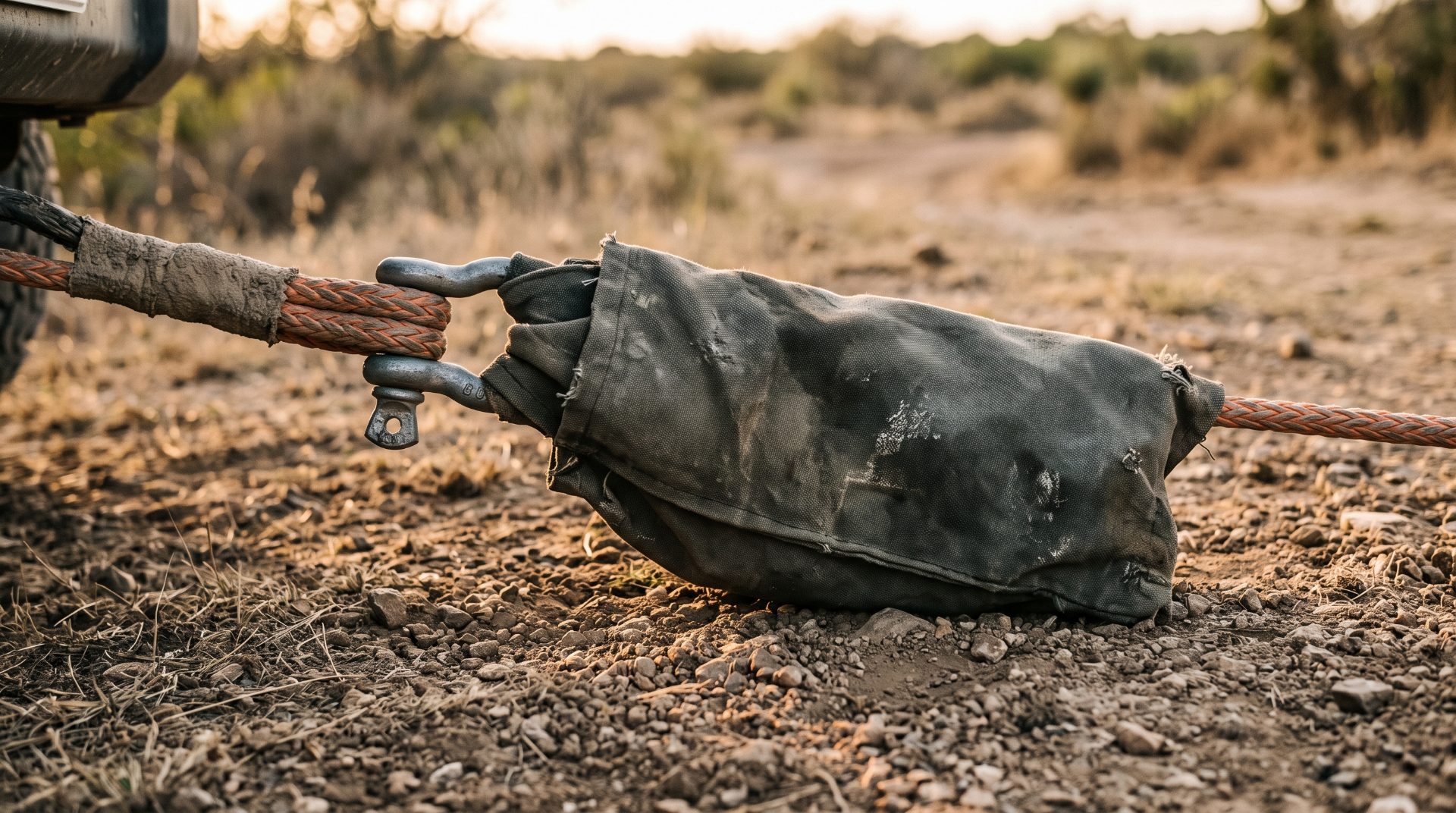
A kinetic recovery rope works by stretching — that’s the entire point, it’s what lets a moving vehicle transfer momentum into a stuck one instead of the line just snapping tight like a chain. But every joule of energy stored in that stretch has to go somewhere if a shackle, recovery point or the rope itself lets go, and the answer is usually a piece of steel travelling at a speed that can seriously injure someone standing metres away. A dampener is the unglamorous accessory that turns a rare but genuinely dangerous failure into a dropped bag on the ground instead.
It rarely makes anyone’s first shopping list because it doesn’t recover anything by itself — no dampener has ever pulled a vehicle out of a bog. What it does is sit on top of the strap or rope near the load-bearing hardware and add enough weight and drag that if something does fail, the broken end drops instead of flying. Every kit that includes a kinetic rope or snatch strap should have one draped over the line before anyone stands back and takes up the slack, and most people who skip it are simply betting that today isn’t the day something fails at the wrong end of the load.
Quick Picks
- Best overall: A weighted dampener bag with an adjustable fill and a clip-through strap, so it sits over the join and stays there under load.
- Best for beginners: A fixed-weight canvas or PVC wrap that needs no filling — unpack it, drape it, done.
- Best dual-purpose: A heavy-duty dampener blanket wide enough to also serve as a ground mat under a jack or shackle mid-recovery.
- Best compact: A clip-on dampener pouch sized for lighter kinetic ropes and smaller vehicles where drawer space is tight.
- Best for long or two-point recoveries: A dampener pair, so both ends of the line are covered when two recovery points carry load at once.

How to Choose a Recovery Dampener
Weight and coverage matter more than the price tag. A dampener needs enough mass to genuinely slow a failed shackle or hook, not just make a token gesture at safety — as a rough guide, look for something in the 3 to 5 kilogram range once weighted, and wide enough to fully cover the shackle or joint rather than draping past it on one side. A fillable bag lets you match the weight to what you’re carrying; a fixed-weight wrap saves you the hassle of finding sand or water on site.
How it stays on the line matters just as much as what it weighs. A dampener that simply balances on top of the rope can slide or bounce clear the moment the line moves — which is exactly when you need it in place. Look for a wrap-through design, a clip, or a hook-and-loop closure that keeps it seated over the joint under vibration and sudden load, not just while everything is still.
Most dampeners are sized for synthetic kinetic ropes and snatch straps, and that’s where they matter most because of how much energy a stretchy line stores. They’ll sit just as well over a winch cable or steel recovery chain, and while a rigid line stores far less elastic energy, a snapped hook under winch load is still worth covering — a dampener costs little enough that there’s no real reason to leave a winch recovery bare.
The Recovery Dampeners
Compare recovery dampeners on Amazon →
Weighted Fillable Dampener Bags
The most common style is a heavy-duty bag with a fill opening for sand, water or gravel, so the weight is whatever you can find on site rather than whatever you happened to pack. Empty, it folds down small enough to live permanently in a recovery bag; filled, most sit in the 3 to 5 kilogram range that actually does the job. The trade-off is a few minutes of filling and emptying each trip, which is a fair swap for something that takes up almost no space the rest of the time. See what’s currently listed for a fillable recovery dampener.
Fixed-Weight Canvas or PVC Wraps
A pre-weighted wrap skips the filling step entirely — pull it out, drape it over the joint, and it’s ready. They’re usually built from heavy canvas or PVC with the weight sewn in, which keeps the pack weight consistent trip to trip and removes any temptation to skip filling one when you’re in a hurry. The compromise is less flexibility: what you buy is the weight you’re stuck with, so check it sits in a genuinely useful range rather than being weighted just enough to tick a box. The ready-to-use wraps on Amazon are worth checking if filling a bag isn’t for you.
Dual-Purpose Dampener Blankets
A wider, heavier-duty blanket does double duty as a dampener and a ground mat — something to kneel on or rest a jack against mid-recovery, which matters more than it sounds when the ground is wet clay or loose sand. They’re bulkier to pack than a bag or wrap, so they suit vehicles that already carry a full recovery kit and have the drawer space, rather than anyone counting grams. Check the current range of dampener blankets built for this kind of dual use.
Compact Clip-On Dampener Pouches
For lighter kinetic ropes, smaller 4x4s, or anyone who’d rather not carry a full-size bag, a compact clip-on pouch covers the joint without the bulk. They carry less weight than a full-size bag, so they suit lower-rated ropes and lighter vehicles rather than serious dual-cab or wagon recoveries — pairing one with a heavier main dampener is a reasonable middle ground if you tow occasionally but recover often. A handful of compact options are listed on Amazon right now.
Dual Dampener Kits
Some recoveries load two points at once — a long kinetic rope recovery run through a snatch block, or a winch extension where both the vehicle end and the anchor end carry real tension. A two-piece kit means both joints are covered without robbing one end to protect the other, which is worth the extra pack space on any trip where multi-point recoveries are routine rather than simple straight-line pulls. Browse the two-piece dampener kits currently available on Amazon.
Comparison
| Type | How it’s weighted | Pack size | Best for |
|---|---|---|---|
| Fillable bag | Sand, water or gravel on site | Small when empty | Adjustable weight, minimal permanent bulk |
| Fixed-weight wrap | Sewn-in weight | Small, consistent | No-fuss, ready every trip |
| Dampener blanket | Sewn-in weight, larger area | Bulky | Dual use as a ground mat, full-kit vehicles |
| Compact pouch | Sewn-in weight, lighter | Very small | Light kinetic ropes, smaller vehicles |
| Dual kit | Two matched units | Moderate, two pieces | Multi-point or long-line recoveries |

Frequently Asked Questions
Do I need a dampener if I’m only using a snatch strap, not a kinetic rope?
Yes. A snatch strap stretches less than a purpose-built kinetic rope, but it still stores real energy, and the shackles at each end carry exactly the same failure risk. The strap type changes how much energy is stored, not whether a failure can send hardware flying.
Can I use a folded jacket or a spare blanket instead?
Only as a last resort. A dedicated dampener is weighted and shaped to stay seated over the joint under load; loose clothing or a blanket can shift or slide off at the exact moment the line takes up tension, which is the one moment it actually needs to be there.
Does a dampener work with a winch cable or chain?
Yes, and it’s worth using one there too. A rigid steel line stores less elastic energy than a stretchy rope, but a hook or shackle failure under winch load can still move fast enough to hurt someone, and a dampener costs little enough that skipping it on a winch recovery isn’t really saving anything.
Where exactly should it sit on the line?
Over the hardware, not the middle of the rope. The highest-risk failure points are the shackles and connection hardware at each end, so that’s where the dampener’s weight needs to be concentrated — draping it over the middle of a bare rope does very little.
How many do I actually need?
One is the minimum for any kinetic rope or snatch strap recovery. A second is worth adding if you regularly do multi-point recoveries or run a longer line where both ends carry real load at once, but for most single-vehicle bog recoveries, one well-placed dampener covers the highest-risk joint.
The Bottom Line
A recovery dampener is one of the cheapest, least exciting items in a 4×4 recovery kit, and also one of the only ones whose entire job is to protect the person standing nearby rather than to get the vehicle moving. A weighted bag or wrap that stays seated over the shackle earns its place the moment you’re relying on a kinetic rope or snatch strap for a real recovery — the only recoveries that can genuinely skip it are slow, rigid tow-bar pulls with no stretch in the line at all.
A dampener is only one piece of a safe recovery setup — see our guides to kinetic recovery ropes and snatch straps, soft shackles and rated recovery points for the rest of the kit it’s meant to protect.