
This page contains affiliate links. Far Cornel may earn a commission if you buy through them, at no extra cost to you.
See the current stringer and keeper net range on Amazon →
Quick answer: For most bank and boat anglers, a stainless chain stringer with individual snap clips is the best all-rounder — durable, easy to rinse, and it keeps fish separated instead of tangled on one cord. Choose a fabric keeper net if you want fish swimming and healthy until you decide what to keep, a floating clip stringer for kayak fishing, and skip rope stringers altogether if you’re chasing toothy or reef species — they won’t survive first contact.
Keeping a fish alive after you catch it is a different job to keeping it cold, and treating a stringer and a keeper net as two names for the same thing is how a good session turns into a wasted one. A stringer clips fish through the jaw or gill on a cord or chain, trailing beside you or through the water. A keeper net holds fish loose and swimming in a mesh bag, usually staked to a bank. Both solve the same problem — what to do with a fish once it’s in your hand and you’re not ready to clean it — in genuinely different ways, and picking the wrong one costs you fish quality, fish welfare, or both.
This matters more than most anglers give it credit for. Leave a fish flapping on the bank in the sun and the flesh softens before you’re back fishing; string it through the gill near structure on a bite-off-prone stringer and you’ll lose it, hook and all, the moment something bigger takes an interest. Everything below costs less than a decent lure, so there’s no good reason to still be improvising with a length of rope and a bent shower-curtain hook.
Quick Picks
- Best overall: a stainless chain stringer with individual snap clips — durable, rinses clean, keeps fish apart instead of tangled.
- Best for fish welfare: a fabric keeper net that holds several fish loose and swimming until you decide what to keep.
- Best for kayak and boat anglers: a floating clip stringer that trails at the surface, away from the hull.
- Best budget: a rope or paracord stringer with brass snaps — cheap, packs flat, fine for soft-mouthed freshwater species.
- Best for solo speed: a single lip-lock clip stringer you can clip and drop with one hand.

How to Choose a Stringer or Keeper Net
Start with what you’re protecting: the fish, or your afternoon. Chasing a feed, fishing a competition, or working from a boat with no livewell all point toward keeping fish alive and in good condition rather than tossing them in a bucket. If you release anything under size, a keeper net is the gentler option — fish swim inside it, and returning an undersized one is a lift-and-tip rather than unclipping a jaw.
Match the hardware to what you’re chasing. Toothy or structure-loving species chew through rope in seconds, so anything with real teeth needs steel cable or chain, not cord. Soft-mouthed schooling fish in open water are easier on gear, which is where a basic rope stringer earns its keep. Current matters too: a stringer dragged behind a moving kayak tows fish through the water hard enough to exhaust or drown them, so anything used on the move needs a float and a short leash, not a long line under the hull.
Handling technique changes the outcome as much as the gear. A clip through the lower jaw keeps a fish alive far longer than one through the gill, since the gill is where it breathes. Gill-clipping is fine for a fish you’re dispatching soon after, but the wrong call if you might release it. Whatever you choose, rinse it after every trip — dried slime and salt are what seize clips and rust chain years early.
The Stringers and Keeper Nets
Browse live stringer and keeper net listings on Amazon →
Stainless Chain Stringer
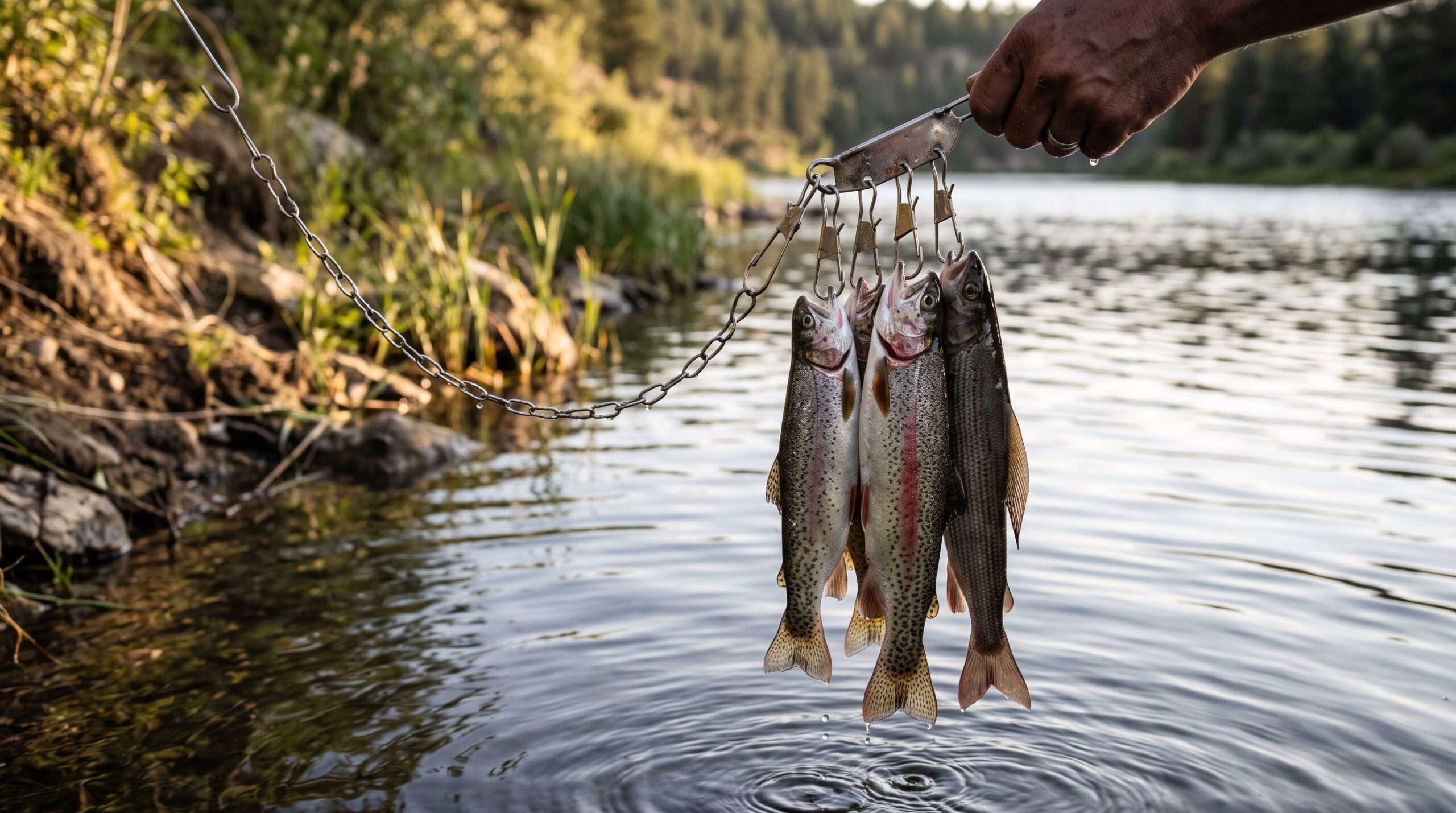
Buy this if you only ever own one. A run of stainless cable or chain with individual snap-lock clips holds each fish separately, so a big one can’t drag the whole catch under or tangle around a smaller fish’s gills. The clips pierce cleanly through the lower jaw and lock shut, and being steel rather than cord, a flathead or anything with a mouthful of teeth won’t bite through it the way a rope loop would. Rinse it in fresh water after saltwater use and it will outlast several rope stringers. See what a decent chain stringer costs on Amazon.
Fabric Keeper Net
A keeper net swaps clips for a drawstring mesh bag on a rigid entry ring, of the kind sold under names like Frabill, staked into the bank or clipped to a jetty rail. Fish go in loose and keep swimming, which is easier on them and on you — no unclipping a jaw one fish at a time to check your catch or release something undersized. The trade-off is that it needs still water and a fixed anchor point, so it suits bank and jetty fishing far better than a drifting boat or a moving current. Compare keeper net sizes and mesh types on Amazon.
Floating Clip Stringer
Built for kayaks and small boats: a short stringer with a float built in, riding at the surface beside the hull instead of dragging fish through the water column as you paddle. A fish towed deep and fast behind a moving kayak works hard to breathe against the flow, and a surface float keeps the drag gentle and the fish visible, so you’re not left wondering if you’ve lost your catch off the back. Clip the float end to a d-ring or milk crate rather than your own belt — a solid pull can genuinely unbalance a kayak. Look at the floating stringer options on Amazon.
Rope or Paracord Stringer
The cheapest and most common option, and there’s nothing wrong with it for the right fish — small-to-mid schooling species with soft mouths in open water. A length of cord with a pointed tip or needle and a couple of brass snaps threads through easily and costs next to nothing. Its weak point is what makes it cheap: cord frays and gets bitten through by anything with real teeth, and one continuous length lets an aggressive fish twist the whole lot into a knot. Treat it as a budget pick for gentle species, not an all-purpose tool. Browse the basic rope stringer range on Amazon.
Single Lip-Lock Clip Stringer
A minimalist option for anglers fishing solo and moving often: one heavy-duty spring clip on a short lanyard, worn on a belt or bag, taking a single fish through the lower jaw at a time. It won’t hold a session’s worth of fish, but for someone walking a bank, or fishing a comp where fish are weighed and released quickly, clipping on and off one-handed beats threading a full stringer every time. Pair it with a net or bucket back at the vehicle if you need to hold more than one or two. See the single-clip stringer options on Amazon.
Comparison
| Style | Fish welfare | Handles toothy species | Best setting |
|---|---|---|---|
| Stainless chain stringer | Good if clipped through the jaw | Yes | Bank, jetty, boat |
| Fabric keeper net | Best — fish swim freely | Not ideal (teeth damage mesh) | Bank, jetty, still water |
| Floating clip stringer | Good — surface float reduces drag | Yes | Kayak, small boat |
| Rope or paracord stringer | Fair | No | Open water, soft-mouthed species |
| Single lip-lock clip | Fair — quick in and out | Depends on clip material | Solo bank fishing on the move |

Frequently Asked Questions
Is a stringer or a keeper net more humane for the fish?
A keeper net is generally gentler, since the fish stays upright and swimming rather than held rigid through the jaw or gill. A stringer clipped through the lower jaw is a reasonable middle ground; through the gill, you’re effectively keeping that fish for the table, so match the method to what you actually plan to do with it.
Do I still need one if my kayak or boat has a cooler on board?
Often yes. A cooler is for fish you’ve decided to keep and are ready to process, but most anglers don’t want to stop and ice every fish the moment it lands, especially early in a session. A stringer or net keeps fish alive and in good condition in the meantime, so you decide what goes in the cooler at the end of the trip rather than fish by fish.
How many fish can I safely put on one stringer?
Fewer than the clip count suggests. Every fish added increases drag and the chance of a bigger one twisting the whole line, and an overloaded stringer tires all the fish on it faster. Four or five similarly sized fish is a sensible practical limit, regardless of how many clips are fitted.
Will a stringer rust or corrode in saltwater?
Cheap chain and clips will, quickly. Look for marine-grade stainless specifically, and rinse any stringer in fresh water after a saltwater session regardless of what it’s made from — salt left to dry in a hinge is what seizes a clip shut by the next trip.
Should the clip go through the lip or the gill?
Through the lower jaw, just in front of where it hinges, is standard for a fish you want to keep alive — it avoids the gills entirely. The gill is faster but ends any chance of a healthy release, so save it for fish you’ve already decided to keep.
The Bottom Line
The right keep-alive gear for a day’s fishing costs less than the fuel to get there, yet it’s the piece of kit most anglers improvise around. A stainless chain stringer is the sensible default for bank, jetty and boat fishing; step up to a fabric keeper net if fish welfare and easy releases matter to you, and fit a floating clip stringer the moment you’re fishing from anything that floats. Skip rope entirely near toothy or structure-loving species — replacing lost fish costs more than the steel version would have. Buy for the fish you actually catch, rinse it after every trip, and it will last years.
Once the fish is on the line, the rest of the handling chain matters just as much: see our guides to the best landing nets for getting it boatside safely, the best fish grips for handling it without a puncture wound, and the best fishing coolers and ice boxes for whatever you decide to keep.