
This page contains affiliate links. Far Cornel may earn a commission if you buy through them, at no extra cost to you.
See the top-rated gear on Amazon →
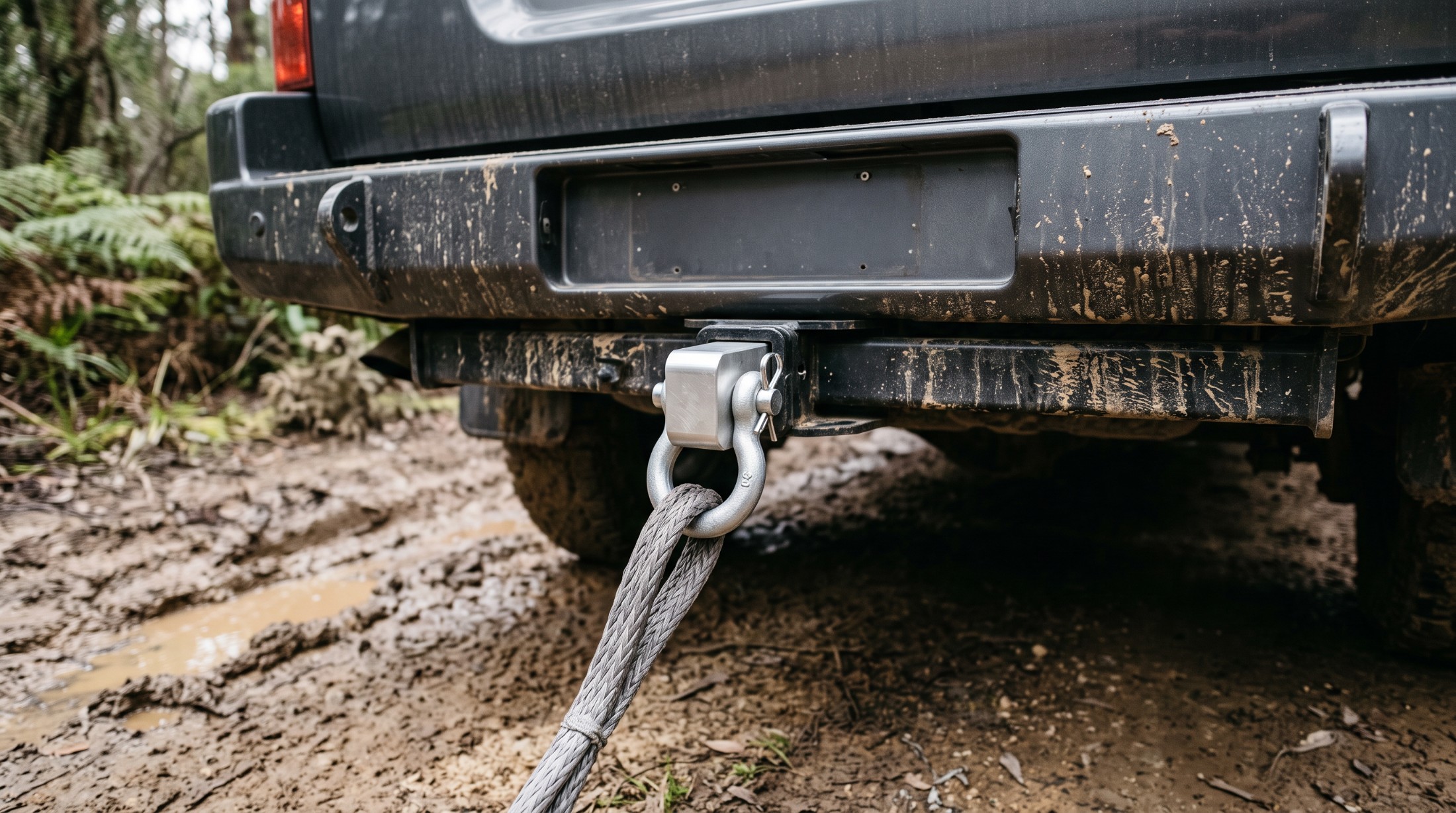
Quick answer: The first recovery attachment most tourers should buy is a rated 50 mm hitch receiver — Saber’s alloy version if weight and corrosion bother you, a steel one if the budget is tight — because it drops into the tow receiver already on the vehicle and carries a stamped working load limit. Up front, fit vehicle-specific rated points from ARB or Roadsafe in pairs, share the pull with an equaliser strap, and never snatch off a towball.
A snatch recovery puts tonnes of shock load through whatever the strap is attached to. That is the whole trick of the thing: the strap stretches, stores energy, and hauls a bogged vehicle out with force well beyond what the tow vehicle alone could deliver. It is also the whole danger. If the attachment lets go, a lump of steel comes back along the strap line at lethal speed, toward wherever the onlookers are standing. This is the one gear category where a bad buy is not a durability complaint — it is a safety failure.
The confusion is understandable, because every 4WD leaves the factory wearing several convincing-looking metal loops. Almost all are lashing points for transport — thin pressed steel on modest bolts, never meant to see a shock load. Rated recovery gear is different in kind, not degree: engineered for the load path into the chassis, and stamped with a working load limit you can read. Here is what belongs at the rear, what belongs up front, and the strap that ties a two-point pull together.
Quick Picks
- Best first buy: a rated 50 mm recovery hitch — no drilling, stamped rating, fits the receiver you already have.
- Best alloy hitch: Saber Offroad alloy recovery hitch — light, corrosion-proof, radiused for soft shackles.
- Best front points: ARB rated recovery points — engineered per vehicle model, not one-size-fits-nobody.
- Best value points: Roadsafe rated recovery points — the same philosophy at a sharper price.
- The missing piece: an equaliser strap — splits a front pull across two points so neither takes the lot.

How to Choose Recovery Attachments
One rule sorts the entire category: if it does not carry a stamped rating, it is not a recovery point. A towball is cast steel engineered for the steady loads of towing, and its documented failure mode under snatch shock is to shear and fly. Factory tie-down loops bend, then tear. Neither belongs anywhere near a snatch strap, no matter how gently anyone promises to drive.
Start at the rear, because that is where recoveries usually happen — backwards, out the way the vehicle drove in. A rated recovery hitch slots into the 50 mm receiver most tourers already have, takes a standard 16 mm pin, and typically carries a working load limit around 4,500 to 5,000 kg. Fitting one takes two minutes and no drilling, which is why it should be the first purchase.
The front is more involved. Bolt-on rated points attach through factory chassis holes with high-tensile hardware, and the good makers engineer and rate them per vehicle model, because chassis sections differ. Fit two, joined by an equaliser strap, so the pull splits and the vehicle tracks straight instead of slewing around a single offset point. Use every bolt supplied and torque to the listed figures — a rated point mounted with the wrong bolts is jewellery.
The Hardware
Check today’s prices on Amazon →
ARB Rated Recovery Points
The reference standard for bolt-on front points. ARB designs each point against a specific vehicle’s chassis rail, spreads load through multiple high-tensile bolts, and stamps the rating on plate thick enough to inspire calm. Per-model engineering is the correct way to do recovery points, and it is what the price buys. The catch follows from the same fact: they exist only for supported vehicles, so confirm the kit matches your model and year, and budget for a torque wrench if the shed lacks one. See ARB recovery point listings on Amazon
Roadsafe Rated Recovery Points
The value alternative that keeps the philosophy. Roadsafe covers a wide spread of popular 4WDs with vehicle-specific, rated, stamped points on high-tensile hardware, at a price that makes fitting a proper pair less painful. Finish and instructions run plainer than the premium option and coverage has gaps, so do the homework — but a correctly fitted Roadsafe pair beats an exquisite single point every time, because two points sharing a bridled pull is the geometry that keeps loads sane. Look up Roadsafe recovery points on Amazon
Saber Offroad Alloy Recovery Hitch
The premium rear option. Machined from 7075-series alloy, Saber’s hitch runs around a third the weight of steel, will not bleed rust down the bar, and its radiused edges are deliberately kind to soft shackles — increasingly the connector of choice. It is real money for what is, functionally, a very nice block with a hole in it, and steel does the job for less. But if the drawer already holds soft shackles and the vehicle lives near salt, this is the version still looking new in five years. Check the Saber alloy recovery hitch on Amazon
Steel Recovery Hitch Receivers
The budget path, and an entirely respectable one. Steel recovery hitches from makers like Hulk 4×4 are simple, stamped with their working load limit, and sized for the standard 50 mm receiver and 16 mm pin. They are heavy in the drawer and will freckle with surface rust eventually; none of that matters in use. For sheer safety gained per dollar nothing else on this page comes close — if alloy feels indulgent, buy steel today rather than deliberating another season. Browse steel recovery hitch receivers on Amazon
Equaliser Straps (ARB, Ironman 4×4)
The unglamorous item everyone skips until their first front pull. An equaliser — or bridle — strap spans two rated points so each sees roughly half the load and the vehicle comes out straight rather than yawing around one corner. Typical lengths run 3 to 5 m, and the strap’s own rating must match or beat the rest of the system. Buy it the same day as the front points; a pair without the bridle is half an installation. Find equaliser strap options on Amazon

Comparison
| Product | Mounts where | Rating class | Buy it if |
|---|---|---|---|
| ARB recovery points | Front chassis, model-specific | Stamped, per vehicle | Your model is supported and you want the benchmark |
| Roadsafe recovery points | Front chassis, model-specific | Stamped, per vehicle | You want a rated pair at the best price |
| Saber alloy hitch | Rear 50 mm receiver | Stamped WLL, alloy | Soft shackles and salt air feature in your life |
| Steel recovery hitch | Rear 50 mm receiver | ~4,500–5,000 kg WLL | You want maximum safety per dollar, today |
| Equaliser strap | Between two rated points | Match to system | You fitted front points — so, always |
Frequently Asked Questions
Why exactly is a towball so dangerous for snatch recoveries?
Because it is cast for towing loads, not shock loads. A stretched strap stores enormous energy, and when a towball shears — a documented, repeated failure — that energy fires the ball along the strap line like a cannon shot. People have died this way. Careful driving does not change the metallurgy; the answer is a rated attachment, full stop.
Are the factory loops under my 4WD recovery points?
Almost always no — they are tie-down points for transport, pressed steel on small bolts. The exceptions exist: some vehicles do ship with genuinely rated recovery points, and the handbook plus a stamped rating on the metal itself are how you confirm it. No stamp, no snatch.
Do I need one front point or two?
Two, joined by an equaliser strap. A single offset point takes the whole shock load on one chassis section and drags the vehicle sideways as it comes out. Two bridled points halve the load and keep the pull straight — cheaper insurance than any panel repair.
What connects the strap to a recovery hitch?
A rated bow shackle — commonly 3.25 to 4.75 t WLL for this duty — or a rated soft shackle. Seat a bow shackle’s pin finger-tight then back it off a quarter turn so it can be undone after loading, and match pin size to the hitch’s hole rather than forcing it. Soft shackles are lighter, float, and are kindest on alloy hitches.
The Bottom Line
Order of operations: rated hitch receiver first, because it is cheap, instant and covers the most common recovery direction. Vehicle-specific front points plus an equaliser strap next, before the trips where forward is the only way out. Towballs tow, tie-downs lash, and neither ever meets a snatch strap. The strap is only ever as safe as the steel it is hooked to — spend accordingly.