
This page contains affiliate links. Far Cornel may earn a commission if you buy through them, at no extra cost to you.
See the top-rated portable BBQs on Amazon →
Quick answer: For most campers a single-burner gas BBQ with a lid and a cast-iron plate — the format Weber, Gasmate and Coleman all build — is the sweet spot: it grills, roasts with the lid down and packs into a drawer. Go dual-burner only if you regularly cook for four or more. Choose a flat-top griddle if breakfasts matter most, and skip a full BBQ entirely if you only ever boil water and cook one-pot meals.
A camp stove will boil your water and simmer a pot of chilli, but it will never give you a seared steak, a tray of grilled vegetables or the smell of onions catching over open heat. That is a barbecue’s job, and a good portable one turns a campsite kitchen from merely functional into the thing people actually gather around at the end of the day.
The trouble is that “portable BBQ” covers everything from a throwaway foil tray to a lidded gas grill that will roast a whole chicken. They cook differently, pack differently and fail differently. Getting the right one comes down to three honest questions: how many mouths you feed, how you like to cook, and how much room is left once the rest of the gear is loaded.
Quick Picks
- Best all-rounder: a single-burner lidded gas grill with a cast-iron plate — it grills, sears and roasts, and it is the format most camp cooks eventually settle on.
- Best budget buy: a compact tabletop gas grill that runs off a screw-on canister — cheap, light and perfectly good for one or two people.
- Best for big breakfasts: a flat-top griddle, which turns out eggs, bacon and pancakes far better than a slatted grill ever will.
- Best for groups: a twin-burner BBQ on a fold-out stand, so you can run high and low heat at the same time.
- Best for flavour: a small charcoal grill or kettle for anyone happy to trade convenience for that over-the-coals taste.

How to Choose a Portable BBQ
Start with fuel. Gas is the default for camping because it lights instantly, holds a steady heat and cleans up fast. The catch is the fitting: small grills run off screw-on butane or propane canisters that are convenient but expensive per cook, while larger units take a hose and regulator to a refillable gas bottle that works out far cheaper over a long trip. Check which system your BBQ uses before you buy — an adaptor hose is cheap, but only helps if you know you need one.
Then the cooking surface. Cast-iron plates hold heat, sear well and recover fast when you pile on cold food, but they are heavy and need seasoning and drying to keep rust away. Enamel and stainless plates are lighter and lower-maintenance but do not hold heat as fiercely. A lid matters more than most buyers expect: drop it down and a grill becomes a small oven, so you can roast a chicken or bake a tray of vegetables without carrying a second appliance.
Finally, be honest about size. A big twin-burner cooks for a crowd but swallows drawer or boot space and adds weight; a compact grill packs away easily but struggles past three or four servings. Look at the cooking area in square centimetres rather than the marketing name, and measure the packed dimensions against the gap you actually have. Burner output, usually quoted in megajoules per hour, tells you how hard a unit can run — useful in wind, which steals heat from every gas BBQ, so a deeper firebox or a built-in wind shield earns its keep.
The Portable BBQs Worth Comparing
Check today’s prices on Amazon →
Single-burner lidded gas grill (the all-rounder)
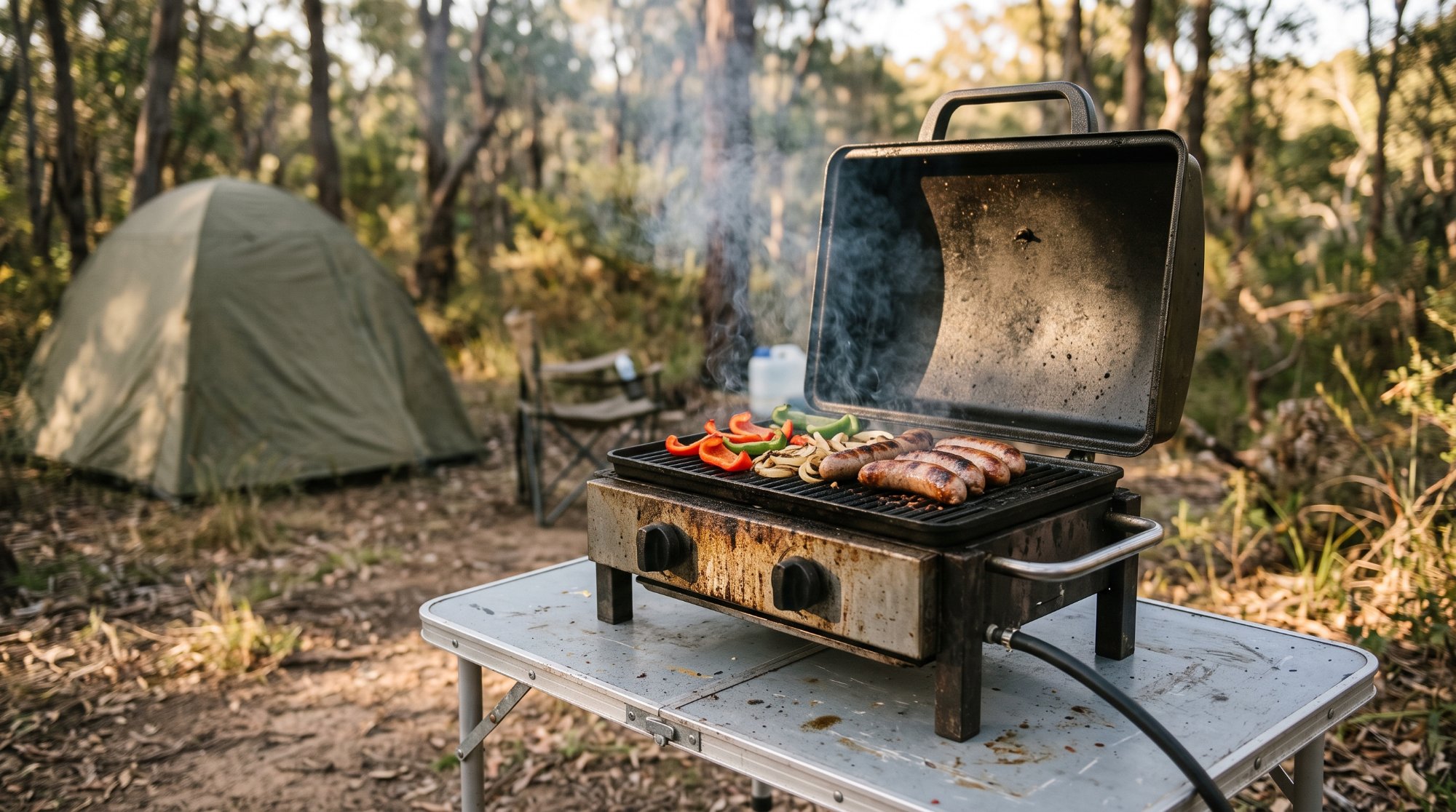
This is the format that has quietly become the camping standard, and for good reason. One decent-sized burner sits under a cast-iron plate, a domed lid with a thermometer traps the heat, and the whole thing still fits on a camp table. Weber’s Q range popularised the shape; Gasmate, Coleman and Companion all build their own versions. The lid is what separates it from a bare grill — you get genuine roasting, not just searing, so one unit handles steaks one night and a slow-cooked roast the next. It is heavier and dearer than a tabletop grill, but it is the one most people stop upgrading from.
See what the lidded roaster-style grills are going for.
Compact tabletop grill (the budget pick)
If you cook for one or two and mostly want sausages, burgers and a bit of veg, a small tabletop grill running off a screw-on canister does the job for a fraction of the price. They light in seconds, weigh a few kilograms and stow in a milk crate. The compromises are real: no lid or a shallow one, so roasting is off the table; a smaller, thinner plate that loses heat the moment you crowd it; and canister gas that adds up if you cook every night. For weekend trips and backup duty, though, they are hard to argue with.
Compare the compact tabletop grills.
Flat-top gas griddle (best for breakfasts)
A griddle swaps the slatted grill for a solid steel plate, and if your best camp meals are breakfasts it is the upgrade to make. Eggs, bacon, pancakes, fried rice and smash burgers all thrive on a flat top and would fall through or dry out on a grill. Blackstone built its name on the format, and many gas BBQs take a flat-plate insert so you can run half grill, half griddle. The one thing to watch is fat management — you want a plate with a grease channel and a catch cup, or breakfast ends in a flare-up.
Look over the flat-top griddle options.
Twin-burner BBQ with a stand (for groups)
Cooking for four or more, or for people who wander in to eat at different times, is where a twin-burner earns its space. Two independently controlled burners let you sear over high heat on one side and hold or slow-cook on the other, and a fold-out stand puts the whole thing at a comfortable working height so you are not hunched over a table. Coleman’s RoadTrip is the familiar name here. Expect more weight, a bigger packed size and a healthier gas appetite — this is a base-camp cooker, not a grab-and-go one.
Check the twin-burner setups with stands.
Compact charcoal grill (for flavour)
Gas wins on convenience, but charcoal wins on taste, and a small kettle or box grill scratches that itch without hauling a full-size barbecue. Weber’s Smokey Joe and Go-Anywhere are the classics, and a basic box grill costs very little. The trade-offs are patience and mess: fifteen to twenty minutes to reach cooking heat, ash to deal with afterwards, and a heat you steer by moving coals rather than turning a dial. For people who treat cooking as part of the trip rather than a chore, that is a feature, not a fault.
Browse the portable charcoal grills.
Comparison
| Type | Typical cooking area | Surface | Fuel | Packed weight | Best for |
|---|---|---|---|---|---|
| Single-burner lidded grill | ~1,800–2,500 cm² | Cast iron | Canister or bottle | ~9–14 kg | All-round camp cooking |
| Compact tabletop grill | ~1,000–1,600 cm² | Enamel / steel | Screw-on canister | ~3–6 kg | Couples, weekends |
| Flat-top griddle | ~1,500–2,800 cm² | Solid steel | Canister or bottle | ~8–15 kg | Breakfasts, big cook-ups |
| Twin-burner + stand | ~2,500–3,500 cm² | Cast iron / steel | Refillable bottle | ~13–20 kg | Groups, base camp |
| Compact charcoal grill | ~1,000–1,800 cm² | Steel grate | Charcoal / briquettes | ~4–9 kg | Flavour over convenience |

Frequently Asked Questions
Can you roast and bake on a portable BBQ, or only grill?
Any model with a domed, well-sealing lid can roast. With the lid down and the burner on low to medium, a gas grill holds oven-like heat, so a whole chicken, a tray of vegetables or a rack of ribs are all on the menu. Flat, lidless grills and shallow tabletop units can really only sear and fry.
Cast iron or enamel plates — which is better for camping?
Cast iron holds and radiates heat better, so it sears well and recovers fast when you load it with cold food, at the cost of weight and a little care (season it, dry it, keep it lightly oiled). Enamel and stainless are lighter and need less maintenance but cook less fiercely. If searing steaks matters, choose cast iron; if pack weight and easy cleaning matter more, enamel is fine.
What gas does a portable BBQ run on, and can I use a big refillable bottle?
Small grills usually take screw-on butane or propane canisters; larger ones connect by hose and regulator to a refillable gas bottle. Most canister BBQs can also run off a bigger bottle with the correct adaptor hose and regulator, which is far cheaper per cook on a long trip — just confirm the fitting and regulator pressure match your appliance before you connect anything.
Are gas BBQs allowed during a fire ban?
Rules vary by area and by how severe the restriction is, and they can change day to day, so always check the current fire restrictions for wherever you are headed before you count on cooking there. As a general guide, purpose-built gas appliances are treated differently from solid fuel and open fires, but on the most severe ban days even gas can be off-limits. When in doubt, pack a no-cook meal as backup.
How do I clean and look after the plates?
Scrape the plate while it is still warm, then wipe it down. For cast iron, burn off any residue, wipe it with a little oil and store it dry rather than scrubbing with detergent, which strips the seasoning. A quick oil after each trip is the difference between a plate that lasts years and one that rusts in a season.
The Bottom Line
If you want one portable BBQ that does nearly everything, buy the single-burner lidded gas grill with a cast-iron plate: it sears, it roasts and it fits where the gear already lives. Step up to a twin-burner only when you regularly feed a crowd, choose a flat-top if breakfast is the meal you care about most, and keep a small charcoal grill for the nights when flavour beats speed. The only truly wrong buy is a cheap, lidless slab you will fight with every trip — spend a little more once and cook well for years.
For the rest of the camp kitchen, see our guides to the best camping stoves for boiling and simmering, camp ovens and Dutch ovens for slow cooking over coals, and camp kitchen tables to give it all a stable home.