
This page contains affiliate links. Far Cornel may earn a commission if you buy through them, at no extra cost to you.
Shop the full family camping range on Amazon →
Quick answer: The best family camping setup is a five-piece core, bought in this order: a proper sleeping mat and bag for every person, a tunnel or cabin tent with standing height, a two-burner stove with one big pot, a 3×3 m gazebo for shade, and two lidded storage boxes that stay packed between trips. Skip the lot if you hike in to your campsites — this is a car-camping list.
Most family camping careers end at about 2 am on night one. The tent went up fine and dinner worked — then the temperature dropped, the bargain foam mats compressed to nothing, and by sunrise two exhausted adults were quietly agreeing never to do this again. None of that is bad luck. It’s how families usually buy camping gear: one enormous tent, a trolley of accessories, and whatever sleeping gear was cheapest on the day.
So here is the opinion that shapes this whole guide: the tent is your second most important purchase. Sleep gear comes first, because a family that sleeps warm in an average tent books another trip, while a family that shivers in an impressive one sells everything within a year. Below is the five-piece setup that actually gets used, in buying order, with notes on where cheap is fine and where it quietly ruins weekends.
Quick Picks
- Best first buy: a decent sleeping mat and a properly rated bag for every family member — this purchase decides whether there’s a second trip.
- Best family tent style: a tunnel or cabin design with real standing height and a separate living area; read “sleeps 8” as sleeps four plus luggage.
- Best camp kitchen core: a two-burner stove, a 4 L pot, a kettle and a fold-flat table — the deluxe kitchen unit can wait.
- Best shade: a 3×3 m gazebo, the most under-bought item in family camping.
- Best support kit: two big lidded storage boxes plus a rechargeable lantern, so packing becomes a 20-minute job instead of a Friday-night argument.

How to Choose a Family Camping Setup
Start with the arithmetic nobody prints on the box. Tent capacity ratings assume sleepers laid edge to edge with no luggage, no stretchers and no toddler starfishing sideways. Halve the number, roughly: a family of four wants a tent rated for six to eight, with a floor plan showing a sleeping area of at least 6 m². Sleeping mats play the same trick: width matters more than thickness for adults, and two 60 cm mats butted together still leave a cold seam. Check measurements, not marketing names.
Then think in systems, not items. The five pieces below earn their place because each one solves a different failure: cold nights (sleep gear), wet afternoons (tent living space), hungry crowds (kitchen), hot mornings (shade) and chaotic packing (storage). A brilliant tent doesn’t fix a freezing kid, and no kitchen gadget rescues a trip where nobody can find the torch. Budget-wise, put roughly a third into sleep gear, a third into the tent, and split the rest across the other three — that ratio looks wrong in the shop and proves right in the field.
Finally, respect your boot. A full setup for four fills a wagon before food and clothes go in, so pack volume is a real specification — favour gear that folds flat or nests. Anything that doesn’t pack down stays home by the third trip, and gear that stays home is money wasted.
The Five Pieces
Price up each piece on Amazon →
1. The sleep system — buy this first
Adults on a tent floor want either a self-inflating mat around 10 cm thick or a stretcher with a thin mat on top; kids are lighter and sleep happily on 4–5 cm. On bags, the number that matters is the comfort rating, not the limit rating printed twice as large — a bag “rated to 0°C” at its limit is a miserable bag at 5°C. Sea to Summit, Exped and Coleman all make family-friendly mats and bags at sane prices, and a fleece liner adds real warmth for pocket money.
The one place not to save: whatever the lightest sleeper in your family lies on. Every family has one person who feels every stone and every degree — outfit them properly and the whole campsite sleeps better. See family-sized sleeping mats and rated bags here.
2. The family tent — living space over sleeping count
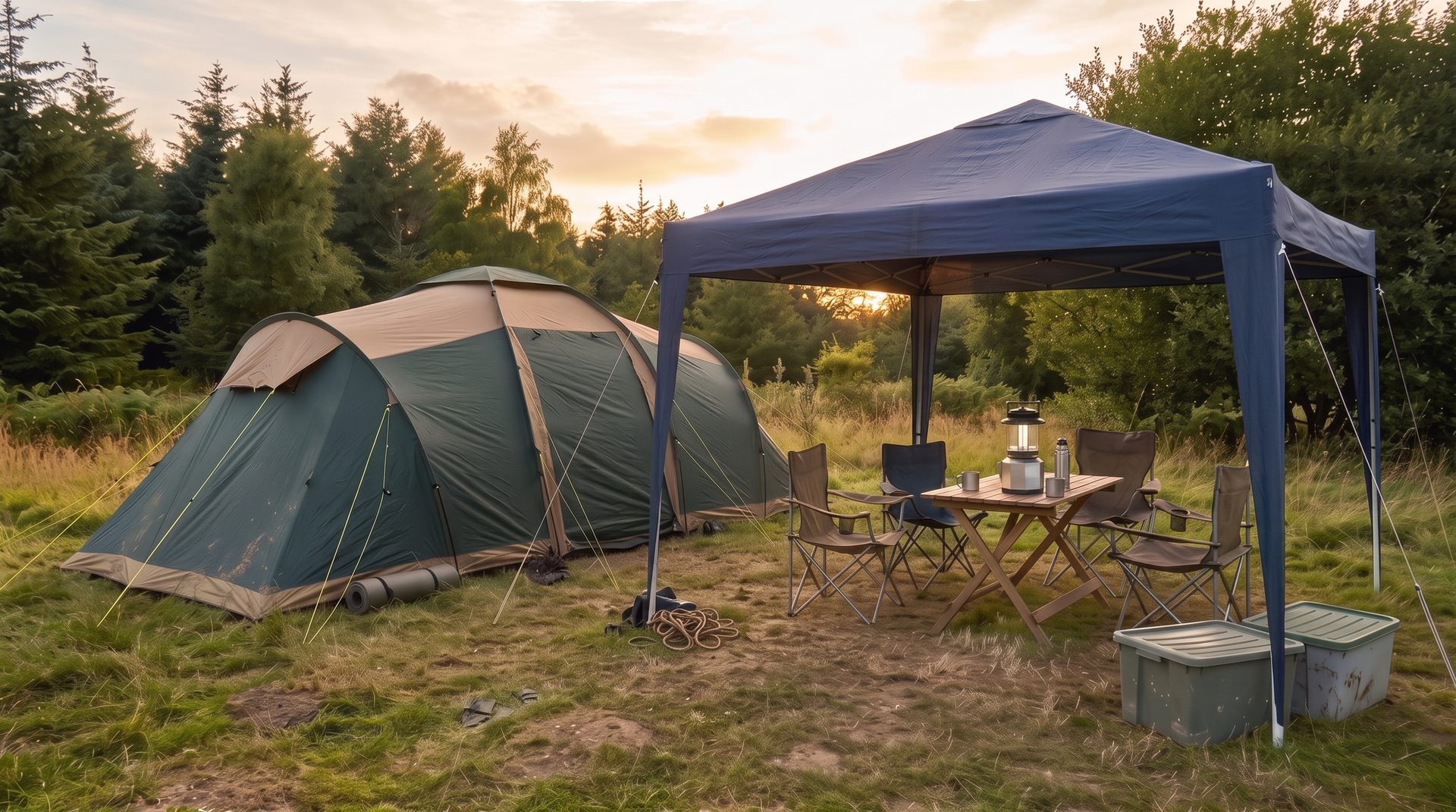
Tunnel and cabin tents dominate family camping for one reason: vertical walls. A dome that “sleeps 6” gives you crawling headroom at the edges; a tunnel of the same floor area gives standing height — look for 200–210 cm — and a living section where four people can wait out rain without lying on their beds. Darkened sleeping compartments earn their keep with young kids — summer sunrises arrive before 5 am, and a blackout bedroom buys you an hour. Coleman, Vango and Dometic all build in this shape.
The trade-off worth knowing: instant-up frames pitch in minutes but pack bulky; classic pole tunnels pack smaller, cost less and handle wind better once guyed. Frequent one-night movers justify the instant frame; week-long stays favour the tunnel. Compare tunnel and cabin family tents by floor size.
3. The camp kitchen — two burners, one big pot
Ignore the fold-out kitchen units with sinks and pantries; they are the most abandoned category in camping. A family kitchen is a two-burner stove with a windshield, one 4 L pot that feeds five, a kettle, a frying pan and a fold-flat table to put them on. The table is the piece people forget — cooking crouched on the ground gets old in exactly one meal. Single-burner canister stoves in the Jetboil mould make fast coffee but can’t hold a big pot steady, so they’re an addition, not the core.
Cheap is fine for utensils, plates and chopping boards. It is not fine for the gas side — buy the stove from an established brand with proper certification and replace perished hoses without sentiment. Price a two-burner stove and the pot to match.
4. Shade — the 3×3 gazebo nobody budgets for
Shade is the most under-bought item in family camping. Tents cook by 8 am in summer, small kids can’t sit in full sun, and a tent awning the size of a beach towel won’t cover a table and four chairs. A 3×3 m gazebo fixes all of it: kitchen under cover, pram parking, wet-weather play space, and somewhere for adults to sit while dinner cooks. Buy one with a solid hub, peg and guy it like you mean it — a gazebo is a kite with legs in a gusty afternoon — and add a wall for low morning sun.
Skip it only if your regular sites are heavily tree-shaded, or your tent carries a full-length awning that covers a real living area. Check 3×3 gazebos with sides and a full peg kit.
5. The support kit — storage, light and the glue
The difference between families that camp monthly and families that camp once is usually a pair of 60–80 L lidded storage boxes that live permanently packed: kitchen box, gear box, done. Add a rechargeable lantern around 1,000 lumens, a head torch per person — kids treat them as toys, so they always have light — and a power bank for phones. A first-aid kit rides in the gear box full-time.
None of this is glamorous, and all of it is why the second trip happens: when leaving takes 20 minutes, you go more often. Compare lidded camp storage boxes by litre size.
Comparison
| Piece | What it fixes | Spend or save? | The classic mistake |
|---|---|---|---|
| Sleep system | Cold, broken nights | Spend — comfort ratings, not limit ratings | Bargain foam mats for adults |
| Family tent | Rain days and privacy | Spend on space, save on gadgets | Believing the “sleeps 8” rating |
| Camp kitchen | Feeding a crowd fast | Save — two burners and one big pot | Buying the deluxe kitchen unit first |
| 3×3 gazebo | Sun, heat and wet afternoons | Mid — solid hub, full peg kit | Not buying one at all |
| Support kit | Chaos, darkness, slow pack-ups | Save — boxes and lights are commodities | Re-packing from scratch every trip |

Frequently Asked Questions
What size tent does a family of four actually need?
One rated for six to eight people, with a marked sleeping area of at least 6 m² and standing height in the living section. Capacity ratings count bodies edge to edge on the floor; they ignore luggage, stretchers and the universal truth that children sleep diagonally.
Should we buy everything before the first trip?
No. Buy the sleep gear, borrow or hire a tent if you can, and camp close to home. One night out teaches you more about what your family needs than any list, including this one. The gazebo and storage boxes can arrive for trip two.
Do we need a 12V fridge, or will an icebox do?
First year: a hard cooler with block ice handles a weekend easily. A 12V fridge is a genuine upgrade once you know you’ll camp often, but it drags a battery or power station into the budget with it — that’s next season’s problem, not this one’s.
What can we safely skip in the first year?
Deluxe kitchen units, camp ovens, matching furniture sets and anything sold as a “system”. If a piece doesn’t stop someone being cold, wet, hungry or lost in the dark, it can wait until you know you love camping.
The Bottom Line
The best family camping setup is not a tent with accessories — it’s a sleep system with a shelter around it. Buy warmth first, space second, then the two-burner kitchen, the 3×3 gazebo and the boxes that keep everything ready to go. Do it in that order and the gear fades into the background, which is exactly where good gear belongs.
Ready to go deeper on the individual pieces? Our family camping tents buyer’s guide compares specific tent designs in detail, the camping sleep system guide covers mats, bags and liners layer by layer, and best kids’ camping gear rounds out the setup for the smallest campers.