
This page contains affiliate links. Far Cornel may earn a commission if you buy through them, at no extra cost to you.
Browse camp stretchers and camp beds on Amazon →
Quick answer: A mid-height aluminium stretcher with a tightly tensioned fabric deck suits the widest range of campers — light enough to shift one-handed, quiet under a restless sleeper, and small enough packed that it earns its space. Pick a compact folding cot if tent floor area is scarce, or a steel frame if you sleep heavy. Skip a stretcher in a low tent, and never run one without insulation underneath you.
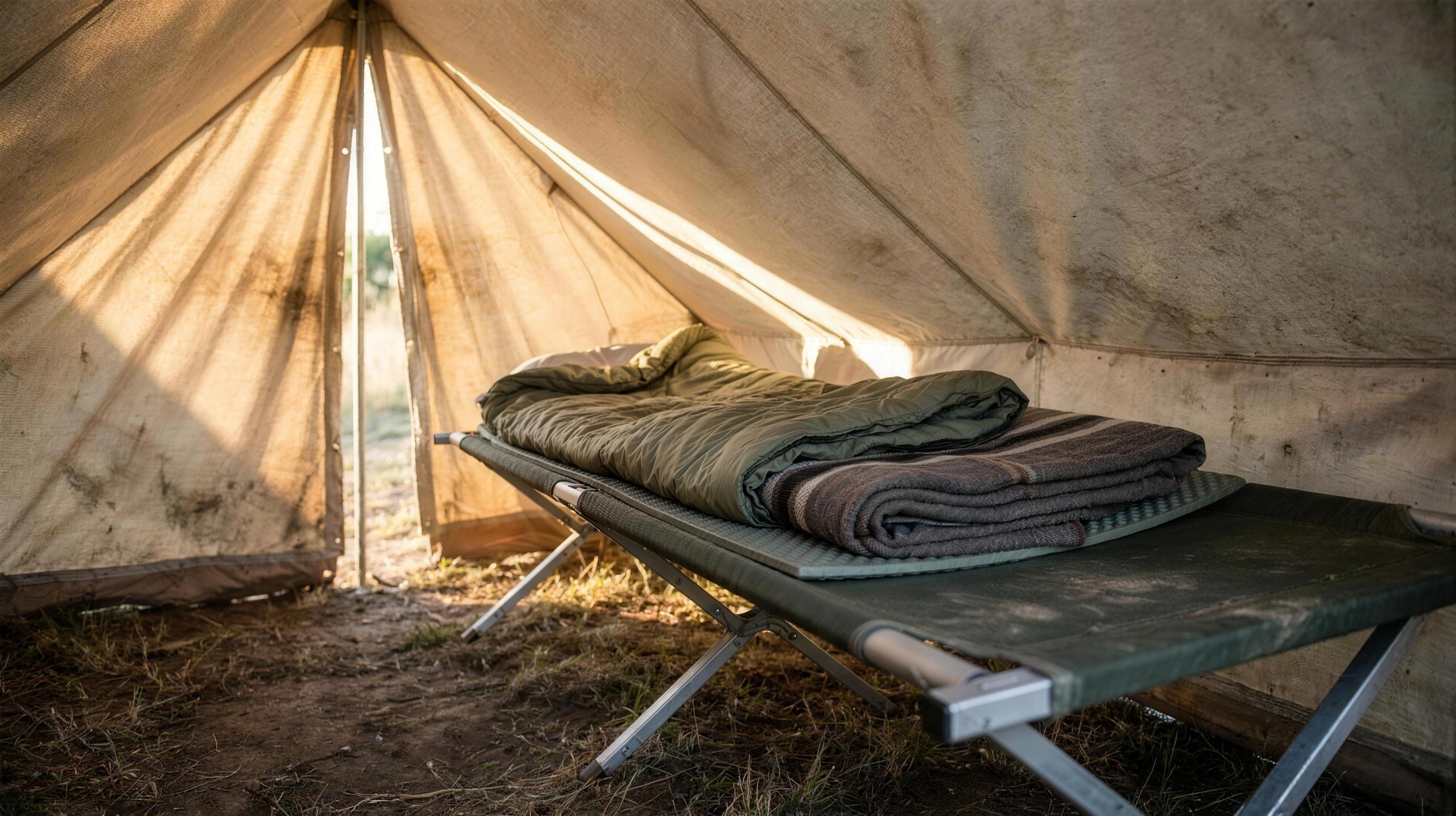
The standard camp stretcher story runs like this. Someone gets sick of waking up on a deflating mat, spends real money to get off the ground, climbs in with the same sleeping bag they have always used — and has the coldest night of the trip. Nothing was faulty. Air was simply moving underneath them, pulling heat out of a bag that had only ever been asked to insulate against still, solid ground.
That one detail decides whether a stretcher is a genuine upgrade or an expensive lesson, and it rarely gets more than a footnote in buying advice. The rest is simpler than the product pages suggest: what the frame is made of, how tight the deck sits, how much tent floor it swallows, and whether you can put it up half-asleep in the dark. Get those right and a stretcher is the best sleep money you will spend on a long trip.
Quick Picks
- Best all-round: A mid-height aluminium stretcher with a tensioned deck — roughly 5–7 kg, folds flat, and the frame can usually be repaired rather than binned.
- Best for tight tents: A packable folding cot on shock-corded poles, sitting low and collapsing to about the size of a daypack.
- Best for heavier sleepers: A steel-framed stretcher — noticeably heavier to carry, far more forgiving under sustained load.
- Best for couples and families: A double-width camp bed, or a pair of stretchers designed to stack as bunks and reclaim floor space.
- Best upgrade almost nobody buys: An insulated topper or fitted stretcher mat — the piece that solves the cold-underneath problem the frame creates.

How to Choose a Camp Stretcher
Start with insulation, because it is the part the frame actively makes worse. Lying on the ground, your body only has to fight conduction into soil that slowly warms up beneath you. Lift yourself 30–45 cm and you swap that for convection: cool air circulating freely under a thin layer of fabric, carrying warmth away all night and never warming up. A bag that felt fine on a mat can feel two seasons thinner on a stretcher. The fix is cheap — foam or a self-inflating mat on the deck, or a purpose-made insulated topper — but it has to be part of the purchase, not an afterthought in month three.
Then look at the frame and, more importantly, the deck tension. Legs almost never fail first. What fails is the stitching where the fabric wraps the side rails, and the tension in the end bars that keeps the deck taut. A stretcher that sags in the middle after a season was under-tensioned from new; a good one takes real effort to click the last bar home, and that effort is the whole design. Aluminium keeps weight down and will not rust in a damp canvas bag, but it bends under a hard drop and stays bent. Steel shrugs off abuse and holds more load, at a weight penalty you notice every time you pack. Sea to Summit, Helinox, Coleman, Therm-a-Rest and Darche all build here, at recognisably different points on that weight-versus-toughness line rather than as interchangeable options.
Finally, be honest about the space. A full-size stretcher is around 190 × 70 cm on the floor and lifts your shoulders well up the tent wall, which is fine in a tall canvas touring tent and miserable in a low three-season dome where you will brush condensation off the fly with your face. Two stretchers in a three-person tent usually leave nowhere to stand and dress. And treat quoted weight ratings as a ceiling, not a target — those figures are static loads on a test rig, not a person rolling over hard at 2 am, so leave meaningful headroom rather than buying to the number.
The Camp Beds Worth Considering
Check current camp bed prices on Amazon →
The full-size aluminium stretcher
This is the default for good reason. An aluminium rail frame with folding cross legs and a tensioned polyester or canvas deck lands around 5–7 kg, sets up in under a minute once you have done it twice, and gives a genuinely flat sleeping surface with no pressure points at the hips. Its real advantage is repairability: a bent leg or snapped foot is usually a part swap, while a broken pole on a sealed lightweight cot is often the end of it. Look for welded or riveted rail ends rather than crimped tube, and fabric stitched around the rail rather than clipped over it.
Line up the full-size aluminium stretchers and see what the frames are made of
The packable lightweight cot
Shock-corded poles, a small footprint and a folded size close to a large loaf of bread. These sit low — often only 12–18 cm off the deck — which is exactly what you want when tent headroom is the constraint, and low enough that the airflow problem underneath is reduced rather than eliminated. The trade-offs are real: assembly is fiddly at first, the end feet concentrate load into small points, and most cap out well below what a steel bed carries. Worth it if you move camp often; overkill if the stretcher lives in one tent for a fortnight.
Pull up the packable folding cots and compare their folded sizes
The steel-framed heavy-duty stretcher
Heavier by 3–5 kg and unapologetic about it. Steel tube frames take load without flexing, tolerate being thrown into a trailer, and are the sensible answer for anyone who has bent an aluminium leg before or who sits well up the weight range. The catch beyond mass is corrosion — stored damp, a steel frame shows rust at the welds within a season or two, so it wants drying before it goes away. If the bed lives in a base camp or a trailer rather than being carried, this is the one that outlives the rest.
Weigh up the steel-framed heavy-duty stretchers side by side
The double and bunk-capable camp bed
Two people, one footprint. Doubles are wide enough that two adults are not negotiating for space, though they need a genuine centre support or the middle sinks and you both roll inward by midnight. Bunk-capable stretchers are the smarter family buy: two beds in the floor area of one, which turns a cramped tent back into somewhere you can stand and get dressed. Check the stacking hardware is a positive mechanical lock rather than a friction fit.
Size up the double and bunk-style camp beds on offer
The insulated topper or fitted stretcher mat
The part of the system that most people discover the hard way. A fitted mat or insulated topper does two jobs: it puts loft between you and moving air, and it softens the slight ridge you feel where the deck meets the side rails. A self-inflating mat with an R-value around 3 or higher is enough for genuinely cold nights; a plain foam layer handles mild weather and costs very little. Get one sized for the stretcher rather than a standard mat that slides off the edge at 3 am — the fit is what makes it stay put.
Sort through the insulated toppers and fitted camp-bed mats
Comparison
| Type | Frame | Rough weight | Setup effort | Who it suits |
|---|---|---|---|---|
| Full-size stretcher | Aluminium rail | 5–7 kg | Low once learned | Most campers, tall tents, repeat trips |
| Packable cot | Shock-corded poles | 2–3.5 kg | Fiddly at first | Small tents, frequent moves, tight storage |
| Heavy-duty bed | Steel tube | 9–12 kg | Low, but bulky | Heavier sleepers, base camps, trailers |
| Double / bunk | Steel or hybrid | 12–18 kg | Two-person job | Couples and families short on floor area |
| Topper / fitted mat | Foam or self-inflating | 0.8–2 kg | Minimal | Anyone using a stretcher below about 12°C |

Frequently Asked Questions
Do I still need a sleeping mat if I have a stretcher?
Yes, and it is the single most common mistake with this gear. The stretcher solves comfort and damp, not warmth — suspending you in circulating air makes heat loss underneath worse, not better. A low-loft foam layer covers mild nights; anything genuinely cold wants a self-inflating mat rated around R3 or above sitting on the deck.
Will a stretcher damage my tent floor?
It can, because the whole load lands on four to six small feet. Most decent frames come with plastic or rubber caps — check they are still there before every trip, since they walk off. On thin floors, a square of closed-cell foam under each foot spreads the load and stops the grinding that eventually wears a hole.
How much weight can a camp stretcher really take?
Quoted ratings are static test figures, not a promise about someone dropping onto it or rolling over hard. Treat the number as an absolute ceiling and leave a decent margin under it. If you are near the limit, the frame material matters more than the rating printed on the box — steel simply behaves better under repeated load than thin-wall aluminium.
Stretcher or a good self-inflating mat — which is actually more comfortable?
For a night or two, a thick self-inflating mat is often more comfortable and far less hassle. Over a week the stretcher wins: it stays flat, stays dry when water tracks across the floor, keeps bedding off the dirt, and makes getting up in the night far easier on knees and backs. Trip length, not comfort alone, is the honest deciding factor.
The Bottom Line
If you are buying one stretcher and want it to be the right one, take the mid-height aluminium frame with a deck you have to fight to tension, and buy the fitted insulated topper in the same order. That pairing fixes both problems at once — the flat, dry, off-the-ground sleeping surface you were after, and the heat loss the frame introduces. Go steel only if load or rough handling makes you nervous, and go packable only if your tent genuinely cannot house a full-size bed. What you should not do is buy the frame alone and hope your existing bag copes.
Worth reading next: our camping sleep systems guide puts the stretcher back in context with the bag, mat and pillow it works alongside, the self-inflating sleeping mats guide covers the insulation layer in detail, and if you would rather skip the frame entirely, our swag buying guide takes the opposite approach to the same problem.