
This page contains affiliate links. Far Cornel may earn a commission if you buy through them, at no extra cost to you.
See the top-rated gear on Amazon →
Quick answer: For records you can trust, a digital hanging scale with five to ten gram resolution beats a big-capacity one you cannot read finely. Keep a mechanical spring scale as a no-battery backup, and a grip-and-weigh tool if you fish alone. For length, a soft roll-up brag mat suits most release anglers, while a rigid measuring trough is what competition length events demand.
A catch log is only as honest as the tools behind it. A scale that drifts two hundred grams, or a mat with markings faded to ghosts, quietly turns a genuine personal best into a guess, and adrenaline already makes most of us overestimate both weight and length in the moment. The gear itself is mechanically simple, which is exactly why it pays to buy carefully once instead of replacing something cheap every season.
What matters is not the headline number on the box but repeatability and readability. A scale that always reads slightly high is more useful than one that is randomly right, because a known bias can be corrected. This guide sorts the tools by the job they actually do.
Quick Picks
- Best overall: a digital hanging scale with fine resolution and a hold function.
- Best backup: a mechanical spring scale that needs no batteries.
- Best for fishing solo: a grip-and-weigh tool that grips and weighs in one.
- Best for release anglers: a soft roll-up brag mat.
- Best for length competitions: a rigid measuring trough with a nose stop.

How to Choose Scales and Measuring Mats
Match the scale to your catch, and ignore the impressive maximum. This is the myth that costs people accuracy: a scale rated to 50 kilograms sounds reassuring, but it usually reads in coarse steps and cannot resolve a 400 gram fish, so every small catch rounds to a lie. If most of what you weigh is small to mid-sized, a 15 to 25 kilogram scale reading in five to ten gram steps tells you far more. Treat any scale that quotes only a huge capacity, with no stated tolerance, as effectively unrated.
For the scale itself, salt is the quiet killer, so look for a genuinely sealed housing, a stainless or coated hook, and a stated water rating rather than a vague “water resistant” claim. A hold function that freezes the reading matters more than it sounds when the fish is swinging. For a mat, the material is the whole game: soft, dense foam or coated fabric protects the fish’s slime coat and folds without cracking, and moulded or heat-pressed graduations survive where surface-printed ones wear off within a season.
Then be honest about whether you need the precise gear at all. If you keep your catch and never enter events, a modest scale and a tape measure cover you. If you log release data or fish length-based competitions where a disputed measurement means disqualification, put the money into the mat’s markings and the scale’s repeatability, not into capacity you will never use.
The Tools
Check today’s prices on Amazon →
Digital hanging scale
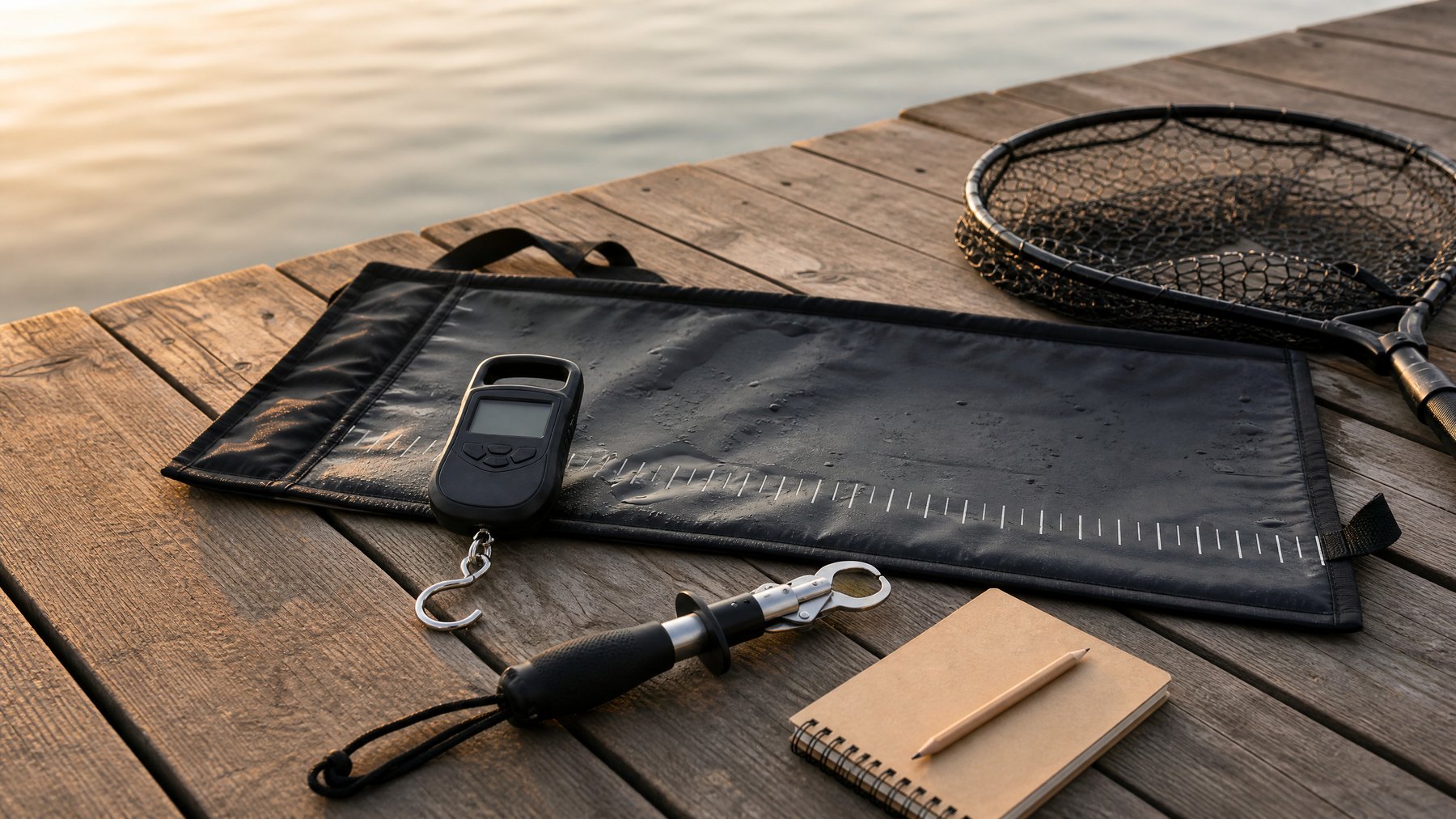
For anyone keeping records, this is the one to own. A good digital scale reads to the gram or close to it, holds the figure so you are not reading a swinging display, and often lets you subtract the weight of a sling or bag so you log the fish, not the gear. Look for a sealed, backlit unit with a stainless hook and a stated resolution; the backlight earns its keep in the low light of the sessions when fish bite best. Verify it now and then against a known weight. Find a digital scale with fine 5-to-10-gram resolution.
Mechanical spring scale
The spring scale is old technology that refuses to die, for good reason. It needs no batteries, shrugs off cold and damp, and keeps working when a digital unit fogs up or goes flat, which is why many anglers keep a cheap one as a knockabout backup. The trade-off is precision: you read a needle against a printed dial, so fine increments are hard to call, and springs can rust if you never rinse them. As a spare that always works, it is hard to beat. Compare mechanical spring scales for a no-battery backup.
Grip-and-weigh tool
If you fish alone, juggling a lip grip in one hand and a scale in the other over the water is how gear ends up wet. A combined grip-and-weigh tool clamps the jaw and reads the weight in a single motion, so you control the fish and log the number without a third hand. The built-in scale is rarely competition-accurate, so treat it as a solid working figure rather than a record, and wet the grip before it touches the fish. For quick, one-handed weighing it is genuinely handy. Look at grip-and-weigh tools for fishing solo.
Roll-up brag mat
For release fishing, length is usually the number that counts, and a soft roll-up mat is the kindest way to get it. Dense foam or coated fabric cushions the fish, folds into a bag without cracking, and printed or moulded graduations let you read the length straight off a phone photo. Wet it first so it lifts slime rather than strips it, and choose one with bold numerals and a raised nose stop so you seat the fish squarely. It stows flat in a kayak hatch or a pack. Check soft roll-up brag mats for release length.
Rigid measuring trough
Length competitions live and die on a clean, verifiable measurement, and a rigid trough with a hard nose stop is what serious length events expect. Pushing the fish’s nose against the stop and reading the tail against moulded graduations removes the argument, and the solid channel keeps the fish straight in a way a floppy mat cannot. It is bulkier and less gentle than a soft mat, so it suits the boat or the bank rather than a long walk in, and it is overkill if you only ever record your own bests. Size up a rigid measuring trough for competition length.

Comparison
| Tool | What it measures | Best for | Watch-out |
|---|---|---|---|
| Digital scale | Weight, fine resolution | Logged records | Needs charged batteries, keep it sealed |
| Spring scale | Weight, coarse steps | No-battery backup | Hard to read fine increments |
| Grip-and-weigh | Weight while gripping | Fishing solo | Only approximate, not comp-legal |
| Roll-up brag mat | Length, fish-friendly | Catch and release | Cheap foam fades and cracks |
| Rigid trough | Length, verifiable | Length competitions | Bulky, less gentle on fish |
Frequently Asked Questions
Do I need both a scale and a mat?
For fish you keep, a scale alone is fine. For release fishing and most competitions, the mat matters more, because length is measured on the mat and many events are settled on length rather than weight. If you only buy one, buy the one your fishing is actually judged on.
Digital or mechanical scale?
Digital reads finer, holds the figure, and is the better choice for logged records; mechanical spring scales need no batteries and keep working in cold and damp, which makes them a reliable spare. Plenty of anglers carry both and trust the digital for the numbers that count.
How should I measure a fish I plan to release?
Wet the mat and your hands, lay the fish flat with its nose against the stop, read the length quickly and take one photo, then return it. Decide in advance whether you record total or fork length and stay consistent, and never leave a fish on a dry surface while you fuss with the scale.
Why do my measurements not match the record books?
Usually because of length convention. Total length runs to the tip of the tail; fork length stops at the fork, and the two can differ by several centimetres on the same fish. Pick one, use it every time, and note which you used so your log stays comparable.
The Bottom Line
Buy for accuracy you can repeat, not a maximum you never reach. A fine-resolution digital scale does the weighing, a spring scale is the backup that always works, and a brag mat or rigid trough covers length depending on whether you enter events. Verify it against a known weight and keep the mat out of the sun.
Related: fishing gear checklist, fishing pliers and tool kits, and fish grips for a safe one-handed hold.