
This page contains affiliate links. Far Cornel may earn a commission if you buy through them, at no extra cost to you.
See the top-rated gear on Amazon →
Quick answer: For most campers a 300 to 450 lumen rechargeable headlamp with a red mode, a lockout and a tilting head does everything from cooking to the 2am toilet walk. Step up to a rechargeable-or-AAA hybrid for long remote trips so a flat battery is never the end of the night, drop to an ultralight if you count grams, and buy a simple single-LED lamp for the kids.
A headlamp is the one light you should not leave home without, because it keeps both hands free while you pitch a tent in the dark, find the toilet block at 2am, cook, or read in your sleeping bag. In a genuine emergency it stops being a convenience and becomes safety gear.
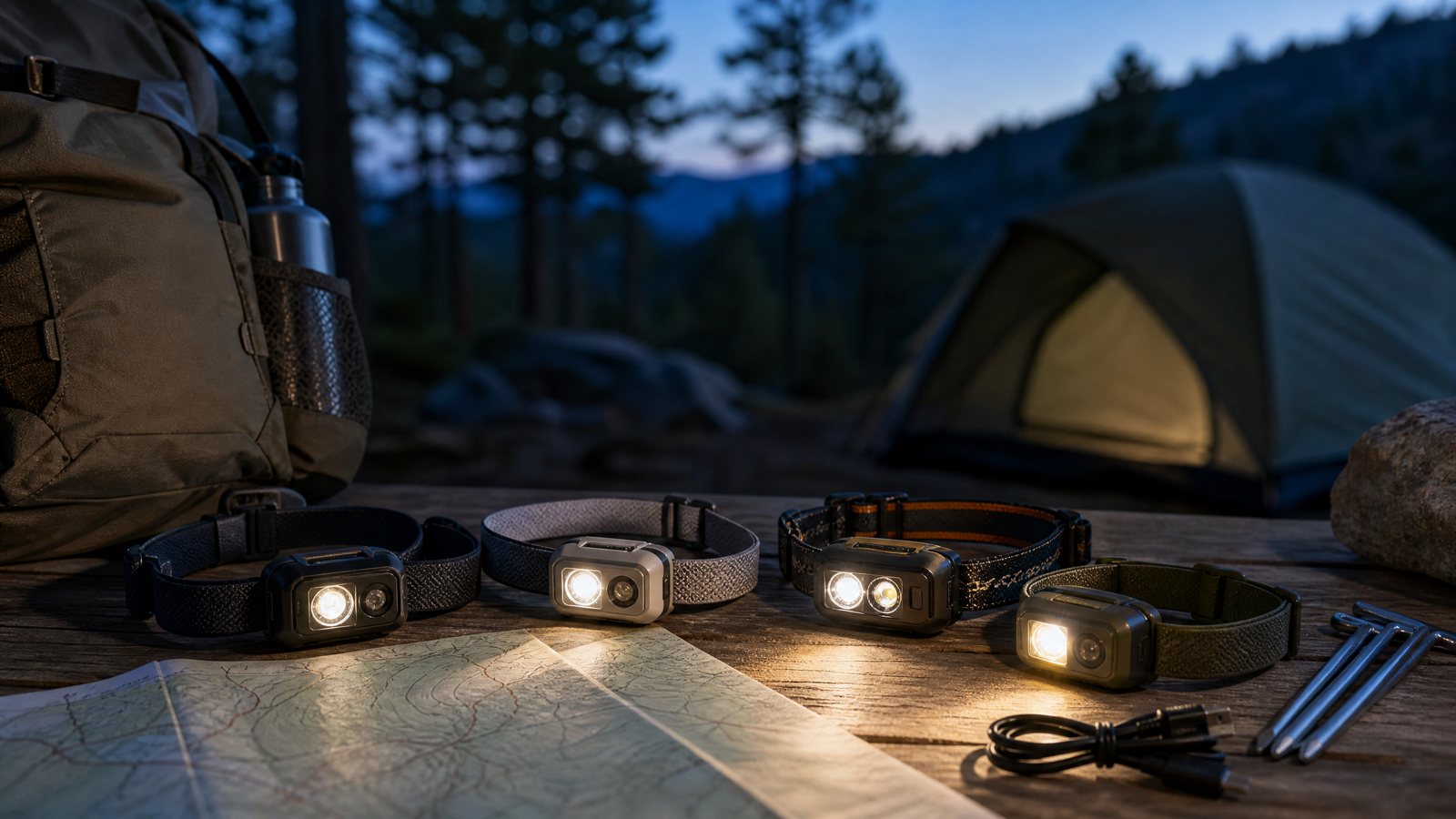
The good news is that modern rechargeable headlamps are brighter, lighter and longer-lasting than they have any right to be at the price. The trap is chasing the biggest lumen number on the box, when the things that actually make a lamp pleasant to live with are runtime, a steady beam, a red mode and a band you forget you are wearing. This guide breaks the field into five types and points you at the one that fits your trips.
Quick Picks
- Best overall: an all-round rechargeable headlamp around 400 lumens with white and red modes.
- Best for long trips: a rechargeable-or-AAA hybrid so a dead battery never strands you.
- Best ultralight: a sub-50-gram rechargeable for gram-counters.
- Best red-light: a lamp with an easy dedicated red mode and a swappable cell.
- Best budget and for kids: a simple, near-indestructible single-LED lamp.

How to Choose a Headlamp
Brightness is measured in lumens, but more is not automatically better. For camp chores, cooking and short walks, 300 to 450 lumens is plenty; only route-finding or moving fast in the dark really calls for 600 and up. The number the box hides is that a bright “turbo” mode often drains the battery in under an hour, while a sensible 100 to 200 lumen setting can run all night. Watch for a regulated lamp too: it holds a steady output through most of the charge, where a cheap one dims from the moment you switch it on.
Power comes down to rechargeable versus disposable. A built-in lithium cell charged over USB-C gives the best run-time for the weight and nothing to buy, but on a long trip away from a charger the smart setup is a hybrid that runs on its rechargeable pack or standard AAAs in a pinch, so a flat battery is a five-second swap rather than a dark walk home.
Then look at the small stuff that decides how much you like it. A red mode preserves your night vision and spares everyone at camp from being blinded; a lockout stops it switching on and cooking its battery in your pack; a tilt hinge aims the beam at your feet or the track; and an IP rating tells you how much rain it shrugs off, with IPX4 fine for showers and IP67 surviving a full dunk. Pick a wide flood for close work and a tighter spot for distance. Have a quick look at the current and most recent options on Amazon for the camping headlamp.
The Headlamps
Check today’s prices on Amazon →
All-round rechargeable headlamp
The do-everything pick, and where most people should start. A lamp like the Black Diamond Spot 400-R gives around 400 lumens with white and red modes, separate spot and flood beams, dimming, a lockout and real water resistance, all in a package light enough to forget on your head. It handles camp tasks and the odd night walk equally well, which is exactly what a single reliable headlamp needs to do. If you buy one lamp and stop thinking about it, make it this type. Have a quick look at the current and most recent options on Amazon for the all-round rechargeable headlamp.
Rechargeable-or-AAA hybrid
The trip-saver. A hybrid such as the Petzl Actik Core runs on its rechargeable pack or three AAAs, so on a long remote trip you carry a set of spares as insurance against a dead battery far from power. It also holds a constant, bright output rather than fading as the charge drops, and the one-button control is easy in the cold. This is the lamp for anyone who wants rechargeable convenience without betting the night on a full battery. Have a quick look at the current and most recent options on Amazon for the rechargeable-or-AAA hybrid headlamp.
Ultralight rechargeable
The featherweight. Something like the Nitecore NU25 packs a 400-lumen output, USB-C charging, white and red modes and a lockout into around 50 grams, which is why long-distance hikers swear by them and campers who hate neck weight love them too. The trade-off is the interface: squeezing that many modes onto one button makes the menu fiddly, so if you want to grab a beam without thinking, this is not your lamp. For pure light-per-gram, though, nothing beats it. Have a quick look at the current and most recent options on Amazon for the ultralight headlamp.
Red-light lamp with a swappable cell
The night-vision specialist. A lamp like the Ledlenser MH5 puts an easy, quick-to-reach red mode front and centre, which matters if you stargaze, get up before dawn, or share a small camp where nobody wants a face full of white light. Its focusable beam and a rechargeable cell that is also a standard swappable size mean you can carry a charged spare and keep going. Solidly built and sensible rather than flashy. Have a quick look at the current and most recent options on Amazon for the red-light headlamp.
Budget single-LED lamp
The cheap, tough spare. A simple lamp like the Petzl Tikkina offers up to about 300 lumens, dead-easy controls and a friendly price, in rechargeable or AAA versions. There is no red mode and no clever beam shaping, but it does the core job well and survives being handed to a six-year-old. Buy one for the kids, one for the glovebox, and one as the backup you will be grateful for when a fancier lamp dies. Have a quick look at the current and most recent options on Amazon for the budget headlamp.
Comparison
| Headlamp type | Output for camp | Power | Red mode | Watch-out |
|---|---|---|---|---|
| All-round rechargeable | ~400 lumens | USB-C built-in | Yes | Nothing major |
| Rechargeable-or-AAA hybrid | ~450 lumens | Pack or AAA | Yes | Slightly heavier |
| Ultralight | ~400 lumens | USB-C built-in | Yes | Fiddly one-button menu |
| Red-light + swap cell | ~400 lumens | Swappable cell | Yes, easy | Bulkier head |
| Budget single-LED | ~300 lumens | AAA or rechargeable | No | No red, basic beam |
Frequently Asked Questions
How many lumens do I actually need for camping?
Less than the marketing suggests. For cooking, camp chores and short walks, 300 to 450 lumens is plenty, and you will spend most of your time on a dimmer setting anyway. Only night-hiking or fast route-finding justifies 600 and up, and running there flattens the battery in a hurry.
Rechargeable or replaceable batteries?
Rechargeable is cheaper to run and more convenient day to day, while replaceable AAAs let you swap in a fresh set the instant the light fades, with no charger needed. For long remote trips a hybrid, or simply carrying a spare set of cells, gives you the best of both.
Why does my headlamp dim as the night goes on?
Because a lot of lamps are unregulated, so the brightness falls steadily as the battery drains. A regulated lamp holds a near-constant output for most of its runtime and only drops off near the end, which is far nicer to use. Look for wording like regulated or constant output.
Do I really need a red light?
You can live without it, but it is genuinely useful. Red light preserves your night vision and does not blind everyone else when you turn your head in a shared camp. Kids’ and budget lamps often skip it, which is one reason to keep a red-capable lamp for yourself.
The Bottom Line
For most campers an all-round rechargeable around 400 lumens, with a red mode and a lockout, is the easy call and the last headlamp decision you need to make. Choose a hybrid for long remote trips, an ultralight if weight rules your pack, and a simple single-LED lamp for the kids. Aim for 300 to 450 lumens rather than the biggest number on the shelf, and keep it somewhere you can lay a hand on it in the dark.
Pair it with our guides to the best camping lanterns, the best camping tents, and our family camping essentials checklist before your next trip.