
This page contains affiliate links. Far Cornel may earn a commission if you buy through them, at no extra cost to you.
See the top-rated shelters on Amazon →
Quick answer: A 3×3 metre steel-framed pop-up gazebo with a 300D or heavier roof is the best all-rounder for camping with a gazebo: fast to raise, strong enough for a typical weekend, and cheap to replace if a storm ever wins. Camp somewhere exposed and a reinforced heavy-duty frame earns its extra weight; travel light and an aluminium canopy or a rigged tarp beats it; battle bugs at dinner and a screen house is the pick. Whichever you choose, the pegs and guy ropes decide whether it survives the trip.
The fastest way to wreck a camp shelter is to trust the frame to hold itself down. A gazebo looks rock-solid on a still afternoon, so it goes up bare — no pegs, no ropes — and everyone gets on with the weekend. Then a gust catches the roof like a sail, a leg folds, and you are chasing a bent canopy across the site in the dark. It nearly always happens at night, and it is nearly always avoidable.
Choosing well starts with being honest about where you camp and what the shelter has to do. Shade on a hot, calm weekend asks almost nothing of a canopy. A windy, exposed site — or a shelter you leave standing for a week — asks a great deal. The numbers printed on the box (fabric denier, a big shade figure, a vague “waterproof” claim) matter far less than frame design and how you anchor it. Below are the five shelters worth your money and the honest trade-offs between them.
Quick Picks
- Best all-rounder: a 3×3 m mid-range steel pop-up gazebo with a 300D+ roof — the value sweet spot for family and car camping.
- Best for exposed, windy sites: a heavy-duty gazebo with thick reinforced trusses and a full peg-and-guy kit.
- Best lightweight and packable: an aluminium-framed canopy for beach days, day trips and weight-conscious setups.
- Best for bugs and evening meals: a screen house with fine mesh walls and a proper zip door.
- Best minimalist and most flexible: a rigged tarp with plenty of reinforced tie-out points and your own poles.

How to Choose a Camping Gazebo or Canopy
Start with the frame, because the frame is what fails. Steel is heavy but stiff and cheap, which is why most family gazebos use it; aluminium is lighter and rust-proof but bends under load and costs more. Look past the marketing at the leg profile and the roof trusses — thicker gauge tube and cross-braced trusses hold their shape when the wind leans on them, while thin round tube crumples. A gazebo that folds in a stiff breeze was let down by its skeleton, not its cover.
Then the roof. Denier (300D, 420D, 600D) measures toughness, not waterproofing: a heavier top resists tearing and sun, but water only runs off if the roof is pitched steeply enough to shed it. Peaked single-skin roofs drain; flat or sagging tops pool water until a leg buckles under the weight, so drop one side or wind a leg up to give it fall. For genuine sun cover, look for a stated UV rating such as UPF 50+ rather than assuming a dark colour blocks the rays.
Finally, be honest about setup and anchoring. A pop-up is standing in two minutes but only earns its keep once you peg and guy every leg; a tarp takes skill and time but flexes to any site. Budget for good anchors from the start — long screw-in or sand pegs for soft ground, steel pegs for hard, and a set of guy ropes for the corners. The anchoring is not an optional extra; it is the line between a shelter and a kite.
The Shelters
Check current gazebo prices on Amazon →
Mid-range pop-up gazebo
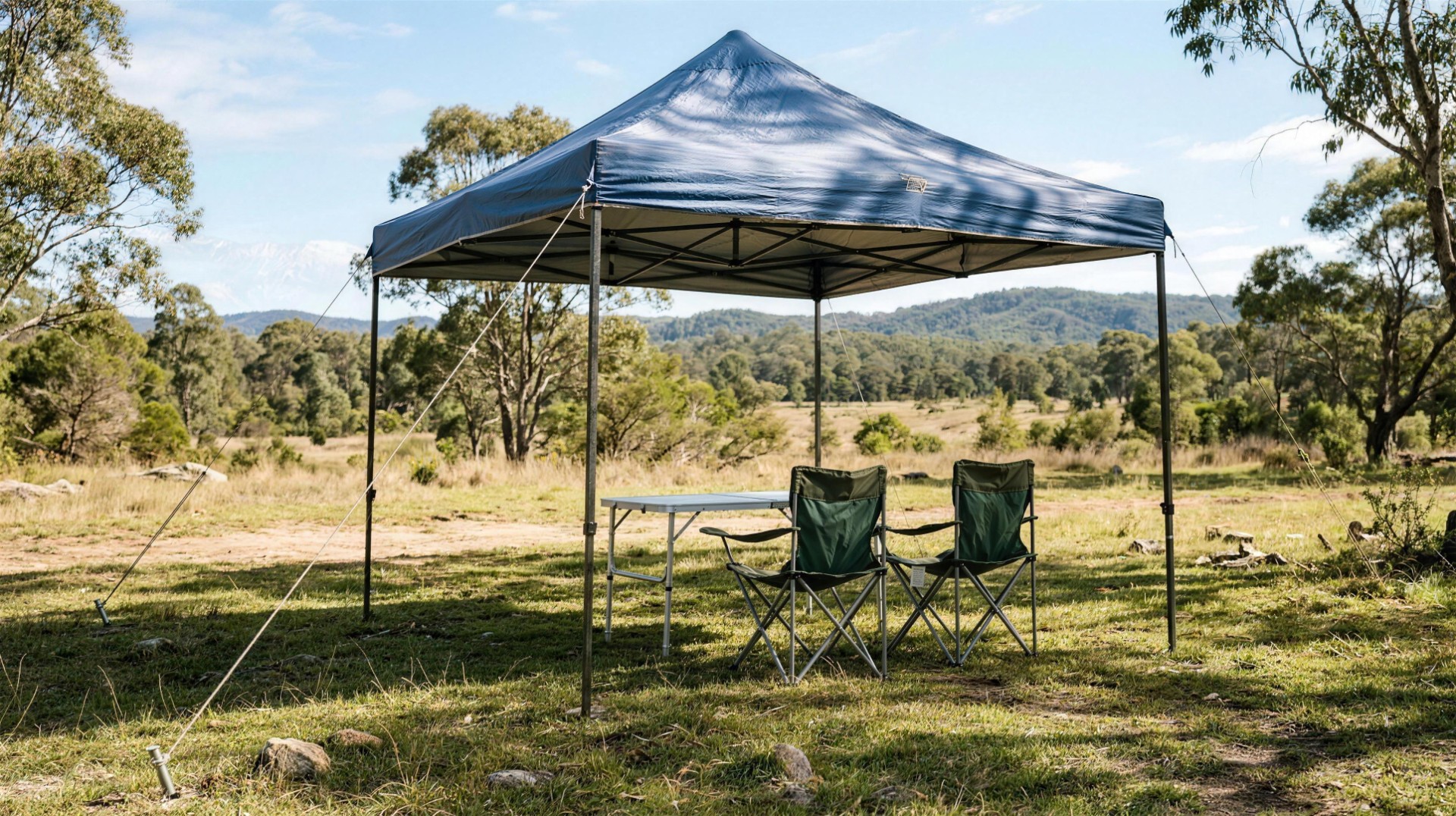
This is the one to buy if you are not sure which one to buy. A 3×3 m steel pop-up with a 300D-plus roof and adjustable-height legs raises in a couple of minutes, throws a generous patch of shade over a table, and costs little enough that a rare write-off does not sting. The catch is honesty about its limits: mid-weight trusses handle a normal breezy afternoon, not a real blow. Don’t buy this one if your usual sites are genuinely exposed — you will bend it and wish you had spent up. For shade over the camp kitchen on ordinary weekends, nothing beats it on value. See what the current 3×3 pop-up gazebos are going for.
Heavy-duty steel gazebo
Step up to a heavy-duty frame when the wind is the enemy. Thicker legs, reinforced truss bars and a heavier, better-tensioned roof shrug off gusts that fold a budget pop-up, and a proper peg-and-guy kit usually comes in the box. You pay for it in weight and pack size — this is a two-person lift and a big bag — so it suits a fixed base camp far more than a mobile, one-night-here trip. If you camp open paddocks, coastal sites or anywhere the forecast turns, the extra kilos buy quiet nights. Price up a reinforced heavy-duty gazebo.
Lightweight aluminium canopy
An aluminium-framed canopy is the pick when every kilo and every centimetre of pack space counts. It is rust-proof, quick to carry to the sand or the sideline, and easy for one person to handle. The trade-off is strength: aluminium bends where steel holds, so treat these as fair-weather shade, not storm shelters, and take them down before a front rather than trusting them to ride it out. For beach days, sports mornings and short trips, the weight saving is worth it. Compare lightweight aluminium canopies.
Screen house
A screen house solves a different problem: dinner eaten in peace while everything with wings stays outside. Fine mesh walls and a zip door keep bugs off without shutting out the breeze, which makes them excellent over a picnic table on still, buggy evenings. They are not built to fight weather — the mesh is not a rainfly and the frames are usually light — so pair one with a real shelter if the sky looks serious. As a bug-proof dining room, though, nothing else comes close. Look at the mesh screen houses on offer.
Tarp and rigged shelter
A tarp is the most flexible shelter there is, and the cheapest and lightest by a wide margin. With a couple of poles, some guy line and a handful of knots you can rig a lean-to against wind, a high roof for airflow, or a low, tight pitch that sheds rain and sun. The price is skill and time: a badly rigged tarp flogs itself to death in an hour, and a good one takes practice. If you enjoy the craft and want one shelter that adapts to any site, it is hard to beat. See the camping tarps worth rigging.
Comparison
| Type | Frame | Wind handling | Packed size | Best for |
|---|---|---|---|---|
| Mid-range pop-up gazebo | Steel, medium gauge | Fair — guy it well | Bulky | All-round family shade |
| Heavy-duty gazebo | Steel, reinforced | Strong | Large and heavy | Exposed, windy base camps |
| Aluminium canopy | Aluminium, light | Low | Compact | Beach and day trips |
| Screen house | Light steel or alloy | Low | Medium | Bug-free dining |
| Tarp shelter | Your poles and lines | Depends on the pitch | Very small | Minimalist, flexible sites |

Frequently Asked Questions
Can I leave a gazebo up overnight?
Only if it is fully pegged and guyed, and even then not in a real blow. Wind works a frame back and forth until a joint fatigues, and the damage usually happens while you sleep. If the forecast turns or the site is exposed, drop the roof or collapse it for the night — two minutes beats a bent frame in the morning.
How much weight or how many pegs do I need per leg?
Peg and guy every leg, not just the two on the windward side — a gust swirls. On soft ground use long screw-in or sand pegs; on hard stands where you cannot drive a peg, add a weight plate or a filled bag to each leg as backup. Weights alone, with no ropes, are the setup that ends up in the next campsite.
Are pop-up gazebos actually waterproof?
The roof will shed rain if it is pitched steeply and the seams are sound, but a gazebo is a shade and shower shelter, not a tent. Watch for water pooling in a sagging top — that is what collapses legs — and re-tension or raise a side so it drains. A PU-coated top with taped seams handles a passing shower comfortably.
What size gazebo suits a family?
A 3×3 m covers a table and a cooking area for a small family and is the easiest size to handle. For bigger groups, or to shelter the whole camp kitchen plus a sitting area, step up to a 3×4.5 m, or run two 3×3 units side by side so you can move one if the sun swings.
The Bottom Line
On an ordinary weekend, a 3×3 m mid-range steel pop-up gazebo with a 300D-plus roof is the shelter that earns its place: fast, roomy enough, and cheap to replace. Camp exposed and the heavy-duty frame is worth its weight; travel light and the aluminium canopy or a rigged tarp wins; eat outdoors in bug season and the screen house pays for itself. None of it matters, though, if you skip the pegs and ropes — anchor whatever you buy and it will outlast the trip.
Shelter is only part of the camp. Once the roof is sorted, our roundup of the best camping gazebos and pop-up canopies covers specific models, the guide to camping tarps and shelters goes deeper on rigging a tarp, and how to choose a camping tent sorts your main sleeping shelter.