
This page contains affiliate links. Far Cornel may earn a commission if you buy through them, at no extra cost to you.
See the top-rated gear on Amazon →
Quick answer: For touring the best pick is a supercapacitor dash cam that survives cabin heat, with clear 1440p or higher video and a wide 140 to 170 degree lens. A single-channel front camera covers most needs; add a rear channel if you tow; a three-channel adds the cabin. Skip battery-based cameras, which swell and fail in a hot parked vehicle. Viofo, BlackVue and Thinkware are the names to know.
A dash cam is the one accessory you forget about until the day you desperately need it. On a long, empty road, an animal steps out at dusk, a truck drifts over a line, or someone reverses into you at a roadhouse, and suddenly a silent, date-stamped witness is worth far more than it cost. It settles insurance arguments, and on the good days it quietly films the best drive of the trip.
The catch for tourers is that most dash cams are built for a cool city commute, not a vehicle that bakes all afternoon and rattles down corrugations. Heat is the real enemy, not resolution. Get the heat tolerance and the sensor right and a mid-priced camera from Viofo, BlackVue or Thinkware will run for years; get seduced by a headline 4K figure on a cheap unit and it will cook itself by the second summer.
Quick Picks
- Best overall: a supercapacitor front camera with a quality 1440p sensor.
- Best for towing: a front-and-rear kit that also watches behind.
- Best for full cover: a three-channel camera that films the cabin too.
- Best for heat: a camera rated for high temperatures, not a battery model.
- Best enabler: a hardwire kit so parking mode runs off the auxiliary battery.

How to Choose a Touring Dash Cam
Start with heat, because it is what kills dash cams. A parked cabin can pass 70 degrees, and a camera with a lithium battery can swell, shut down or worse in that environment. Buy a model that uses a supercapacitor instead: it tolerates high temperatures and is the only sensible choice for a vehicle that sits in the sun. This single spec matters more than any other, and it is where cheap cameras cut the corner you will feel.
Then chase clarity, not megapixels. You want to read a number plate and a road sign, so 1080p is the floor and 1440p is the sweet spot, ideally on a good sensor such as the Sony STARVIS range that pulls detail out of dawn and dusk. Here is the myth to bust: a headline 4K figure on a cheap unit is often worse than sharp 1440p on a quality sensor, because the lens and processing cannot keep up. A wide 140 to 170 degree lens catches what happens off to the side.
Finally, sort storage and parking mode. Loop recording hammers a card, so use a high-endurance microSD of at least 128GB, not the cheap one from the drawer that fails in a month. If you want the camera watching while you are parked, plan a hardwire kit run off your auxiliary battery rather than the cranking battery, so an overnight recording session never leaves you unable to start. GPS and app connectivity are useful extras, not essentials.
Two things sink more touring dash cams than picture quality ever does. The first is the memory card: a dash cam overwrites its own footage all day, so a standard microSD corrupts within months and hands you nothing on the day you need it — fit a high-endurance card rated for continuous recording and reformat it every so often. The second is power. Parking mode only works off a hardwire kit, and that kit needs a voltage cut-off (or a feed from the auxiliary battery rather than the starter) or a few nights parked up will flatten the very battery you need to get home. And read the bitrate, not just the headline resolution — a well-fed 1440p reads number plates better than a starved “4K”.
The Dash Cams
Check today’s prices on Amazon →
Single-channel front dash cam
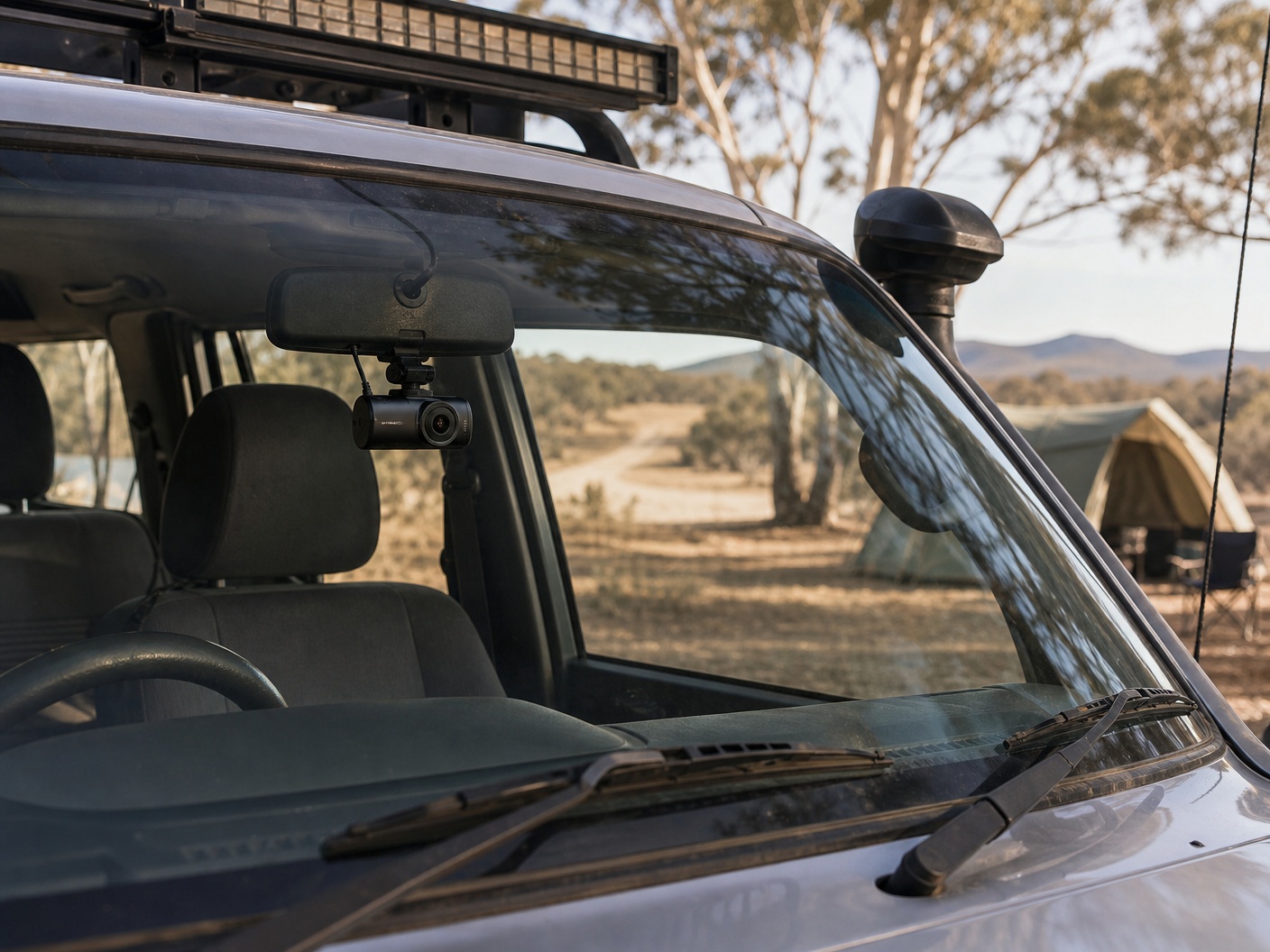
A good single-channel front camera is all most tourers need, and it keeps the install clean and the cost sensible. A supercapacitor unit from Viofo or Thinkware with a sharp 1440p sensor covers the incidents that matter most, the ones happening ahead of you, and sips storage compared with a multi-camera rig. It is the easiest to hide behind the mirror and the least to go wrong. Start here unless you specifically need to see behind or inside. Find the right single-channel front cam
Front-and-rear dash cam
The moment you tow a van or a trailer, or spend time in traffic, a rear channel earns its place. A front-and-rear kit records what happens behind as well as ahead, which is exactly the evidence you want after a nose-to-tail or a careless overtake. The catch is the install: you run a thin cable the length of the vehicle to a second camera on the rear glass, which takes patience. For anyone hauling something, it is the setup I would choose. Price up a front-and-rear kit
Three-channel dash cam
A three-channel camera adds an interior lens to the front and rear pair, filming the cabin as well as the road. It is overkill for a private touring vehicle, but genuinely useful if you carry passengers you want a record of, or leave the vehicle loaded and want eyes inside. The trade-offs are real: the highest cost, the fiddliest install and the biggest files to manage, so only step up if you actually need the cabin view rather than buying it for the spec sheet. See current three-channel cam prices
High-heat supercapacitor dash cam
If you buy for one thing, buy for heat tolerance, and that means a supercapacitor rather than a battery. These models are built to sit in a scorching cabin and keep recording without the swelling and shutdowns that plague cheap battery units, which is why the serious names like Viofo and BlackVue use them. You give up the ability to record for long after the ignition is off without a power source, but for a vehicle that lives in the sun it is the only reliable choice. Don’t buy a battery-based camera for touring. Compare supercapacitor dash cams
Hardwire kit for parking mode
Parking mode is what lets the camera catch a hit-and-run at a roadhouse or a scrape at a caravan park, and it needs constant power to work. A hardwire kit taps the camera into the vehicle’s wiring, ideally off the auxiliary battery so an all-night recording never flattens your cranking battery. The better kits include a voltage cut-off to protect the battery. It is a cheap add-on that turns a driving camera into a full-time guard, and it tidies away the dangling cigarette-socket lead too. Check the latest hardwire kits

Comparison
| Setup | Coverage | Best for | Watch-out |
|---|---|---|---|
| Single-channel | Front only | Most tourers, simple installs | Nothing behind or inside |
| Front-and-rear | Front and rear | Towing and traffic | Long cable run to fit |
| Three-channel | Front, rear, cabin | Passengers, loaded vehicles | Costly, big files |
| Supercapacitor | Any of the above | Hot cabins, touring | Limited off-power recording |
Frequently Asked Questions
Single, front-and-rear, or three-channel?
A single front camera covers most needs and is the easiest to live with. Add a rear channel if you tow a van or trailer or spend time in traffic, since that is where rear evidence pays off. A three-channel with a cabin lens is worth it mainly if you carry passengers or want eyes inside a loaded vehicle.
Why does heat matter so much?
A parked cabin can exceed 70 degrees, and a lithium battery inside a cheap camera can swell and fail at those temperatures. A supercapacitor model is built to cope with the heat, which is why it is the only sensible choice for touring. Pair it with a high-endurance memory card, since heat and constant recording kill ordinary cards fast.
What resolution do I actually need?
1080p is the minimum to read a number plate, and 1440p on a good sensor is the sweet spot for touring. Do not assume a bigger number is always better: a cheap 4K camera with a weak lens and processor often looks worse than a sharp 1440p unit. Night performance and a wide lens matter as much as the pixel count.
Do I need to hardwire it?
Only if you want parking mode to record while the vehicle is off. For normal driving, the socket lead is fine. If you do hardwire it, run the feed from your auxiliary battery with a voltage cut-off so an overnight session never leaves you unable to start in the morning.
The Bottom Line
Buy a touring dash cam for heat tolerance and clarity, not for a headline resolution. A supercapacitor front camera with a quality 1440p sensor, a wide lens and a high-endurance card is the right core on most vehicles, from names like Viofo, BlackVue or Thinkware. Add a rear channel if you tow, step up to a cabin lens only if you truly need it, and hardwire off the auxiliary battery for parking mode. Keep it simple, keep it reliable, and let it run quietly in the background.
For the rest of your setup, see our guides to GPS navigators, caravan reversing cameras, folding solar panel kits and portable power stations.
Compare your options on Amazon →
For the rest of the touring setup, see our guides to the best caravan reversing cameras, the best GPS navigators for remote touring, and the best UHF radios for 4WD touring.