
This page contains affiliate links. Far Cornel may earn a commission if you buy through them, at no extra cost to you.
See the fish attractant range on Amazon →
Quick answer: An amino-based gel — Pro-Cure Super Gel or Squidgies S-Factor style — is the one to buy if you fish soft plastics: it clings through a dozen casts and buys you the extra beat while a fish decides whether to swallow or spit. Sprays suit natural bait, pre-scented plastics suit slow fishing, oils rescue frozen bait. Skip scent altogether if you burn metal lures back at speed — the fish never holds one long enough for taste to matter.
Most of the bites you miss, you never even feel. A bream picks up your plastic, holds it for half a second, registers something wrong — polymer, sunscreen, the fuel you pumped an hour ago — and blows it back out before the tap ever reaches your rod tip. That half-second is the entire case for fish attractant. Not the label promising to pull fish in from the next postcode. Just a slightly longer hold, often enough for a tap to become weight.
So this guide treats scent honestly: as a conversion tool, not a summoning spell. Fish taste and smell dissolved compounds in concentrations down to parts per billion, which cuts both ways — the right amino profile reads as food, and the wrong chemical reads as a warning. Below are the five types worth owning, what each does well, and the situations where the bottle stays in the tackle bag.
Quick Picks
- Best all-round: Amino-based gel attractant — a pea-sized smear survives cast after cast on a soft plastic.
- Best for natural bait: Scent spray — fast recharge for strip baits and tired frozen prawns.
- Best heavy cling: Dip pot or thick paste — maximum coating for jigs and vibes fished slow.
- Best set-and-forget: Pre-scented soft plastics — the lure itself is the scent delivery.
- Best bait booster: Bait oil — brings freezer-burnt bait back to life and thickens a trail.

How to Choose a Fish Attractant
Start with the base, because it decides how the scent behaves. Water-based formulas disperse quickly and feel natural in a fish’s mouth, but they rinse off hard surfaces within a couple of casts and need constant topping up. Oil-based formulas do the opposite: they cling to a lure for a long stretch and keep working, but overdo it and you leave a slick on the surface while the excess sheds off in globs. Gels split the difference — most of the serious ones suspend real ground bait or amino concentrate in a sticky carrier that stays put without slicking.
Then match the profile to what your target actually eats. Bottom feeders that grub for prawns and crabs respond to crustacean profiles; pelagics keyed on baitfish respond to pilchard and fish-oil profiles. A generalist blend covers you when you fish mixed water, but if you chase one species most weekends, buy the profile that matches its diet rather than the bottle with the loudest label. And keep your expectations calibrated: scent does not make a fish cross a bay, and it will not rescue the wrong lure at the wrong depth on the wrong retrieve. What it reliably does is convert — the fish that would have mouthed and rejected your plastic holds it that little bit longer.
The last factor is you. Sunscreen, insect repellent and fuel are all detectable at concentrations fish can taste, and DEET is a solvent aggressive enough to visibly soften some soft plastics. If you have just sprayed repellent, whatever you rig next carries it. Wipe your hands, rig the lure, then apply scent last — in that order, every time. Half of what a good attractant does is simply cover the chemicals you brought with you.
The Attractants
Compare attractant prices on Amazon →
Amino-Based Gel Attractants
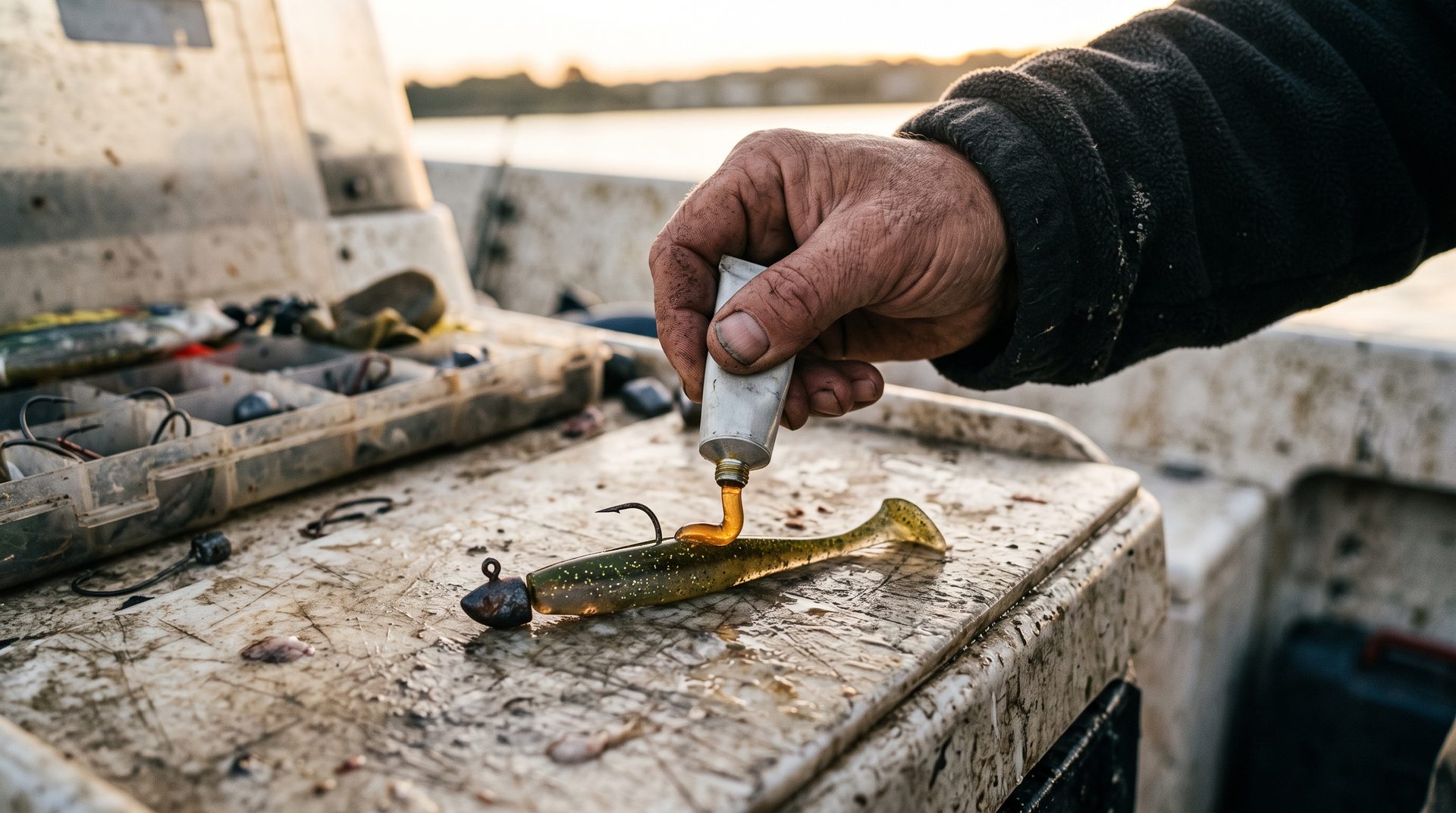
This is the default buy, and the reason is purely mechanical: viscosity. A gel like Pro-Cure’s Super Gel range — which grinds actual bait into the mix — or the S-Factor style pastes hangs onto a soft plastic through a dozen casts, so the scent is still working at the exact moment a fish closes its mouth on the tail. That is the moment that matters. A smear the size of a pea along the belly of the plastic is plenty; painting the whole lure just feeds the water.
Profiles matter more with gels than any other type because they last long enough to be tasted properly. Crustacean and prawn blends are the pick for flathead, bream and anything that roots around the bottom; mullet, pilchard and garfish profiles suit the fish that chase. If you only buy one tube, buy the crustacean blend — more of the fish most of us actually catch eat crab and prawn than anything else. Compare the amino gel tubes and profile options on Amazon
Scent Sprays
Sprays are the fastest way to cover a lot of surface, and the worst at staying there. On a hard-body or a metal, a water-based spray is mostly gone by the third cast — which is why the honest use for a spray bottle is natural bait. A few pumps over a tray of strip baits or a packet of thawed prawns restores the oily smell that freezing flattened, and porous bait actually absorbs the scent instead of shedding it. They are also the right tool for re-charging pre-scented plastics that have dried out mid-session.
Do not make a spray your only scent if you fish plastics — you will be re-applying every few casts and wondering why the tube-of-gel crowd catches more. As a bait-station bottle, though, it earns its spot in the tray. Scan the scent spray range and pick a profile
Dip Pots and Thick Pastes
When you fish slow — soft vibes hopped along the bottom, jigs left to soak, plastics dead-sticked in current — a dip pot puts on the heaviest coat available. The whole rigged lure goes into the pot and comes out wearing a layer that outlasts anything a spray or light gel manages. Slow presentations give fish the longest look, so they are exactly where maximum scent pays off.
Two cautions. Thick paste can deaden the action of fine-tailed plastics — a paddle-tail relies on a thin, flexible tail beat, and a heavy coat stiffens it — so dip the body and keep the tail mostly clean. And the pot lives up to its reputation for mess: keep it bagged, or everything in that tray pocket smells like the pot forever. Poke through the dip pots and paste attractants
Pre-Scented Soft Plastics
Berkley’s Gulp range built an entire category on a simple idea: make the lure out of the scent. Water-based, biodegradable material impregnated with attractant releases scent constantly, no application required, and it is the closest a lure gets to being bait. For slow fishing — and for anyone who wants one less thing to remember — pre-scented plastics are genuinely hard to beat, and they out-fish unscented plastics most obviously when the bite is shut down and fish are inspecting everything.
The trade-offs are real, though. Out of the tub on a hot day they dry to jerky in minutes, so the packet juice is not packaging — it is life support. They are also softer than standard PVC plastics, which costs you durability by the fish. Treat them as semi-consumable, store them in their own liquid, and never loose in a tray with your other plastics. Check the tub sizes on pre-scented plastics before you commit
Bait Oils and Boosters
Bait oil is the unglamorous workhorse of the scent shelf. Tuna oil and similar fish-oil blends have one honest job: making average bait smell like good bait. A splash over a bag of supermarket-freezer pilchards before they thaw puts back the oil that months in a freezer stripped out, and a soaked handful of chopped bait turns a thin trail into a proper one — the same logic that drives a berley pot, in bottle form.
It will not make old, mushy bait fish like fresh, though — texture still wins. Buy it to rescue decent frozen bait and to enrich a trail, not to disguise bait past saving. A little goes a long way — oil floats, and a heavy pour ends up on the surface instead of in the water column where the fish are. See what a bottle of tuna oil goes for these days
Comparison
| Type | How it applies | How long it lasts | Where it shines | Where it’s wasted |
|---|---|---|---|---|
| Amino gel | Pea-sized smear on the lure | A dozen casts or more | Soft plastics fished normally | Fast metals and surface speed |
| Scent spray | Pump bottle, several passes | A few casts on hard surfaces | Natural bait and re-charging | As your only lure scent |
| Dip pot / paste | Dunk the rigged lure | Longest of the add-ons | Slow-fished vibes, jigs, dead-sticking | Fine-tailed plastics (kills action) |
| Pre-scented plastics | None — built in | Constant while wet | Shut-down bites, slow fishing | Anglers needing tough, re-usable lures |
| Bait oil | Splash over bait or trail mix | Session-long on soaked bait | Reviving frozen bait, enriching a trail | Disguising genuinely spoiled bait |

Frequently Asked Questions
Do fish attractants actually work, or is it marketing?
Both exist in the same bottle. The marketing version — scent pulling fish in from far away — is not how it plays out on the water. The real, observable effect is hold time: fish keep a scented lure in their mouth longer before rejecting it, which converts missed taps into hookups, and scent masks the human chemicals that cause instant rejections. That is a modest claim, and it is the one that survives contact with actual fishing.
Should I buy oil-based or water-based?
Water-based disperses fast, feels natural and needs frequent re-application — it suits porous baits and pre-scented plastics. Oil-based clings for a long time and suits hard lures and slow fishing, but it is easy to over-apply and it floats if you do. If the choice is one tube, an amino gel gives you most of the cling without the slick.
Will scent make fish bite a lure they’re ignoring?
Almost never. If fish are following and turning away, the problem is the lure, the depth or the retrieve — fix those first. Scent earns its keep after the fish has already committed to a bite, by extending the hold and covering off-flavours. It is the last percent, not the first.
Is one scent fine for every species?
A generalist amino blend works broadly, because most feeding responses key on similar amino acids. You gain an edge matching the profile where fish feed selectively — crustacean blends for bottom feeders, baitfish oils for pelagics. One crustacean gel plus one fish-oil spray covers almost every situation without a shelf of bottles.
Does sunscreen or insect repellent on my hands really matter?
More than most anglers accept. Fish detect dissolved compounds at parts-per-billion concentrations, and repellent, sunscreen and fuel all register. DEET will even soften some soft plastics on contact — a solvent doing visible damage to your lure is certainly leaving a taste on it. Wipe your hands before rigging, and apply scent as the final step.
The Bottom Line
A tube of crustacean-profile amino gel is the best-value item in the lure bag: it works at the only moment scent can work, and it covers the contamination you did not know you were adding. Add a fish-oil spray if you fish natural bait, a dip pot if you fish genuinely slow, and a bottle of tuna oil for the freezer stock. Just buy them for the right reason — a longer hold on the fish already eating, not a shortcut to finding them.
Soft plastics and scent are a natural pair — our soft plastic lure kits guide covers the lures themselves and our jig heads guide covers rigging them right. For scent’s big brother — laying a whole trail — see the berley pots guide.