
This page contains affiliate links. Far Cornel may earn a commission if you buy through them, at no extra cost to you.
See the top-rated gear on Amazon →
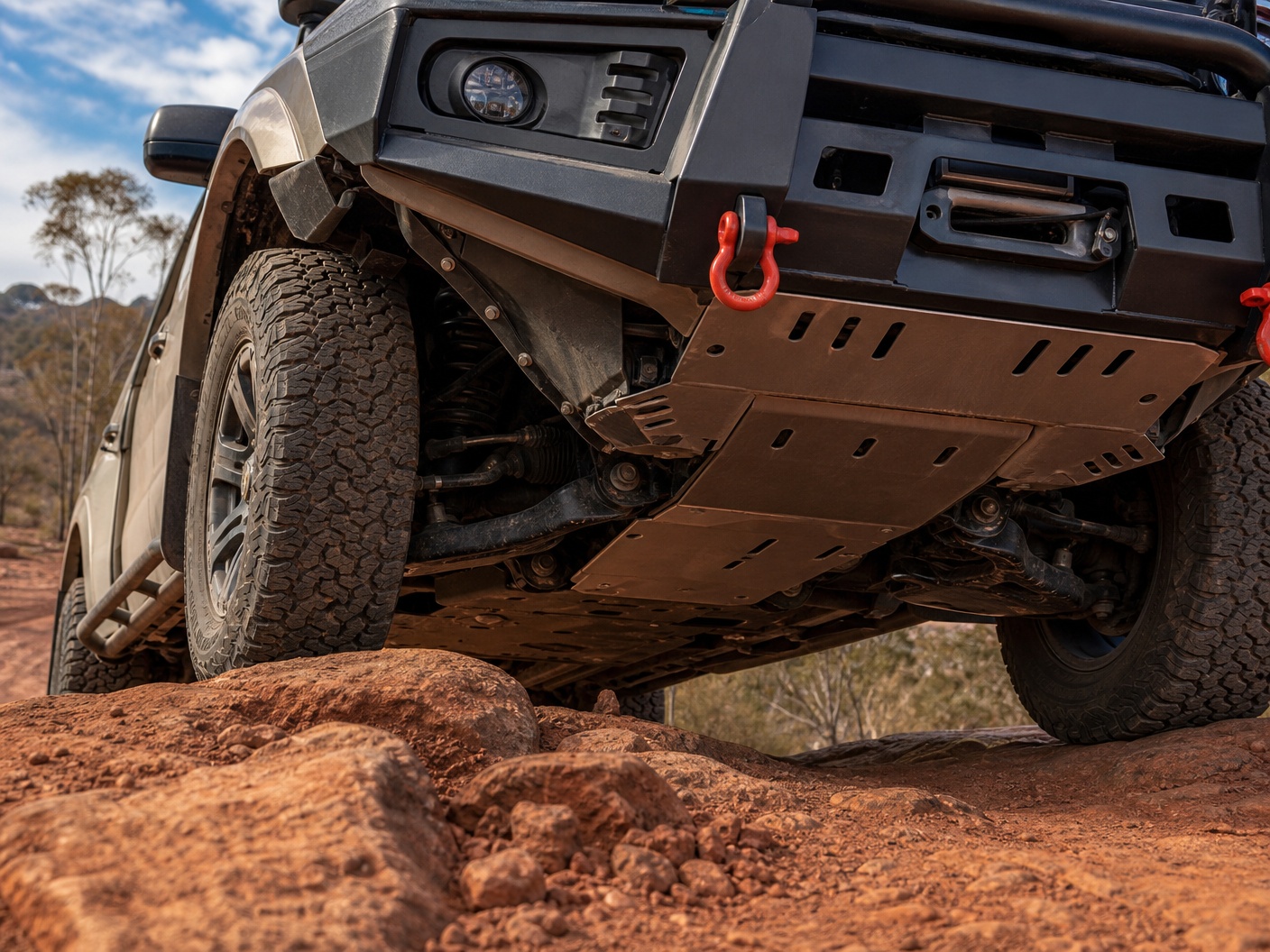
Quick answer: For serious tracks you need two things: bash plates to shield the sump, transmission and fuel tank, and rated recovery points bolted to the chassis. Steel plates suit hard rock work, aluminium saves weight for general touring, and a full plate set covers the lot. Fit rated recovery points from ARB, Roadsafe or Superior Engineering with their high-tensile bolts, and never snatch off a factory tie-down.
The underside of a four-wheel drive is where the expensive, fragile parts live, the sump, transmission, transfer case and fuel tank, and it is exactly what a hidden rock finds when you drop into a rut. One sharp strike can hole a sump and end a trip. Bash plates turn that strike into a scrape and a slide instead of a repair bill and a long wait.
The other half of the job is getting unstuck safely, and that is where rated recovery points matter. The single most dangerous myth in four-wheel driving is that the little loops under your bumper are recovery points. They are almost always transport tie-downs, never engineered for the shock load of a snatch, and they can tear off and fly. Get the protection and the recovery points right together and you can tackle rough country knowing both the vehicle and the recovery are covered.
Quick Picks
- Best for rock work: heavy steel bash plates for repeated hard hits.
- Best for touring weight: aluminium bash plates that shed kilograms.
- Best full cover: a multi-plate set guarding sump to transfer case.
- Best safety fix: rated front recovery points bolted to the chassis.
- Best finishing piece: high-tensile mounting hardware and a rated shackle.

How to Choose Underbody Protection and Recovery Points
The first choice is steel or aluminium bash plates, and it comes down to how hard you drive and how much weight you can spare. Steel is toughest and cheapest, shrugging off repeated heavy hits and taking a hammer or a weld to straighten in the field, but it is heavy and eats into a tight payload. Aluminium weighs roughly half as much and resists corrosion, which suits general touring and salty air, but it gouges under sharp impacts and is hard to repair. Look for at least 3 to 4 mm of steel or 6 to 8 mm of aluminium.
Whatever the material, buy plates cut for your exact make and model. Laser-cut plates that use the factory mounting holes fit properly and protect fully, while universal plates leave gaps and often need drilling you should avoid. Don’t buy a generic plate to save a few dollars on a vehicle worth thousands.
Recovery points are safety gear, so treat them like it. Fit rated points with a stamped working load limit that comfortably exceeds your loaded weight, bolted to the strongest part of the chassis with the high-tensile hardware supplied, never hardware-store bolts. Use them in pairs with an equaliser strap so the load spreads across both sides rather than twisting the chassis. Names like ARB, Roadsafe and Superior Engineering make points tested for exactly this, and the bolts they include are part of the rating.
The single most dangerous mistake in vehicle recovery is trusting a factory tie-down point. Those little slotted tabs on the chassis are lashing eyes for strapping a vehicle onto a transport truck — they are not rated for the shock load of a snatch, and when one tears loose under load it becomes a lump of steel flying at head height. A rated recovery point is a different animal: forged or thick laser-cut plate, engineered and marked with a working load limit, and bolted to the chassis rail with high-tensile bolts torqued to the maker’s spec. Fit them in pairs, use the exact grade of bolt specified, and re-check the torque after the first few hard trips.
Match the rest of the system to the point. Run a rated bow shackle or a soft shackle whose minimum breaking strength comfortably exceeds your strap — never a hardware-store D-shackle — and lay a heavy damper over any strap or winch line under tension so a failure drops rather than flies. On the protection side the trade-off is simple: steel bash plates take the worst rock hits and can be tapped straight again but add weight low and forward, while aluminium saves kilos and sheds mud yet dents deeper on a sharp ledge. Pick steel for hard rock work and aluminium for long touring where every kilo of fuel range counts, and leave the drain holes clear so the plates do not turn into trays that trap water and mud against the sump.
The Underbody Protection and Recovery Points
Check today’s prices on Amazon →
Steel bash plates
If you drag your belly over rock and stumps, steel is the material that takes it. A 3 to 4 mm steel plate from Ironman 4×4 or Rhino 4×4 absorbs repeated hits without tearing, slides over obstacles, and can be hammered or welded back into shape on a trip. The cost is weight, often 20 to 30 kilograms once you plate the sump, transmission and transfer case. Watch the powder coating, since a chip lets rust start. For hard-core work, steel wins. See what the steel bash plates cost
Aluminium bash plates
For general touring where every kilogram matters, aluminium bash plates are the smart trade. Weighing roughly half what steel does, they claw back payload for water, fuel and gear, and they resist corrosion in salty air far better, so they suit vehicles that see sand and damp more than boulders. The honest limit is that a sharp impact can gouge or tear them, and repair usually means replacement. Choose 6 to 8 mm thickness. Don’t buy aluminium if your idea of a track is a rock garden. Compare the lighter aluminium bash plates
Full underbody protection set
A single sump guard is a start, but a full multi-plate set is what actually protects a vehicle for remote travel, shielding the sump, transmission, transfer case and fuel tank as one continuous underbelly. Bought as a matched set for your model, the plates overlap cleanly and share mounts, which a piecemeal collection never quite manages. It is the dearest and heaviest option and overkill for graded dirt roads, but for genuinely rough country it is the difference between a scrape and a recovery. Factor the total weight into your build. Look at the full underbody protection sets
Rated front recovery points
This is the upgrade I would fit before any snatch strap sees use. A rated recovery point is a thick plate-steel bracket bolted to the chassis and destructively tested to survive the dynamic load a snatch throws at it, unlike the factory tie-down loop it replaces. Fit them in pairs so you can bridle the load across both sides with an equaliser strap, and check the stamped working load limit clears your loaded weight with margin. ARB, Roadsafe and Superior Engineering all make model-specific points. Skip this and every recovery is a gamble. Check the rated front recovery points
Mounting hardware and rated shackle
The recovery point is only as strong as the bolts holding it on, so use the high-tensile hardware supplied and torque it to spec, never a substitute from the hardware store. A thread-locking compound keeps critical bolts from vibrating loose on endless corrugations. Finish the job with a rated shackle or soft shackle to connect the strap, since the point, the bolts and the shackle all have to be rated for the same chain to be safe. It is the cheap detail that makes the expensive parts trustworthy. Weigh up the mounting hardware and rated shackles

Comparison
| Feature | Steel bash plates | Aluminium bash plates |
|---|---|---|
| Toughness | Takes repeated heavy hits | Strong, but gouges on sharp impacts |
| Weight | Heavy, eats payload | About half the weight |
| Corrosion | Rusts where coating chips | Naturally resists rust |
| Repair | Hammer or weld in the field | Usually needs replacing |
Frequently Asked Questions
Do I need bash plates and rated recovery points?
If your trips go beyond a graded dirt road, yes to both. Bash plates protect the sump, transmission and fuel tank from rocks and stumps, while rated recovery points let you be snatched or winched out safely. They cover two different failure points, so most people fit them together as core off-road safety.
Are factory tie-down points safe to recover from?
Usually not. The loops under many bumpers are transport tie-downs, meant to hold the vehicle still on a truck, not to take the shock of a snatch. Under a real recovery load they can bend or tear off and become a projectile. Fit proper rated recovery points before you rely on anything to snatch from.
Steel or aluminium bash plates?
Steel is toughest and cheapest but heavy, which suits rock crawling and hard-core use. Aluminium saves roughly half the weight and resists corrosion, which suits general touring where payload is tight. Choose on how hard you go off-road and how much weight you can spare, and match the thickness to the material.
How thick should the plates be?
As a guide, look for at least 3 to 4 mm of steel or 6 to 8 mm of aluminium to give real impact resistance. Thinner than that and a plate can deform into the part it is meant to protect. More important than chasing thickness is a model-specific fit that uses the factory mounts and covers the vulnerable parts fully.
The Bottom Line
Underbody protection and rated recovery points are among the smartest upgrades for a touring rig, because one saves your expensive driveline from a hidden rock and the other saves a recovery from turning dangerous. Choose steel for hard rock work and aluminium for weight-conscious touring, step up to a full plate set for remote country, and fit rated recovery points in pairs with their high-tensile bolts. Never trust a factory tie-down for a snatch, and torque everything to spec.
For the rest of your recovery kit, see our guides to traction boards, soft shackles and our recovery gear checklist.