
This page contains affiliate links. Far Cornel may earn a commission if you buy through them, at no extra cost to you.
See the top-rated gear on Amazon →
Quick answer: For car camping, a mid-weight poly tarp with plenty of reinforced tie-outs is the practical, affordable pick for shade and rain. Drop to a silnylon tarp if you hike or hang a hammock and count grams, step up to a taped-seam ripstop for serious weather, and grab a freestanding pop-up if you want shade with no rope or poles at all. Buy a size up from what you think you need.
A tarp is the most versatile thing in a camp kit. Rig it one way for shade over the kitchen, another for rain cover across the tent door, pitch it low as a windbreak, or string it over a hammock as a fly. One sheet of fabric and some rope does the lot, and for the money it is the cheapest way to make a site genuinely liveable when the sun or the weather turns on you.
The mistake is treating every tarp as the same cheap blue sheet. They are not. The material decides the weight and the lifespan, and the humble tie-out points decide whether it survives its first windy night or tears itself off the guy lines. This guide breaks tarps into five types and steers you to the one that fits your camp.
Quick Picks
- Best overall: a mid-weight poly tarp with reinforced edge and centre tie-outs.
- Best value: a budget polyester tarp with plenty of loops for flexible pitching.
- Best lightweight: a silnylon tarp for hiking and hammock flies.
- Best heavy-duty: a taped-seam ripstop tarp for serious, sustained rain.
- Best easy shade: a freestanding pop-up shelter with no rope or poles.

How to Choose a Camping Tarp
Start with the material, because it drives weight, durability and price. Poly, or polyethylene, tarps are cheap, fully waterproof and tough enough for car camping, but heavy and bulky to pack. Ripstop nylon and silnylon tarps are far lighter and stuff down tiny, shedding water through a coating, which is why hikers and hammockers choose them. Canvas and poly-cotton tarps are heavy and dear but breathable and extremely hard-wearing, ideal as a long-stay shade sail.
Then match the size to the job and respect the tie-outs. A 3 by 3 metre tarp shades a small kitchen or sleeping area, while 4 by 4 and up covers a group camp, and a bigger sheet catches more wind, so it needs more guy lines and firmer pegging. The part that fails first is almost always the tie-out points, so look for plenty of reinforced grommets or loops around the edges and in the middle. Well-stitched, generous attachment points mean more ways to pitch it and a much longer life.
Finally, think about waterproofing and how you will rig it. Check for a decent hydrostatic head rating or a quality coating if you are relying on it for rain, and remember most tarps need poles and guy ropes, though some kits include the poles. Pack adjustable poles, quality cord and decent pegs, and learn a few configurations, such as a flat fly, a lean-to and an A-frame, which between them cover most situations. Do not buy a heavy poly tarp if you are carrying it on your back; that is what silnylon is for.
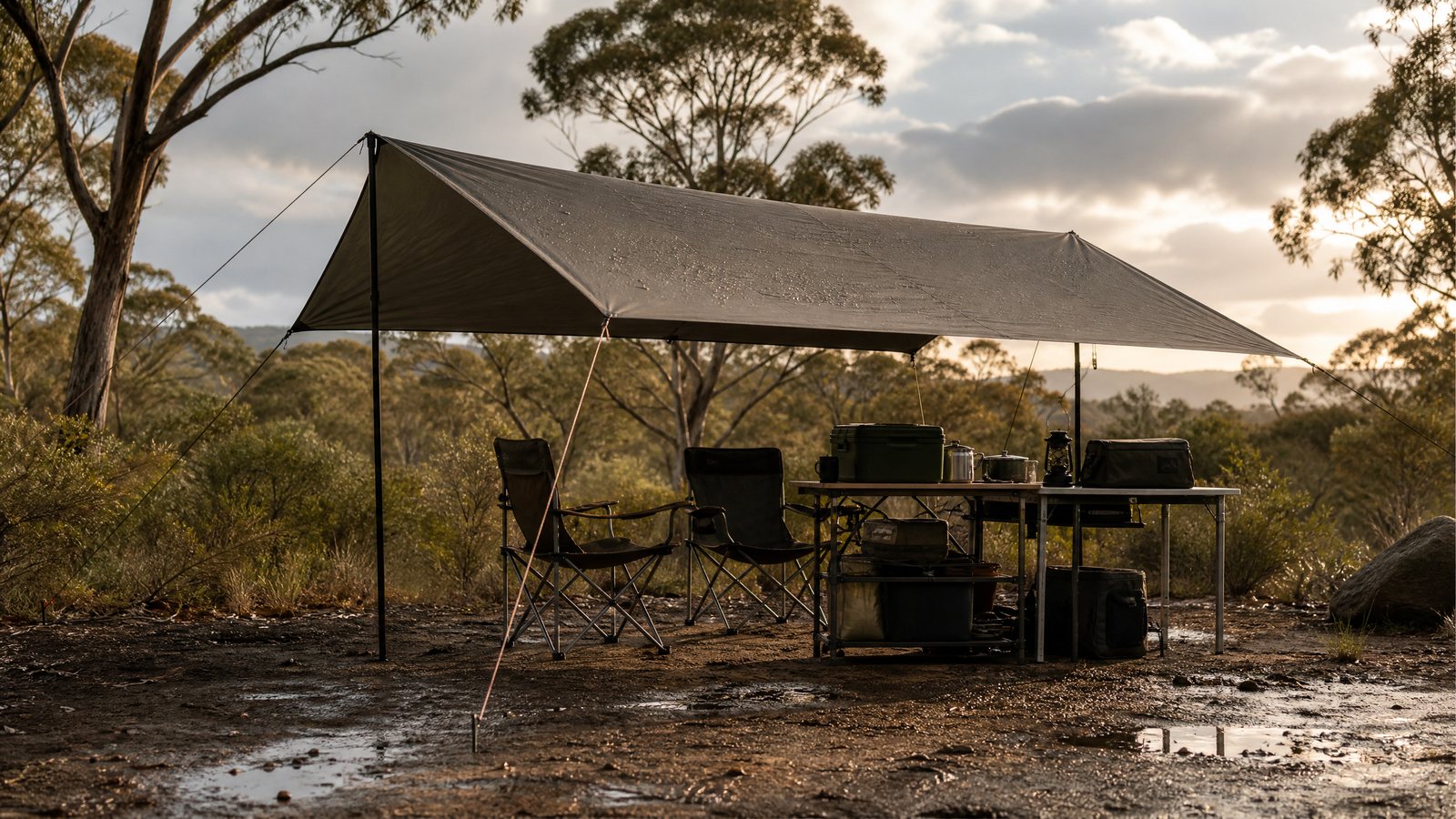
One more thing decides whether a tarp shrugs off weather or collapses in it, and it is not the tarp — it is the pitch. Give it a taut ridgeline and a real slope so rain runs off instead of pooling in a belly that eventually lets go; a flat pitch is what fails in a downpour. Use adjustable line tensioners or a taut-line hitch on every guy, because cord stretches overnight and soaks slack in the wet, and drop the low edge into the wind so gusts spill over the top rather than lifting the tarp like a sail. Pack a couple of spare guy lines and decent pegs — the fabric almost never fails first, the rigging does.
The Tarps
Check today’s prices on Amazon →
All-round poly tarp
The dependable default. Poly tarps like the Oztrail range come in a wide spread of sizes with reinforced edges and multiple tie-down points, fully waterproof and tough enough to live in the back of a touring setup trip after trip. There is nothing clever going on, and that is the appeal: it costs little, shrugs off rough handling, and does the two jobs a camp tarp is for. It is the tarp to own first. See what a solid all-round poly tarp costs.
Budget polyester tarp
The cheap and cheerful pick. A polyester tarp such as the Adventure Kings range keeps the price down while still giving you plenty of reinforced loops for flexible pitching, sized to shade a camp kitchen or a sleeping area. It is not as bombproof as a heavy poly or a taped-seam tarp, but for a first tarp or a spare to throw in the car it is honest value. Just check the loops are properly stitched, since that is where the cheapest tarps give up. Price up a budget polyester tarp for the car.
Ultralight silnylon tarp
The gram-counter’s choice. A silnylon tarp like the Sea to Summit Escapist packs down to almost nothing and weighs very little, with multiple tie-out points for rigging as a hiking shelter or a hammock fly. It sheds water through its coating rather than being a solid waterproof sheet, so it is made for weight-saving rather than a week of parked-up shade. If you hike, bikepack or hang a hammock, this is the tarp that will not punish your back. Weigh up the ultralight silnylon options.
Heavy-duty taped-seam tarp
The foul-weather workhorse. A fully waterproof ripstop tarp like the Aqua Quest Defender adds taped seams and a generous number of strong, reinforced loops, built to take a beating in sustained rain and wind. It is the tarp for when the forecast is genuinely grim and you want a dry living space no matter what. It costs more and weighs more than a basic tarp, and it earns both. Look at the taped-seam heavy-duty tarps.
Freestanding pop-up shade
The no-rope option. For campers who would rather not rig cord and poles, freestanding shades and shelters like Coleman’s pop up to give instant sun cover with almost no fuss. You lose the endless rigging options of a true tarp, and most are shade-focused rather than storm-proof, but for day trips, sports sidelines or a quick sun break at camp they are up and useful in a minute. Buy this if convenience matters more than versatility. Sort out a freestanding pop-up shade.
Comparison
| Tarp type | Material | Weight | Waterproofing | Watch-out |
|---|---|---|---|---|
| All-round poly | Polyethylene | Medium | Fully waterproof | Bulky to pack |
| Budget polyester | Polyester | Medium | Waterproof | Check the stitching |
| Ultralight silnylon | Silnylon | Light | Coated | Not for long stays |
| Heavy-duty ripstop | Taped ripstop | Medium-heavy | Fully, taped seams | Costs and weighs more |
| Freestanding pop-up | Frame + fabric | Varies | Shade-focused | Not storm-proof |

Frequently Asked Questions
What size tarp do I need?
A 3 by 3 metre tarp shades a small kitchen or sleeping area, and 4 by 4 and up covers a group camp or a big annexe. When in doubt, size up, because you can pitch a large tarp small but cannot stretch a small one, and the extra fabric gives options in bad weather.
Poly or silnylon?
Poly is cheap, tough and fully waterproof but heavy, which suits car camping where weight does not matter. Silnylon is light and packs tiny for hiking and hammock flies, shedding water through a coating. Canvas or poly-cotton is the third option, heavy but breathable and hard-wearing for a long-stay shade.
Where do tarps actually fail?
At the tie-outs, nearly every time. Cheap tarps tear at the eyelets when the wind loads them up, because the attachment points are thin or poorly stitched. Look for reinforced, well-sewn grommets or loops around the edges and in the centre, and that one detail does more for longevity than the fabric itself.
How do I pitch it so the rain runs off?
Give it a slope so water sheds instead of pooling, angle the low side into the wind, and guy it out firmly with quality cord and pegs. A well-angled tarp sheds weather far better than a flat one, which will sag, collect water and eventually dump it on you. Good poles and taut lines are half the battle.
The Bottom Line
A poly tarp like the Oztrail or a budget Adventure Kings is the practical, affordable pick for shade and rain. Go silnylon like the Sea to Summit Escapist if you hike or hang a hammock, step up to a taped-seam Aqua Quest for serious waterproofing, and choose a freestanding pop-up if you want sun cover with zero rigging. Buy a size up, prioritise reinforced tie-outs, and pack good poles, cord and pegs so you can pitch it however the weather demands.
Round out your shelter setup with our camping gazebo and canopy guide, the best camping tents, and the best camping swags.