
This page contains affiliate links. Far Cornel may earn a commission if you buy through them, at no extra cost to you.
See the top-rated gear on Amazon →
Quick answer: A retractable reel or an elasticated pegless line is the sweet spot — tidy to pack, quick to string, and tensioned enough to hold washing in a breeze. Twisted pegless cord is the lightest and cheapest but gives up in wind and under heavy towels, rope-with-clips saves carrying pegs, and a freestanding folding airer is the answer when there are no trees or poles to tie to.
Wet gear is the quiet problem of every multi-day trip. Towels after a swim, a rain jacket that copped a shower, socks that lost a fight with a creek crossing — it all has to dry somewhere, and without a line it ends up draped over the awning, the seats and the end of the bed, staying damp and turning the whole camp musty. A portable clothesline is a few dollars and a handful of grams that keeps the wet stuff off everything you actually want dry.
The catch is that a clothesline is easy to get wrong. A length of cheap cord sags to the dirt the moment a heavy towel goes on it, whips itself into a tangle in a gust, and still needs a pocketful of pegs. The lines worth owning solve those problems on purpose — with elastic to keep tension, built-in grips instead of pegs, or a freestanding frame for sites where there is nothing to tie to. Match the design to how exposed your camps get and you never think about it again.
Quick Picks
- Best overall: a retractable reel line that pays out, tensions and winds away tidily.
- Best in wind: an elasticated pegless line that self-tensions and holds through gusts.
- Best ultralight: a twisted pegless cord for a pack where every gram counts.
- Best pegless convenience: a rope line with clips built in, so you carry no pegs.
- Best with no anchor points: a freestanding folding airer that stands anywhere.

How to Choose a Portable Clothesline
The single thing that separates a good camp line from a frustrating one is how it copes with weight and wind. A rigid cord strung between two points sags in the middle under a wet towel and flogs about in a gust; an elasticated line stretches to hold its tension and absorbs the same gust instead of flinging your washing on the dirt. Look for either built-in elastic or a proper tensioner, and be honest about how exposed your usual sites are.
Then think about anchoring and length. Tie-between lines need two solid points — an awning arm, a pole, a sturdy branch — and if your sites rarely offer those, a freestanding airer earns its bulk. A pegless design of twisted strands or built-in clips saves carrying pegs but grips light items better than heavy ones. Three to four metres suits most setups; longer lines dry more but sag more and want an extra support in the middle. Check the cord is UV-stable, too, because a cheap line goes brittle and stains after a season in the sun.
The myth worth dropping is that any old paracord will do the job. It technically holds clothes, but it sags, tangles and needs pegs you will inevitably lose, and it is genuinely miserable in wind. Spend a little on a purpose-made line and the difference shows the first breezy afternoon. And skip a long tie-between line altogether if you camp on open, hard ground with no trees or poles nearby — you will never find two anchors, and a freestanding airer is the honest answer.
The Portable Clotheslines
Check today’s prices on Amazon →
Twisted pegless cord
The lightest, cheapest and most compact option: two twisted strands that you poke a corner of each item between, no pegs required. It packs down to nothing, strings up in seconds, and is the natural pick for anyone counting grams in a pack. The trade-off is grip and capacity — a heavy wet towel can pull loose and a strong gust will shed the lot — so it shines for light clothing at sheltered sites and struggles anywhere exposed. Brands like Sea to Summit do a tidy version. Compare today’s pegless clothesline prices on Amazon.
Retractable reel line
A neat spool pays out a single line to a hook and winds it away afterwards, so there is nothing to tangle, coil or lose. You set the length to suit the gap and dial in the tension, and it stows as a tidy puck in a drawer. The limitation is that it gives you one line, so capacity is modest for a family’s worth of washing, and it still wants two solid anchor points. For a couple who value a tidy pack and a quick setup, it is the easiest of the lot to live with. See the newest retractable clothesline listings on Amazon.
Elasticated pegless line
This is the one I reach for at an exposed site. The line is elastic, so it self-tensions and absorbs a gust instead of catapulting your socks into the dirt, and the braided strands grip items without pegs. It sags far less than a fixed cord under a load and forgives an overenthusiastic armful of washing. The elastic does perish faster than plain cord over years of sun, but for all-round camp use, especially anywhere the wind gets up, it is the most forgiving design going. See current elastic camping clothesline prices on Amazon.
Rope line with built-in clips
Some lines come pre-loaded with clips or pegs spaced along a sturdy cord, which makes setup fast and keeps items secure without a separate bag of pegs to spill. It is a genuinely handy design on a breezy day, since the clips hold better than friction alone, and it suits people who hate hunting for pegs at dusk. It packs a little larger than a bare cord and the clips are the part most likely to wear out, so treat them gently. Coghlan’s is a common maker. Find the right clothesline with clips on Amazon.
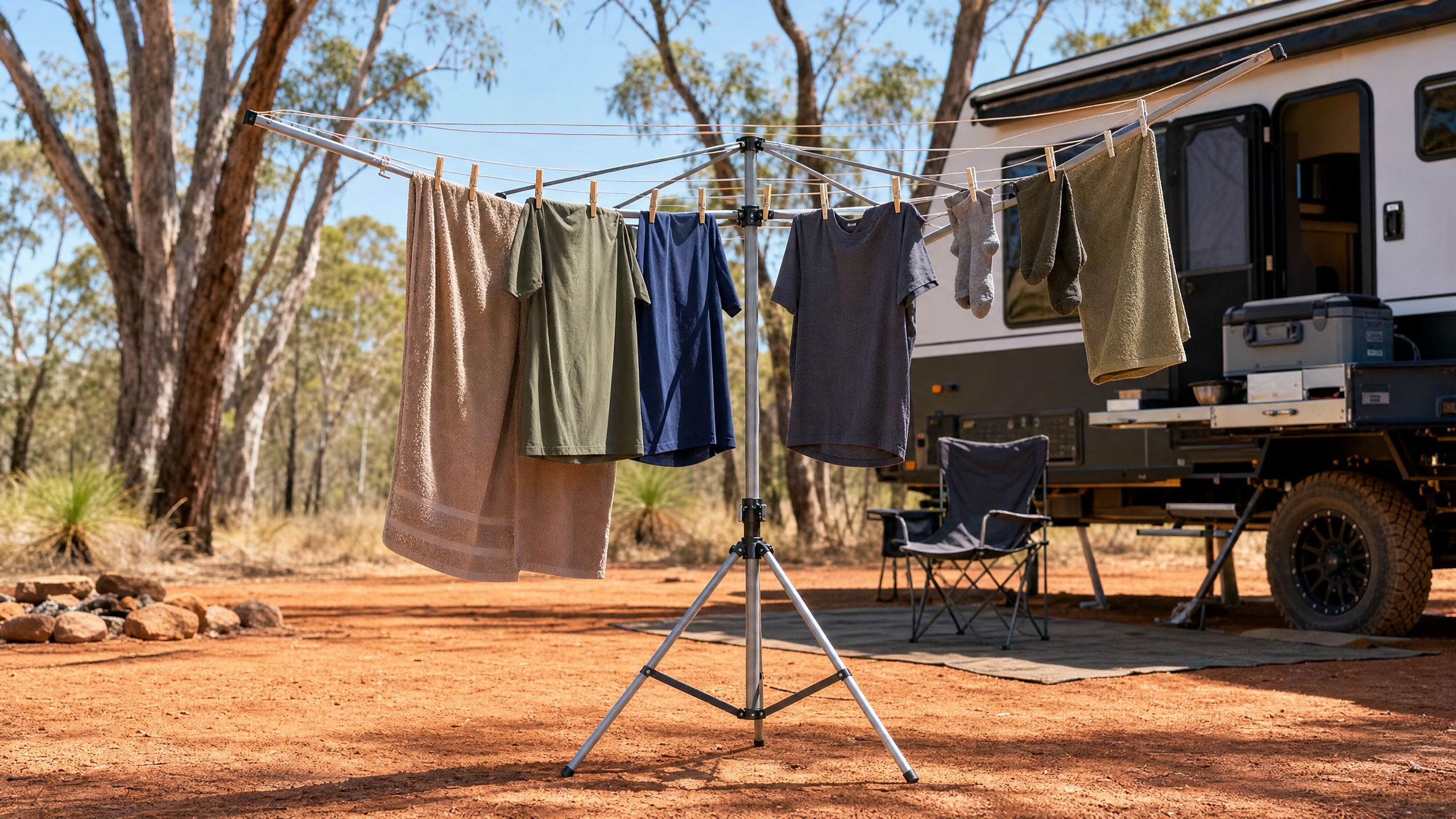
Freestanding folding airer
When there is nothing to tie to — hard ground, gravel, an open site with no trees or poles — a freestanding folding airer is the only thing that works. It stands on its own legs, gives you several rungs of drying space, and folds flat against a wall or into a bag. The cost is weight and pack size, so it suits caravanners and campervanners with room to spare rather than anyone counting grams. If your camps rarely offer two anchor points, this is the design that actually gets your washing dry. Run your eye over the freestanding clothes airer range on Amazon.

Comparison
| Type | Best for | Wind resistance | Needs anchor points | Capacity |
|---|---|---|---|---|
| Twisted pegless cord | Ultralight packs, sheltered sites | Moderate | Yes, two | Low |
| Retractable reel | Tidy setup, couples | High | Yes, two | Modest |
| Elasticated pegless | Exposed, windy sites | Excellent | Yes, two | Medium |
| Rope with clips | Pegless convenience | Good | Yes, two | Medium |
| Freestanding airer | Sites with no anchors | Good, low profile | No | Medium to high |
Frequently Asked Questions
What type of clothesline works best for most camps?
A retractable reel or an elasticated pegless line covers most people — both pack tidily and hold washing in a breeze. Twisted pegless cord is lightest and cheapest but gives up under heavy towels and in gusts. Match the type to how exposed your usual sites are.
How do I dry washing at a windy, exposed site?
Peg or clip everything, and run the line across the breeze rather than sheltered from it, since moving air dries faster. Keep it short and taut so it does not whip, use an elasticated line that soaks up gusts, and put heavy items in the middle where the sag and movement are least.
Tie-between line or a freestanding airer?
A tie-between line is lightest and cheapest but needs two solid anchor points, which are not always there. A freestanding airer stands anywhere, including hard, open ground, at the cost of weight and pack space. If your camps reliably offer trees, poles or an awning, tie-between is simpler; if not, freestanding earns its bulk.
Will a camp line hold heavy wet towels, or just light clothes?
A tensioned elasticated line or a freestanding airer handles towels and jeans; a thin twisted cord really only suits light clothing before it sags to the ground. Spread a heavy load along the line rather than bunching it, and dry big items in batches if your line is a light one.
The Bottom Line
A portable clothesline is one of those small buys that quietly improves every trip — dry towels, no musty tent, nothing draped over the seats. The pick for tight sites is a retractable reel or an elasticated pegless line that hits the mark: tidy, quick, and steady in a breeze. Carry a twisted cord if grams matter, a clip line if you hate pegs, and a freestanding airer if your sites never offer anything to tie to. Pick for the wind you actually camp in, string it taut across the breeze, and let the air do the work.
For more on keeping a camp organised, see our guide to collapsible storage crates, and browse our 4×4/Overlanding/Touring and Camping Essentials sections.