
This page contains affiliate links. Far Cornel may earn a commission if you buy through them, at no extra cost to you.
See the top-rated gear on Amazon →
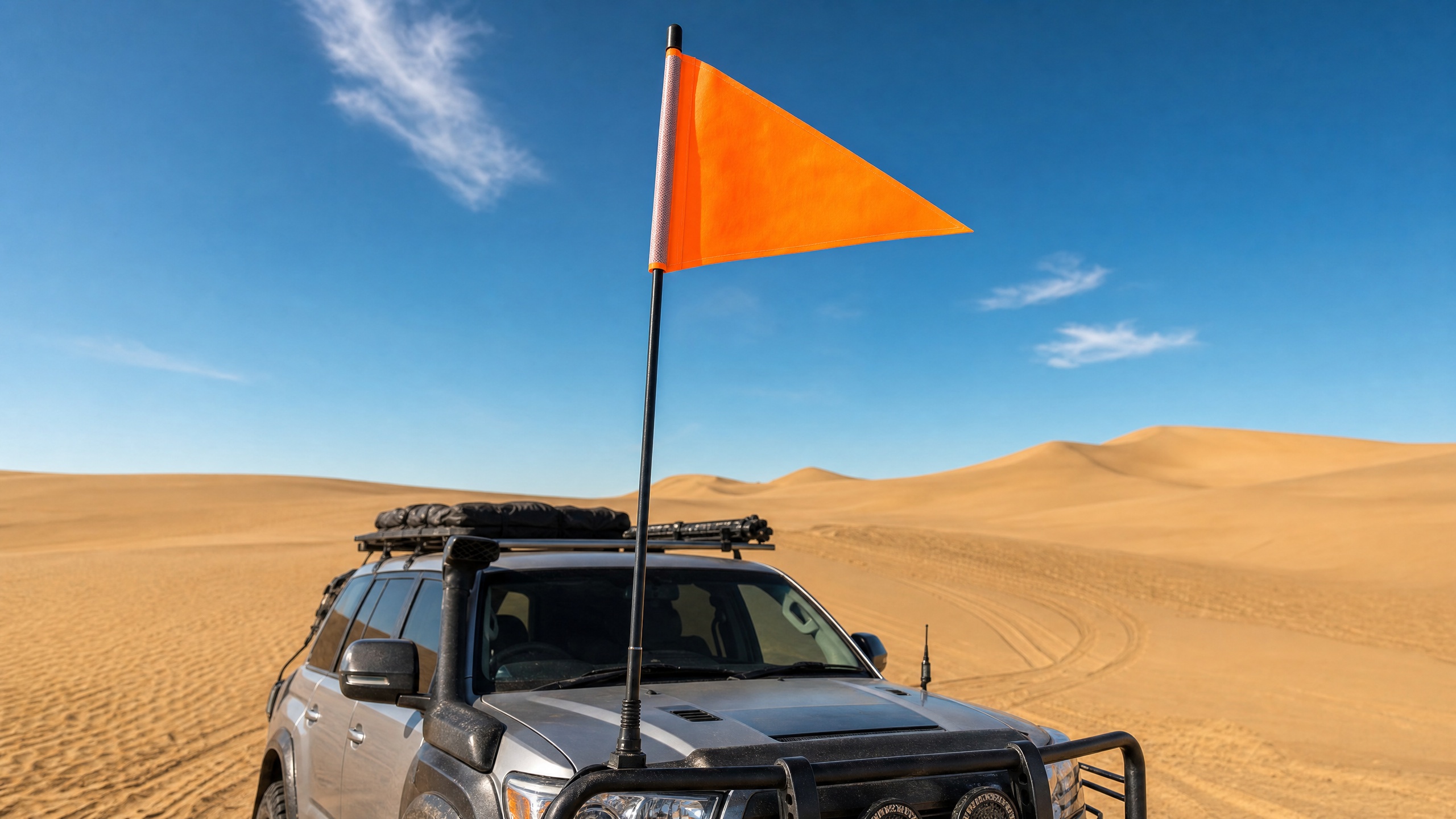
Quick answer: For dune work the flag to own is a bright flexible fibreglass whip, tall enough to stand well above the dune line and fitted to a quick-release spring base at the front of the vehicle. A telescopic pole is handy if you want to adjust height or pack it short, a reflective or LED-lit flag earns its keep at dawn and dusk, and a complete kit with a bracket saves piecing a mount together. Skip cheap rigid PVC poles — they snap.
Sand driving is one of the few places where a twenty-dollar accessory genuinely keeps you out of a head-on. Dunes are blind country: you climb a face with no idea what is on the far side, and a vehicle doing the same from the other direction is invisible until the instant you meet on the crest. A tall, bright flag standing above the sand is the one thing that lets two drivers see each other in time to lift off and steer clear.
It is also, in a lot of dune areas, required by the rules — with a minimum height, a set flag size and a high-visibility colour — so it is worth checking what applies where you are heading before you air down. But the safety case stands on its own. Even where nobody is enforcing anything, a flag that clears the dune line turns a terrifying blind crest into a manageable one, which is exactly why every experienced sand driver runs one without being told.
Quick Picks
- Best overall: a flexible fibreglass whip flag on a quick-release spring base.
- Best adjustable: a telescopic pole you can raise, lower or pack short.
- Best for low light: a reflective or LED-lit flag for dawn, dusk and night.
- Best complete kit: a flag, whip and bracket bundled so the mount just works.
- Best avoided: a cheap rigid PVC pole that snaps on the first branch.

How to Choose a Sand Flag
A sand flag has one job — to be seen — so height and brightness come first. The tip needs to stand well clear of the dune line, which in practice means a pole reaching somewhere around 2.5 to 3 metres above the ground once it is mounted, and the flag itself should be a fluorescent orange or red that pops against both sky and sand. Many areas also set a minimum height and flag size in their rules, so check what applies where you are going and buy to clear it comfortably.
Then look at what the pole is made of and how it mounts, because a flag that snaps or tears off helps nobody. A flexible fibreglass whip bends flat in a gust or against a branch and springs back, where a rigid pole simply breaks — this is the single most important choice. Mount it to a solid point at the very front, a bull bar or a recovery point, so oncoming drivers spot it earliest, and insist on a quick-release spring base so you can drop it in seconds for a low branch or pull it off before the sealed road home.
The myth to bin is that a sturdy, rigid pole is the tough choice. The opposite is true: rigid poles transfer every impact straight into your mount and snap at the worst moment, while a whippy fibreglass pole shrugs off the same hit. And a flag does not make dune driving safe — it makes you visible. You still crest slowly, keep to one side, and call blind rises on the radio. Do not buy a cheap PVC pole if you run scrubby tracks; it will be in two pieces by lunch.
The Sand Flags
Check today’s prices on Amazon →
Flexible fibreglass whip flag
This is the standard for good reason. A tall fibreglass whip carries a bright flag well above the dune line and bends right over in a gust or against a branch before springing straight back, so it survives the punishment that snaps rigid poles. Paired with a spring base it shrugs off impacts that would otherwise crack a mount. It is the flag I would fit to any vehicle heading for the sand, and brands like ARB and Bushranger do proven versions. Buy one tall enough to clear your roof line comfortably. Check the latest fibreglass sand flag range on Amazon.
Telescopic flag pole
If you want to adjust height for different rules or pack the pole short for transport, a telescopic whip collapses down and extends back out in seconds. It suits a vehicle that does a lot of on-and-off-sand travel, or a flag shared between rigs of different heights. The catch is the joints: every telescoping section is a potential weak point, so buy a quality one with solid locking collars and keep them clear of grit, since a section that collapses mid-drive drops the flag below the crest line just when you need it up. Compare telescopic sand flag options on Amazon.
Reflective high-visibility flag
The best time to tackle soft sand is often the cool of dawn or dusk, which is exactly when a plain flag fades into a grey sky. A flag with a reflective cross or hi-vis panels catches low light and headlights, buying oncoming drivers a little more warning in the gloom. It is a small upgrade over a standard flag and well worth it if you drive early, late or in dust. Keep the reflective material clean, since caked sand and salt dull it fast and quietly undo the point of it. Look over the current reflective sand flag options on Amazon.
Complete flag kit with bracket
Rather than piecing a whip, flag, base and mount together, a complete kit bundles them so the parts actually fit — a fibreglass whip, a bright flag, a spring quick-release base and a bracket to bolt to your bar or rack. It takes the guesswork out of getting the height and fitment right and often works out cheaper than buying the bits separately. Check the bracket matches your mounting point before you order, since a bar tab and a flat rack need different brackets and a mismatch means a return. Check current sand flag kit with bracket stock on Amazon.
LED-lit whip flag
For genuine movement on sand after dark, an LED-lit whip runs a lit strip up the pole so the flag is visible at night, not merely reflective. It is overkill for daylight-only trips and it needs wiring to a switched power source, but if your driving runs into the dark it turns an invisible pole into an obvious one. Treat it as a night-visibility tool on top of a proper flag rather than a replacement for real height and a bright panel by day, which do the heavy lifting when the sun is up. See current LED sand flag pole prices on Amazon.

Comparison
| Flag type | Pole | Height | Low-light | Best for |
|---|---|---|---|---|
| Fibreglass whip | Flexible fibreglass | Tall, fixed | Reflective option | Most dune driving |
| Telescopic | Adjustable, jointed | Adjustable | Add reflective flag | Shared rigs, transport |
| Reflective hi-vis | Fibreglass | Tall | Reflective cross | Dawn, dusk, dust |
| Complete kit | Fibreglass + base | Set by bracket | Depends on flag | Getting fitment right |
| LED-lit whip | Fibreglass + LED | Tall | Lit | Night dune driving |
Frequently Asked Questions
Why do I need a sand flag on dunes?
A tall, bright flag makes your vehicle visible over crests to drivers you cannot yet see — which is precisely where head-on hits happen in blind, soft country. It gives both of you time to react. In many dune areas it is also required by the rules, but the safety case holds up entirely on its own.
How tall should it be, and where do I mount it?
Tall enough that the flag stands well clear of your roof and the dune line — commonly around 2.5 to 3 metres from the ground once mounted. Fit it to a solid point at the front, such as a bull bar or a recovery point, where oncoming drivers spot it first. A secure mount matters as much as the height.
Fibreglass whip or a rigid pole?
A flexible fibreglass whip, almost always. It rides out gusts and branches and springs back, where a rigid pole snaps and passes the shock into your mount. Rigid poles are a false economy that fail at the worst time; a telescopic whip is a fair middle ground if you want adjustable height.
Do I have to take it off for sealed roads?
Yes. At road speed a tall flag flogs hard enough to snap the pole or wreck the bracket, and it is against the rules in many places. A quick-release spring base lets you drop it in seconds, so pull it before you leave the sand and refit it when you air down again.
The Bottom Line
A sand flag is a small purchase with an outsized payoff, so it is the wrong place to save ten dollars. Fit a bright, flexible fibreglass whip tall enough to stand clear of the dune line, on a secure quick-release base at the front of the vehicle, and add reflective or lit options if you drive in low light. Check the height and colour rules where you are heading, mount it properly, and keep driving to the terrain rather than the flag — it makes you seen, not invincible. Do that and it earns its keep on every blind crest.
For more on getting set up for the soft stuff, see our recovery gear checklist, our guide to tyre deflator kits for airing down in sand, and the traction boards that get you moving again.