
This page contains affiliate links. Far Cornel may earn a commission if you buy through them, at no extra cost to you.
See the top-rated gear on Amazon →
Quick answer: For a 12V setup, the best pick is a dedicated RF thermometer with its own dash display — it reads through a metal canopy and stays glanceable while you drive, where phone apps drop out. Choose a Bluetooth tag if the fridge sits beside you in the cab, a dual-zone unit if you run a fridge-freezer, a WiFi model with push alerts when you leave the rig parked, and a simple in-fridge min/max thermometer as a cheap backup.
A 12V fridge is the one appliance on a trip that quietly ruins your week if it fails and never tells you. A blown fuse, a lid left ajar, a plug shaken loose on rough tracks, a battery that dipped overnight — any of them can let the fridge creep toward room temperature, and you usually find out by lifting the lid to warm meat and a smell you will not forget. Worse, the fridge’s own display will happily show a healthy number while the food behind the basket sits warm.
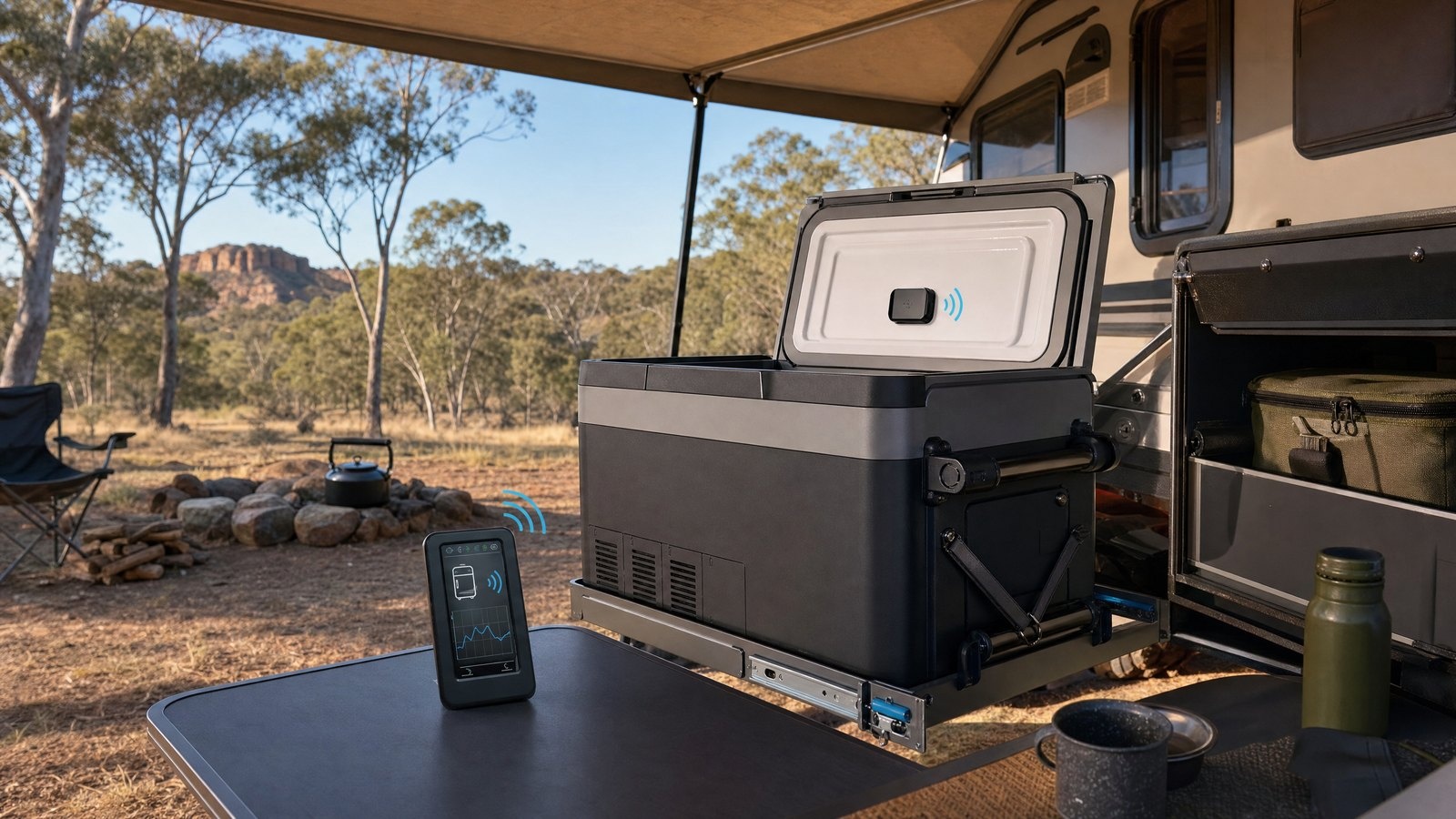
A wireless thermometer closes that blind spot. A small sensor sits in the fridge with your food, and a display on the dash — or your phone — shows the real air temperature and shouts if it drifts out of range. It is a cheap sensor guarding a fridge full of food and a fridge that itself cost a fair bit, and it turns “I hope it’s still cold” into a number you can read from the driver’s seat. The trick is matching the type to where your fridge actually lives.
Quick Picks
- Best overall: a dedicated RF thermometer with its own dash display and temperature alarms.
- Best for an in-cab fridge: a simple Bluetooth sensor tag read on your phone.
- Best for a fridge-freezer: a dual-zone monitor that reads two sensors at once.
- Best for a parked rig: a WiFi monitor that pushes alerts when there is reception.
- Best cheap backup: an in-fridge digital thermometer with a min/max memory.

How to Choose a Wireless Fridge Thermometer
Start with the distance and what sits between the sensor and you. A fridge in the back of a wagon is an easy reach for almost any unit, but a fridge in a metal canopy or a towed camper needs a strong radio-frequency signal, because metal and glass eat wireless range fast. This is where dedicated RF units with their own screen beat phone apps: a good one holds a link across tens of metres and through a canopy, while Bluetooth commonly drops the moment you walk to the cab.
Accuracy should be within about a degree — food safety is not the place for a vague reading — and the sensor’s battery has to survive the cold. Standard alkaline cells sag in a freezer and drop offline, so a sensor that takes a lithium AA or AAA, good for six to twelve months, is worth seeking out. The feature that actually saves your food, though, is the alarm: a high-temperature alert that beeps or pushes to your phone the moment the fridge hits, say, five degrees is the early warning a plain display never gives.
Here is the myth to bin: the fridge’s built-in display is not the truth. Most read the temperature at the cooling plate, not the air around your food, so they show a colder, rosier number than reality — an independent sensor sitting with the food is the only honest reading. And do not buy a long-range RF kit for a fridge that rides in the cab beside you; you will glance at the fridge’s own controller anyway, and a simple in-fridge thermometer covers the rest for a fraction of the cost.
The Wireless Fridge Thermometers
Check today’s prices on Amazon →
RF monitor with a dash display
The workhorse for serious touring. A sender in the fridge beams to a dedicated screen you mount on the dash, with no phone, no app and no pairing to drop. The best units hold a link across tens of metres and through a metal canopy, remember high and low alarm points, and run for months on a set of cells. Brands like ThermoPro and Inkbird build this style well. If your fridge lives in a canopy or a camper you tow, this is the one to buy — always on, always glanceable, and immune to the app roulette that plagues cheaper options. Compare RF wireless fridge thermometer options on Amazon.
Bluetooth sensor tag
For a fridge that rides in the cab or just behind the back seat, a small Bluetooth tag is tidy and cheap. It logs temperature to an app on your phone, often with a graph so you can see how the fridge cycles overnight, and there is no extra screen cluttering the dash. Govee and SensorPush are common picks. The catch is range: Bluetooth struggles through metal and past a few metres, so it is a poor choice for a towed trailer but a neat one when the fridge is close and you just want a log and an alert on your phone. Browse the current Bluetooth fridge thermometer listings on Amazon.
Dual-zone fridge-freezer monitor
Run a dual-zone fridge-freezer, or a fridge in the vehicle and another in the camper, and you want one display reading two sensors at once. A dual-zone monitor shows both temperatures side by side with separate alarms, so a freezer creeping above minus fifteen and a fridge drifting past five both get flagged on the same screen. It saves buying and glancing at two separate units. Check that each channel has its own high and low alarm, and that the sensors are rated to keep working at freezer cold. Find the right dual zone fridge freezer thermometer on Amazon.
WiFi monitor with phone alerts
When you leave the rig set up and wander off — a day out fishing, a long walk, a night away from camp — a WiFi monitor sends an alert to your phone the moment the fridge misbehaves, as long as there is a connection to lean on. Paired with a phone hotspot or camp reception, it is the only type that reaches you when you are nowhere near the display. Off-grid with no signal it falls back to logging locally, so treat the remote alerts as a bonus for when you have coverage, not a guarantee you can rely on everywhere. See the newest WiFi fridge thermometer alarm listings on Amazon.
In-fridge min/max thermometer
The cheapest useful tool here, and a smart backup even if you own a fancy monitor. A small digital thermometer sits inside with its probe in the food zone and remembers the highest and lowest temperature it has seen, so a quick glance when you stop tells you whether the fridge got warm while you drove. No wireless, no app, no battery drama beyond a coin cell. It will not warn you in real time, but as a five-minute sanity check and a fallback if your wireless unit fails, it earns its tiny cost many times over. Check the latest fridge thermometer with min max range on Amazon.

Comparison
| Type | Best for | Range | Alerts | Watch-out |
|---|---|---|---|---|
| RF + dash display | Canopy, camper | Tens of metres, through metal | On-unit alarm | Extra screen on the dash |
| Bluetooth tag | In-cab fridge | A few metres | Phone alert | Dies through metal |
| Dual-zone | Fridge-freezer | Tens of metres | Two-channel alarms | Pricier |
| WiFi monitor | Parked, away from rig | Anywhere with signal | Phone push | Needs reception |
| In-fridge min/max | Cheap backup | At the fridge | Memory only | No live warning |
Frequently Asked Questions
Bluetooth or RF for a caravan or canopy?
RF with its own display, almost every time. Bluetooth range collapses through metal and past a few metres, so it suits an in-cab fridge but not a towed trailer. A dedicated RF unit holds the link across tens of metres and through a canopy without dropping out.
Will a wireless thermometer drain my battery?
No. The sensor runs on its own small cell — often a lithium AA or AAA — and sends a tiny signal, so it puts no real load on your dual-battery system. Just use lithium cells in a freezer, since alkalines fade in the cold and drop offline.
Where should I put the sensor?
In the middle of the fridge, sitting with the food, not stuck to the cooling plate. Against the plate it reads falsely cold; buried under a pile of meat it can block the signal. Clip or tape it near the top basket in open air.
Can one monitor read both a fridge and a freezer?
Yes, if you buy a dual-zone unit. It reads two sensors at once and shows both temperatures with separate alarms, which is ideal for a fridge-freezer or a second fridge in the camper. Check both channels have high and low alarms.
The Bottom Line
A wireless fridge thermometer is a few dollars of insurance on a fridge full of food and a fridge that was not cheap to begin with. For a touring setup, a dedicated RF unit with a dash display and proper alarms is the right call — it reads through a canopy, stays glanceable, and warns you before the food is gone rather than after. Drop to a Bluetooth tag if the fridge sits beside you, add a dual-zone unit for a fridge-freezer, and keep a cheap in-fridge min/max thermometer as a backup. Set the alarms, put the sensor with the food, and stop guessing whether it is still cold.
For more on building out a dependable 12V setup, see our guides to 4×4 fridge slides and dual battery monitors, and portable fridges.