
This page contains affiliate links. Far Cornel may earn a commission if you buy through them, at no extra cost to you.
Browse water carriers on Amazon →
Quick answer: Buy two 10-litre rigid carriers with taps instead of one 20-litre. Twenty litres of water weighs 20 kg, most people cannot lift that onto a table, and a tap sitting in the dirt pours nothing. Two smaller cubes carry one-handed, stack in the boot and leave you a spare if one splits. Add a roll-up bladder for bulk. Skip the lot if your camper has plumbed water.
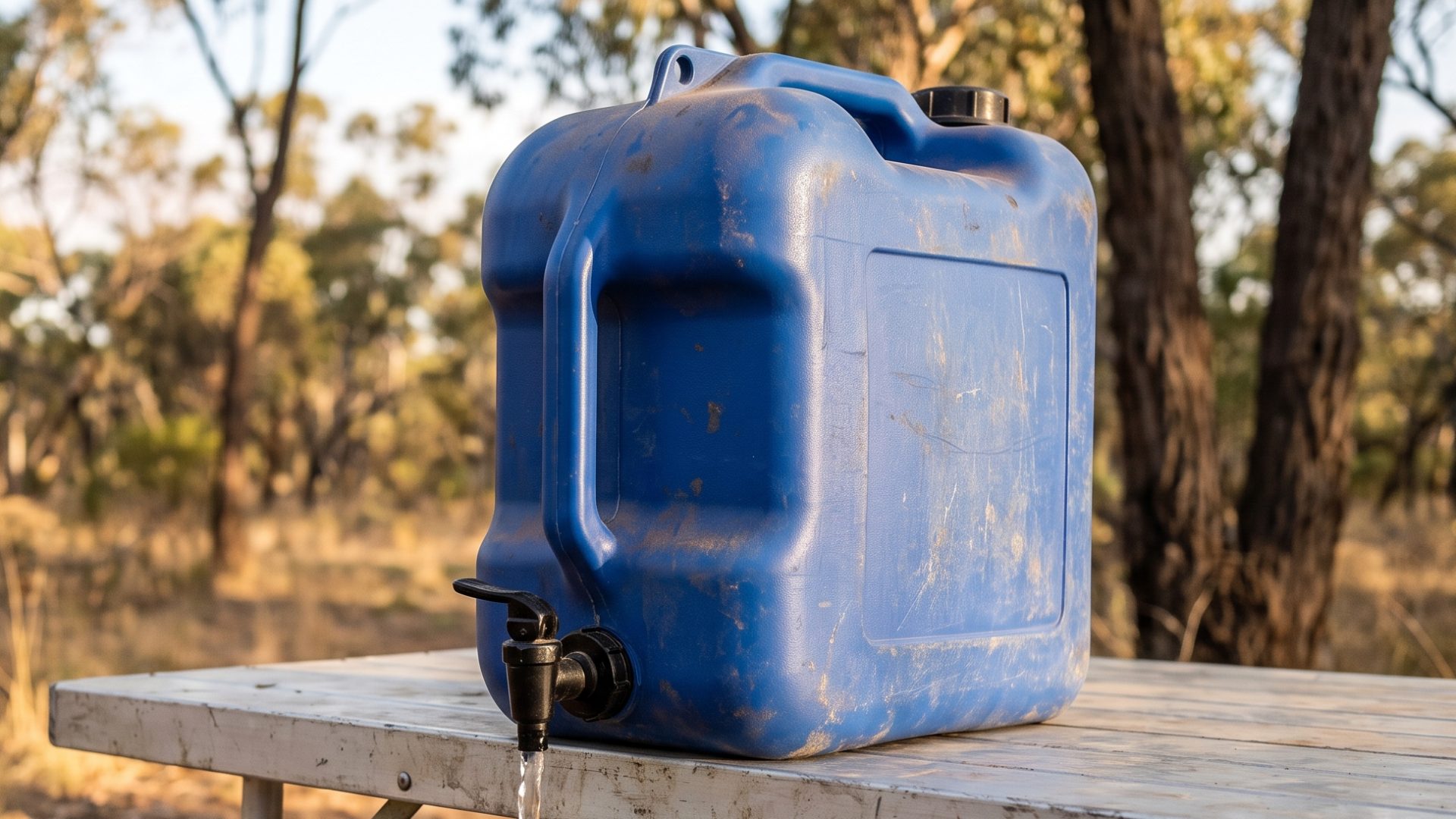
A litre of water is a kilogram on the scales, and that single fact settles which container you should buy. Almost nobody runs the numbers first. A full 20-litre cube is 20 kg of sloshing dead weight hanging off a single moulded handle, and because the tap sits low on the bottom edge, you cannot get a cup out of it until you have lifted all 20 kg onto something waist-high. At a finished campsite that means the table. At a bare site with the table still strapped to the roof, it means nothing at all.
So the useful question is not how much a container holds. It is how high you can lift it and what fits underneath the spout. Get those right and a plain plastic box will outlive most of your kit. Get them wrong and you will spend the trip tipping a cube over your knee to fill a kettle, which is exactly how taps get snapped off. Here are the five container types sorted by that test, plus the part everyone eventually kills.
Quick Picks
- Best all-rounder: a rigid 10–15L carrier with a replaceable tap — a one-handed carry that stands up on its own.
- Best bulk reserve: a stackable 20L+ cube or drum that lives in the vehicle and gets decanted, never carried full.
- Best for packing small: a roll-up carrier that flattens to the size of a paperback once empty.
- Best fix for tap height: a hanging gravity bag slung from an awning rail, so the spout sits at hand height with nothing to lift.
- Best in heat: an insulated dispenser with a spigot, which keeps water pleasant to drink when everything else has gone warm.

How to Choose a Water Container
Start with the lift, not the litres. Ten litres is about 10 kg plus the container — a one-handed carry from the car to the table. Twenty is a two-handed, straight-backed lift made worse by a wide body and a handle stuck in the middle of the lid. Two 10L carriers hold the same water, cost nothing extra in boot space because they stack, and hand you a real safety margin: if a seam splits or a tap shears, you still have half your water. One big cube is a single point of failure carrying the whole trip.
Then work out where the spout ends up. A rigid carrier on the ground puts its tap four or five centimetres above the dirt, which fits nothing but a shallow lid. You want roughly 25–30 cm of clear air under it to fill a kettle, and 40 cm to wash your hands. That height has to come from a camp table, a crate, an open tailgate, or a container designed to overhang an edge. If you have no reliable table, stop looking at cubes and look at hanging bags — they solve the problem instead of moving it.
Two details decide whether you keep a container or bin it in a year. First the tap: cheap push-button spigots weep constantly and cross-thread the moment grit reaches the collar, so favour one that unscrews and can be replaced, and store the container with the tap open and dry, because a closed wet tap grows slime in a fortnight. Second, light — clear plastic plus a few warm days is all algae needs, which is why opaque containers stay cleaner. And one absolute: a container that has held petrol or diesel holds fuel forever, because residue soaks into the plastic. Keep the two fleets separate and colour-code them.
The Water Carriers
See the full range on Amazon →
The rigid jerry-style carrier
The default, and deservedly so. A moulded 10–15L carrier in food-grade HDPE stands square on a table, stacks in the boot, takes a knock without splitting and puts the handle where a one-handed carry wants it. Sea to Summit, Willow and Reliance all make sensible versions, and the design has barely changed in decades because it works. Watch two things: the fill cap diameter, which decides whether a brush fits inside for cleaning, and whether the tap screws in separately or is moulded into the body. A moulded tap is a container with an expiry date.
Fifteen litres suits two people over a long weekend; 10L is the call if you camp alone or carry water any distance. Sort through the rigid carriers that hold ten to fifteen litres.
The stackable cube or drum
Anything from 20L up is bulk storage, not daily use. Square cubes and upright drums with a wide screw cap work brilliantly as a reservoir left in the vehicle and decanted each morning — low cost per litre, almost no wasted space. Used as a carry container, they are a back injury waiting for a soft patch of ground.
Look for a genuinely flat base and vertical walls, because tapered “stackable” cubes only stack in the marketing photo, and check the cap is a coarse thread you can open with wet hands. Cast an eye over the twenty-litre cubes and drums.
The roll-up or folding carrier
Collapsible carriers earn their place on the trip home, not the trip out. Empty, a 10L roll-up folds to the size of a paperback; full, it is a floppy bag that will not stand up, cannot be stacked and hates gravel. The failure mode is a pinhole in a crease, usually from being packed away with grit still on it, so rinse and dry before it goes back in the tub. MSR and Sea to Summit build theirs in coated fabric rather than thin welded film, and the difference in lifespan is not subtle.
Buy one as your second container rather than your first, and pick a model with a real carry handle and a cap that takes a filter. Flick through the roll-up carriers to see which packs smallest.
The hanging gravity bag
The most underrated of the five, because it is the only one that fixes tap height rather than working around it. A gravity bag hangs from an awning rail, a rack crossbar or a branch, putting the hose and clip valve at chest height with a metre of clear air beneath — you wash hands under it, fill bottles under it, and never lift it again after the first hoist. Katadyn and Platypus build versions with an inline filter, so one bag pulls water from a creek and serves it clean at camp.
The catches are real ones: you need something to hang it from, the hose is one more thing to keep out of the dirt, and capacity runs 6–10L rather than 20. Dig through the hanging bags and gravity kits.
The insulated dispenser with a spigot
Essentially a cooler with a tap: a double-walled 7–20L body that keeps water cold through a hot day and serves it without opening a lid. Igloo and Coleman have made the same jug for a very long time and there is little to go wrong. In real heat it is the difference between people drinking enough and people not bothering, which counts for more than it reads on the page.
The cost is bulk — an insulated jug is heavier empty than a plain cube, and the insulation eats space you could have filled with water. Base camps and vehicle trips, not anything you carry. Take stock of the insulated dispensers.
Comparison
| Container type | Weight when full | Where the tap sits | Packs down? | Buy it for |
|---|---|---|---|---|
| Rigid jerry-style carrier | 10–15 kg | Low — needs a table | No, but stacks | Everyday camp water |
| Stackable cube or drum | 20 kg+ | Low — decant instead | No | Vehicle reserve |
| Roll-up or folding carrier | 10–20 kg | None — pour or squeeze | Yes, to a paperback | Spare capacity |
| Hanging gravity bag | 6–10 kg | Chest height, hands-free | Yes | Sites with no table |
| Insulated dispenser | 7–20 kg | Mid — a short stand helps | No | Hot-weather base camps |

Frequently Asked Questions
How much water should I plan on per person per day?
Three litres each covers drinking in mild conditions and doubles in real heat. Cooking, washing up and teeth add two to three litres more. A pair on a two-night trip therefore wants roughly 25 litres — two 15L carriers with a sensible margin, not one 20L cube filled to the brim and rationed.
Can I reuse an old fuel jerry can for drinking water?
No. Petrol and diesel residue soaks into the plastic and leaches back into whatever you put in afterwards, and no amount of detergent, bleach or airing reverses it. Keep fuel cans for fuel permanently and buy a separate food-grade container for water.
Why does the water taste of plastic, and does it stop?
New HDPE off-gasses slightly for the first few fills. Fill it, leave it a day, empty it, and repeat once or twice before the trip and the taste usually clears. If a taste appears later in a container that was fine before, that is not the plastic — that is biofilm in the tap or on the walls, and it needs a proper clean rather than a rinse.
What causes the green film inside a container?
Algae, and it needs water, warmth and light. You cannot remove the first two, so remove the light: store containers empty, dry and out of the sun, and choose opaque plastic if the container will ever sit outside with water in it. A capful of bleach in a full container, left overnight and rinsed thoroughly, resets one that has already gone green.
Do I still need a filter if I fill from a mains tap?
For the water itself, no. The risk with a mains fill is what the container adds afterwards, especially one that has sat damp with the tap closed. If you are filling from a creek, a bore or a rainwater tank of unknown history, then yes — and a gravity bag with an inline filter does the carrying and the treating in one step.
The Bottom Line
Two 10–15L rigid carriers with replaceable taps will serve almost everyone better than the single 20L cube they were about to buy, because the constraint was never storage volume — it was the lift and the spout height. Add a roll-up carrier for longer trips, and a hanging gravity bag if your sites rarely come with anything to stand a container on. Store whatever you choose empty, dry and with the tap open, and never let it near fuel.
For treating what you collect, read our guide to portable water filters for camping. For the washing-up end of the problem, see the camp wash basins guide, and our camp shower systems guide covers the pumps and bags worth having.
Find the right size on Amazon →
