
This page contains affiliate links. Far Cornel may earn a commission if you buy through them, at no extra cost to you.
Browse overhead reels on Amazon →
Quick answer: For most people the right first overhead is a mid-size star-drag levelwind in the 10–15 kg line class — simple, cheap to service, and suited to bait fishing, reef work and light trolling. Move to a lever drag only if you fight fish on a preset drag curve. Two-speeds earn their keep on big pelagics. If you mostly cast lures, skip overheads and stay on spin.
Walk a tackle aisle and the lever-drag reels sit at the top of the rack like the finished version of everything below them. They are not. A lever drag is a different tool, not a better one, and plenty of anglers pay double for the privilege of setting it to strike on the first trip and never touching the lever again. That extra money would have bought a stronger frame, a bigger spool and a decade of service kits.
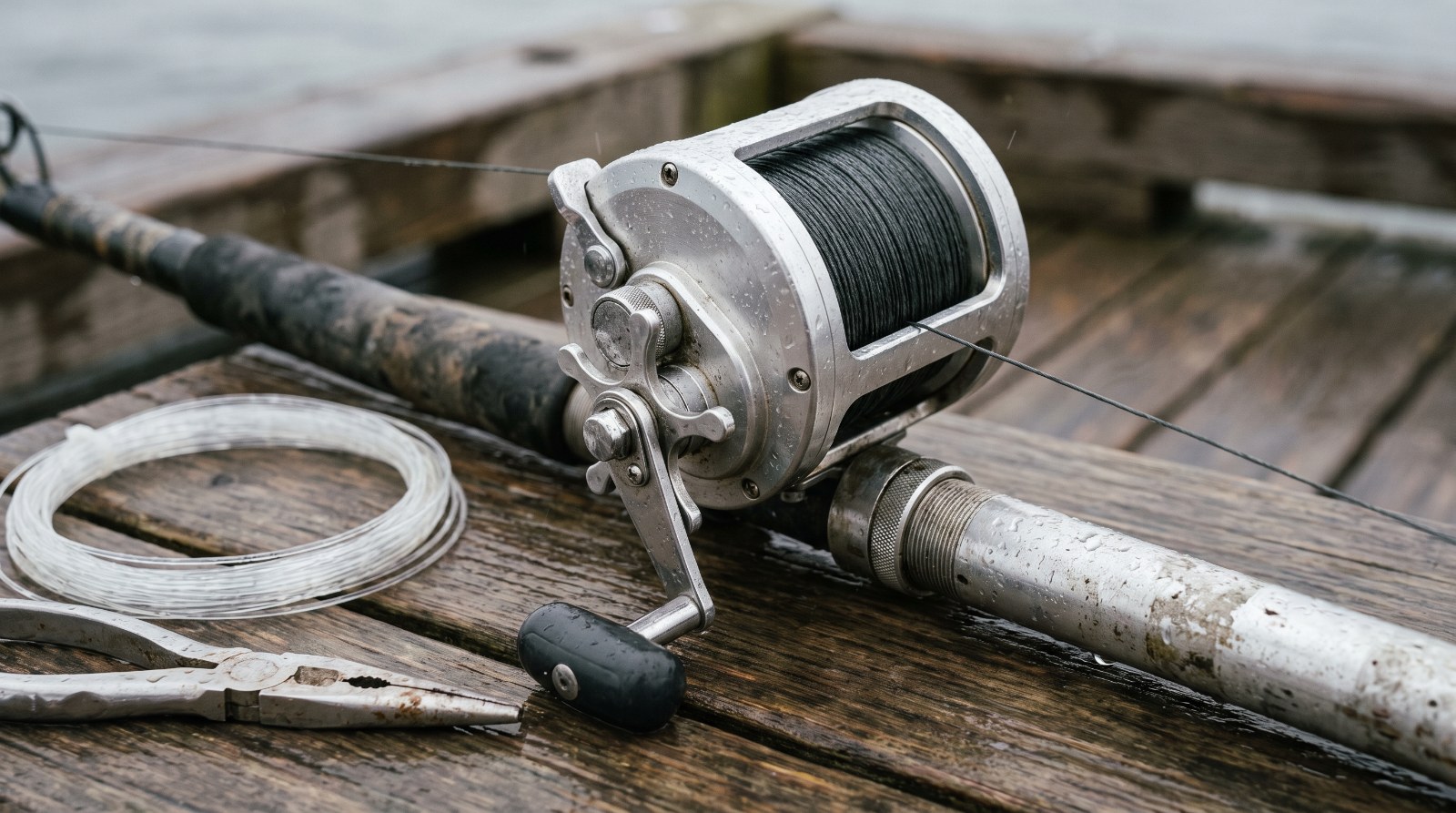
An overhead sits on top of the rod and winds line onto a spool that turns in line with the blank. No bail, no line twist, and far more pulling power per gram than a spinning reel at the same price. That is why bait anglers, trollers and jiggers keep buying them. The trap is the spec sheet: maximum drag is quoted at a setting nobody fishes, and line capacity is printed in monofilament while most of us spool braid. Knowing the classes apart is what saves the money.
Quick Picks
- Best all-rounder: a mid-size star-drag levelwind — covers bait, reef and light trolling with no learning curve.
- Best for heavy pressure: a plain non-levelwind star drag — more line, more drag, one more job for your thumb.
- Best for game trolling: a two-speed lever drag — repeatable strike settings and a low gear for when the fish sounds.
- Best for jigging: a narrow-spool overhead with a fast retrieve — short cranks, no line stacking, less shoulder.
- Best for deep drops: an electric reel — expensive, heavy, and the only sane answer past about 200 metres.

How to Choose an Overhead Reel
Start with the drag, because that is the fork in the road. A star drag tightens a stack of washers through a wheel behind the handle: infinitely adjustable, dead simple, and impossible to return to exactly where it was ten minutes ago. A lever drag runs the same washers on a cam, so the positions repeat. You set strike once against a scale and the lever finds that number every time. That repeatability is the entire product. Fishing a spread of trolled baits where every reel must pull the same measured pressure at hook-up, it is worth real money. Dropping baits to the bottom and adjusting by feel, you are buying a feature that will sit at strike forever.
Ignore maximum drag on the box. The number you actually fish is strike drag, and the working rule is roughly a third of the line’s breaking strain — about 5 kg on 15 kg braid. Reels are marketed on a figure measured at a locked-down setting used for a few seconds to turn a fish away from structure. What matters far more is whether the frame holds its shape under load. Graphite flexes, the spool binds against the sideplates, and the drag you set stops being the drag you get. Anything you intend to fish above about 10 kg wants an aluminium frame, and the reels worth buying say so plainly.
Capacity is printed in mono, so a reel rated for 300 m of 15 kg mono swallows far more 15 kg braid — which is how people end up two sizes larger than they need, carrying the weight all day for line they will never see. Levelwind or not is the last real decision: convenience below about 15 kg, more capacity and fewer salt-exposed parts above it.
The Overhead Reels
Check current prices on Amazon →
Star-Drag Levelwind Overheads
This is the reel most people should buy first, and the one shops push least, because the margin lives further up the rack. A levelwind star drag in the 10–15 kg class handles bait on the bottom, a slow-trolled lure and a live bait under a float, and it does all three without asking you to think about anything. The Shimano Torium and TR families, Penn’s Squall and Fathom levelwinds and Okuma’s Classic all sit in this space. The compromises are honest: you give up some spool capacity to the mechanism, and the worm gear wants a freshwater rinse after every salt trip or it starts to grind. Shortlist the levelwind models in this size class
Plain Star-Drag Overheads
Strip the levelwind off and the same reel gains line, gains drag and lasts longer, because the part most likely to seize has gone. The trade is that you now lay line with your thumb, and doing it badly means a spool stacked up one side that jams mid-fight. It is a real skill and it takes about three trips to learn. The Penn Senator and Daiwa Sealine families live here, and they are why old tackle rooms are full of them: fewer parts, cheap to rebuild, still fishing long after a levelwind would have stopped. Cost out a plain-frame star drag against its levelwind twin
Two-Speed Lever-Drag Reels
On a genuinely big fish, two speeds is not a luxury — it is the difference between gaining line and standing there. High gear picks up slack fast when the fish swims at the boat; a button drops you into a low gear that lifts dead weight without wrecking your shoulder or the reel’s gear train. The Shimano Talica and Penn Fathom two-speeds are the reference points. Skip the whole class if your fishing tops out on reef bottom under 20 kg: the extra gears add weight, cost and rebuild complexity you will never draw on, and a good single-speed lever will out-fish a cheap two-speed every day of the week. Weigh up the current two-speed range before you commit
Narrow-Spool Jigging Overheads
Jigging reels are built narrow for one reason: without a levelwind, line lands roughly where it left, and a short spool has nowhere to stack. They run high retrieve rates, which are worth measuring in centimetres per crank rather than gear ratio — a ratio tells you nothing until you know the spool diameter. Heavy drag in a small aluminium body is the other half of the recipe, and the Shimano Ocea Jigger, Daiwa Saltiga and Okuma Cavalla are the shape of the class. They are poor reels at everything else: 400 m of braid on a narrow spool makes a clumsy bait reel and a worse troller. Narrow it down to the jigging reels with a retrieve you can live with
Electric Deep-Drop Reels
Past about 200 metres, cranking stops being fishing and starts being labour, and an electric reel is the honest answer. The Daiwa Seaborg and Shimano Beastmaster define the category. They cost more than most people’s rod, reel and holder combined and need a power feed run properly back to the battery — and the depth counter, not the motor, is the part that changes your fishing: it puts a bait back on the exact metre mark that produced last time. Buy one only if you drop deep often and the alternative is not going. Find out where electric deep-drop reels really start
Comparison
| Type | Drag system | Line lay | Where it earns its keep | The catch |
|---|---|---|---|---|
| Star-drag levelwind | Washer stack, wheel-adjusted | Automatic | Bait, reef, light trolling | Worm gear seizes if not rinsed |
| Plain star drag | Washer stack, wheel-adjusted | Thumb | Heavy bottom work, big baits | Bad thumb work jams the spool |
| Two-speed lever drag | Cam, repeatable presets | Thumb | Game trolling, stand-up | Heavy, dear, complex to rebuild |
| Narrow-spool jigger | Cam or washer, high pressure | Thumb, minimal stacking | Vertical jigging | Useless outside its one job |
| Electric | Motor-assisted, preset | Automatic | Deep dropping past 200 m | Cost, weight, wiring |

Frequently Asked Questions
Is an overhead reel just a big baitcaster?
Mechanically they are relatives — both sit above the rod on an in-line spool. What splits them is purpose. A low-profile baitcaster is a casting tool: light spool, cast controls, a few kilos of drag at most. An overhead in the classes above is a lifting and trolling tool with a heavier frame and several times the drag, and most of them cast badly or not at all. Buying one to throw lures all day is the most common mistake in this whole category.
How much drag do I actually need?
Roughly a third of your line’s breaking strain, measured against a set of scales rather than guessed: 15 kg braid wants about 5 kg, not 15. A reel quoting 25 kg maximum is describing a locked-down setting held for seconds on tackle built for it. Buy on that number and you end up with more reel than you can physically hold.
Do I need a levelwind?
Under about 15 kg, yes, unless you enjoy the thumb work — an even spool for no effort is worth the small capacity loss. Above that, most people go without, because the mechanism eats drag, adds a failure point in salt and limits how much braid you can carry. If you do go plain, spread line across the spool with your thumb on every retrieve, not only when you remember.
Why does my braid slip on the spool?
Braid has no stretch and almost no grip on a bare metal or graphite arbor, so under heavy drag the whole fill rotates and you wind against nothing. Lay a few dozen metres of monofilament backing down first and tie the braid to that, or run a strip of electrical tape around the arbor before you start. It is a five-minute job that people skip exactly once.
The Bottom Line
Buy for the fishing you actually do, not the reel in the poster on the wall. For most people that means a mid-size star-drag levelwind on an aluminium frame, filled with braid over a mono backing and set to about a third of its breaking strain — a reel that will handle bait, reef and a slow-trolled lure for a decade on nothing but a rinse and an annual service. Lever drags, two-speeds and electrics all solve genuine problems, but they answer questions most anglers never ask. Work out which question you are asking, then spend.
Still weighing up the whole reel decision? Our guide to choosing a spinning reel by size and drag covers the other half of the market, and the baitcaster versus spinning comparison is the closest call most buyers face. Whichever way you go, a reel that lives in salt water needs a basic service kit from the first trip.