
This page contains affiliate links. Far Cornel may earn a commission if you buy through them, at no extra cost to you.
See the current brake controllers on Amazon →
Quick answer: Buy proportional, not time-delayed — a proportional controller reads how hard the tow vehicle is actually slowing and feeds the trailer to match. A hidden module with a dash dial suits a car that always tows the same van; a trailer-mounted wireless unit suits a van shared between vehicles; a display unit suits anyone who wants live output on screen. Skip all of them if your trailer runs override brakes.
There is a small lever on every brake controller that most owners never touch. It applies the trailer brakes on their own, with the pedal untouched. That lever is how you set the unit up properly in the first place, and it is the only correct answer to a van that starts to swing behind you — brake the trailer alone and the rig pulls straight; brake the car and you make it worse. Buy a controller for what it does with that lever, not for the size of its screen.
It is a modest purchase next to everything else bolted to a tow rig, and it does more for how the whole thing stops than any of it. The unit sits between the vehicle’s brake circuit and the electric magnets inside the trailer drums, deciding how much current those magnets get and exactly when. Get that right and a loaded van feels like it is helping you stop; get it wrong and you either drag the trailer in on chirping wheels or spend every long descent with two tonnes leaning on the towbar.
Quick Picks
- Best overall: A hidden-module proportional controller with a coin-sized dash dial — nothing to knee, gain adjustable while you drive.
- Best readout: A dash-mounted proportional unit with a display showing output current and fault codes as they happen.
- Best across two tow vehicles: A trailer-mounted wireless controller that lives on the A-frame and pairs to a handheld remote or phone.
- Best with no wiring at all: A plug-in Bluetooth controller that sits in the vehicle’s trailer socket and needs no dash work.
- Best budget: A time-delayed controller — fine on a light, rarely-towed trailer, and honestly nothing more than that.

How to Choose an Electric Brake Controller
The split that matters is proportional against time-delayed. A time-delayed unit knows nothing about how hard you are braking; touch the pedal and it ramps the trailer up along a preset curve every single time, whether you are easing to a roundabout or standing on it. Proportional units carry an accelerometer, read the deceleration of the tow vehicle and feed the magnets to match — barely a nibble in a gentle stop, full output inside a fraction of a second in a hard one. Anything heavier than a small box trailer deserves proportional, and the gap in price has narrowed far enough that saving on it is a poor trade.
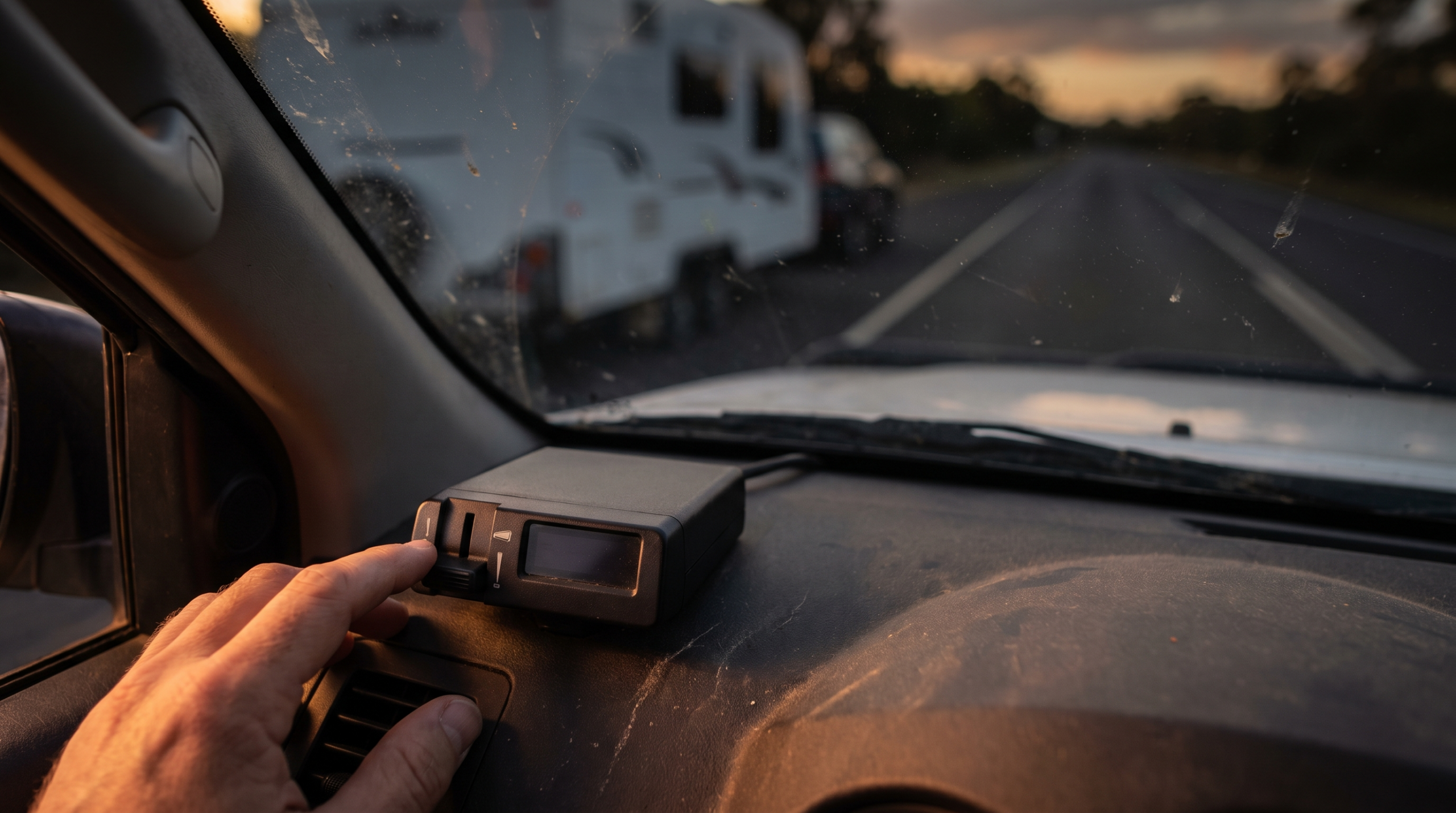
Then decide where the thing lives. A hidden-module design puts the electronics behind the dash and leaves a dial the size of a coin on the fascia: the tidiest result, and the one that survives a knee. A conventional dash-mounted unit gives you a screen and a proper override lever, but it has to sit within the angle range its maker specifies or the accelerometer reads deceleration wrongly, and it glows at you for six hours after dark unless it dims. Trailer-mounted wireless units invert the idea completely — the controller bolts to the A-frame, runs off the trailer, and the tow vehicle needs no wiring whatsoever. Before you buy anything hardwired, check whether a vehicle-specific plug-and-play harness exists for your model. Most recent tow vehicles hide a factory brake-controller plug behind the dash, and using it beats splicing into a brake-light circuit.
The last thing to understand is that you are buying a dial, not a fitting. A controller does nothing useful until the gain is set, and gain is not a set-and-forget number — it shifts with load, tyre pressure, road surface and rain. Get to about 40 km/h on a quiet flat stretch, pull the manual override on its own with the pedal untouched, and wind the gain up until the trailer wheels just begin to chirp, then back it off slightly. Do it loaded, and do it again whenever the load changes much. A great many controllers get blamed for a problem that lives entirely in the setting.
A word on the wiring, because a controller is only as good as its connections. Behind the dash unit sit four wires: a fused feed straight from the battery, a solid earth, a brake-signal wire off the stop-lamp circuit, and the blue output wire that carries current back to the trailer magnets. Run that feed heavy enough and fuse it close to the battery — a twin-axle van pulls real current under brakes, and a voltage drop there shows up as weak, late trailer braking. And do not skip the break-away system: the cable-pulled switch and its own small battery on the A-frame that slam the trailer brakes on hard if the van ever parts company with the car. Test that it works and keep its battery charged, because it is the one part of the whole setup that has to function on the worst day you will ever have.
The Brake Controllers
Check today’s prices on Amazon →
Hidden-module proportional controller with a dash dial
The pattern set by units like the RedArc Tow-Pro Elite: a sealed module tucked behind the dash, wired once, with a compact dial mounted somewhere clean on the fascia. That dial is both the gain adjuster and the mode switch, so you can wind braking back on a wet descent without pulling over or scrolling a menu. There is no screen, which is exactly the point — nothing lights up the cabin at night, and there is no bracket sticking into your left knee.
The trade-off is that you give up a live readout of what the trailer is drawing, so a developing fault announces itself as a change in feel rather than a number on a display. Installation is also a genuine wiring job rather than a plug, which is where a vehicle-specific harness earns its money. Sift through the hidden-module controllers and the dash dials that pair with them.
Dash-mounted proportional controller with a display
The classic shape, as seen on the Tekonsha Prodigy line and the Hayman Reese equivalents. A screen tells you the output current in real time, flags a short or an open circuit in the trailer wiring before it becomes a roadside mystery, and lets you store separate profiles for a heavy van and a light trailer. Most carry a boost setting that biases braking toward the trailer — genuinely useful on a long descent with weight behind you.
Against that: it occupies fascia space, and a bright display at head height gets old on a night run unless it dims properly. The override lever, though, is the best of any type — a big physical slider you can find without looking. Pull up the display-style proportional units and read their specs side by side.
Trailer-mounted wireless controller
Units in the Elecbrakes mould bolt to the A-frame between the coupling and the body, take their power from the trailer, and talk to a handheld remote or a phone app in the cab. Nothing is cut into the tow vehicle, which means one controller works behind any car that can pull the van — a hire vehicle, a friend’s wagon, the second car in the driveway. For a van that gets towed by more than one vehicle this is not a convenience, it is the whole argument.
Watch the practicalities. The unit lives out front where stones and road spray find it, so the ingress rating matters; the pairing wants confirming before you roll rather than at the first set of lights; and the remote is another thing to charge and another thing to lose. Look at what the trailer-mounted wireless controllers are offering right now.
Plug-in Bluetooth controller for the tow socket
The lightest-touch option of the lot, in the style of the Curt Echo: the controller plugs into the vehicle’s trailer socket, the trailer plug goes into the controller, and your phone becomes the interface. Fitting is measured in seconds and costs nothing to have done.
The catch is that phone-as-controller means phone-as-override, and reaching for a handset is a poor substitute for a lever in the moment you actually want one. It also hangs off the back of the car where a low drawbar or a steep driveway can foul it, so check the clearance on your own combination first. Size up the plug-in Bluetooth controllers that live in the tow socket.
Time-delayed controller
The cheap end, and worth being straight about. A time-delayed unit applies a fixed ramp of trailer braking whenever the brake light circuit goes live, with a delay and an intensity you set once. Behind a light single-axle trailer that goes out a handful of times a year, on flat roads, that is acceptable and it is a lot better than no controller at all.
Behind a heavy van it is the wrong tool. The same ramp that feels tolerable slowing for a corner arrives far too late in an emergency stop, and dialling it up to fix that leaves the trailer grabbing every time you brush the pedal in traffic. Buy one knowing what it is. Weigh up the time-delayed units before you commit to one.
Comparison
| Type | Where it mounts | How you adjust it | Suits | Main trade-off |
|---|---|---|---|---|
| Hidden module + dash dial | Behind the dash, dial on fascia | Rotary dial, on the move | One car, one van, permanently | No live readout |
| Dash-mounted with display | On the fascia, angle-critical | Buttons and screen menu | Owners who want diagnostics | Takes space, glows at night |
| Trailer-mounted wireless | On the A-frame | Remote or phone app | A van towed by several vehicles | Exposed to spray and stones |
| Plug-in Bluetooth | In the vehicle’s trailer socket | Phone app only | Renters, swapped vehicles | No physical override lever |
| Time-delayed | On the fascia | Preset ramp and intensity | Light, occasional trailers | Ignores how hard you brake |

Frequently Asked Questions
Does every trailer need a brake controller?
No — only trailers fitted with electric drum brakes. An unbraked trailer has nothing to control, and a trailer with an override (surge) coupling brakes itself mechanically as the tow vehicle slows, so an electric controller does nothing for it at all. Check the axle before you buy anything: the giveaway is a wire running to each hub and a live brake pin in the trailer plug.
What gain setting should I use?
There is no universal number, and anyone who hands you one is guessing — it depends on trailer mass, tyres and surface. Set it on the override lever as described above, then learn the two failure signals: a trailer that shunts you forward at the last metre of a stop is wound too high, while a van that pushes the car through the final few car lengths is too low. Drop the gain in the wet before you find out the hard way.
Can I move one controller between two tow vehicles?
A hardwired unit needs its own harness in each vehicle, so you are looking at either two controllers or a swap-and-refit every time. Trailer-mounted wireless units and socket plug-ins move freely between cars, which is the main reason to pick one — a single controller, any vehicle, no second installation to pay for.
Will an electric controller run electric-over-hydraulic brakes?
Only with a matched actuator, and only if the controller’s output suits it. Those systems use the controller signal to drive a hydraulic pump rather than energising magnets directly, and not every proportional unit is happy driving that load. Check the actuator’s compatibility list before you choose the controller, not afterwards.
The Bottom Line
Buy proportional, and mount it where your hand will actually go. A hidden module with a dash dial is what I would fit to a car that tows the same van every time: clean install, gain adjustable mid-descent, nothing glowing at midnight. If the van moves between vehicles, a trailer-mounted wireless unit saves you a second controller and a second installation bill, and that maths is hard to argue with. Whatever you choose, none of the money does anything until you take it to a quiet road, loaded, and set the gain on the override lever.
Worth sorting alongside it: our guides to tow-ball weight scales, caravan towing mirrors and tyre pressure monitoring systems cover the rest of the towing setup worth getting right before a long trip.